It has become almost trite to liken the political context of the 2020s to that of the 1920s, but the parallels are hard to ignore. The established world order is unravelling before our eyes. Demagogic leaders are scapegoating immigrants for economic problems not of their making. Millions of people are investing heavily in stocks that may be hugely overvalued…
Against this backdrop, it’s little wonder that many are turning again to one of the great minds of that earlier era, someone who helped set the world on a more stable and egalitarian path: John Maynard Keynes. Take the Guardian’s Larry Elliott, who, commenting on chancellor John Healey’s cautious speech to Labour’s party conference, trotted out one of Keynes’s eminently quotable lines: “Anything we can actually do, we can afford.”
Elliot is far from alone. In appraising contemporary problems, many commentators ask: what would Keynes do? For that reason, the late Keynes biographer Robert Skidelsky published Keynes for Our Times earlier this year, “exploring the enduring relevance of his ideas”, to coincide with the 80th anniversary of the economist’s death.
Princeton economist Markus Brunnermeier took things a step further in a recent New York Times video essay, literally ventriloquising Keynes with the help of artificial intelligence, to ask him what AI will mean for the economy. The virtual Keynes’s answer? “If the gains are not shared”, we will see a bifurcation of burned-out employees and despondent jobseekers, who will suffer both materially and existentially. Such an outcome is “not preordained by the technology itself,” said robo-Keynes. “It will be determined by your government.” Say what you will about digital reincarnation, but it was a convincing impression.
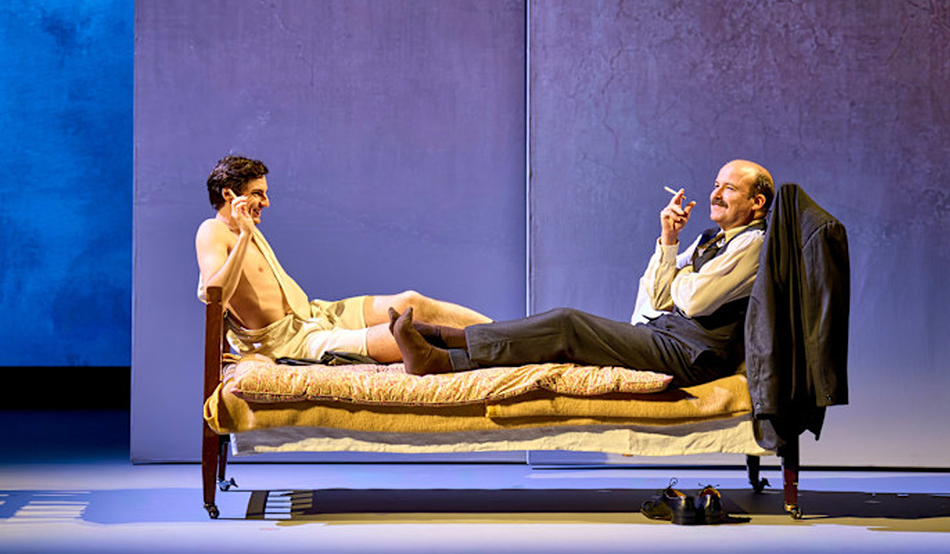
Playwright James Graham has chosen a more old-fashioned medium to channel the great economist. In The Standard of Living, he brings Keynes’s life to the stage for the first time at London’s Theatre Royal Haymarket. Rory Kinnear, who deftly portrays the protagonist as both headstrong and awkward, begins proceedings by reassuring the economically illiterate: “I have no doubt that many of you will be feeling somewhat daunted by this subject matter...” He is not, however, breaking the fourth wall—it is quickly revealed that Keynes is practising a lecture in front of his lover Duncan Grant. The painter helps steer the professor away from his complex graphs and towards a moral message: that a more expansive role for government in the economy could enable people to live fuller lives. “What makes a good life?” Kinnear repeats. It becomes a refrain throughout the play, emphasising the ethical edge to Keynes’s applied philosophy. His personal answer, revealed to Grant later, is to make the world a better place.
The same question weighs on the other notable individuals portrayed onstage—many of whom reach different answers. Keynes was part of the Bloomsbury group of artists and intellectuals including Virginia Woolf and Vanessa Bell, who were known as much for their bohemian lifestyles and formidable sex lives as for their works of art and prose. During the First World War, a rift emerged between Keynes and the more pacifist lodgers at the circle’s Charleston farmhouse. While they benefitted from his largesse, they judged him for going to work for the civil service as part of the war effort. While Keynes had his doubts about the conflict and the way it was being prosecuted, he mucked in and did his best to avert further disaster in the bureaucratic trenches. For his jilted former lover Lytton Strachey, whom Pip Carter gives a fabulously curmudgeonly demeanour, this was unforgivable. The artist or intellectual should, in his view, be detached from the world, so they can view it clearly and criticise it. Keynes slowly won his friends over, however, as the force of his thinking began to yield tangible results—and the spectre of fascism loomed.
Keynes slowly won his friends over as his thinking began to yield tangible results
Graham seems to have borrowed more from Zachary Carter’s sparkling biography The Price of Peace than Skidelsky’s, for the action similarly continues past Keynes’s death in 1946 up to the demise of Keynesianism and the dawn of Thatcherism in the 1970s. This makes the intellectual history it presents particularly relevant to Britain today, as prime minister Andy Burnham promises to end the neoliberal settlement. The literal tango Kinnear dances with Laurie Kynaston’s Friedrich Hayek feels just as pertinent to today’s political skirmishes as it would have at the end of the long post-war boom.
But it is not just because our politics still revolve around the unresolved quandaries of the 1970s that it feels so relevant. Graham draws out a startlingly modern theme in Keynes’s thinking, one that Brunnermeier’s robo-Keynes also drew on: the cultural, and indeed existential, implications of a changing economy. As is evident from that opening scene, Keynes is at his best when synthesising economic rigour (the how) with Grant’s emphasis on what makes life worth living (the why). For instance, what will people do with their time if AI renders them unemployable? Will they languish, or will they spend their time in languorous bliss making love and art, like his Bloomsbury friends? In other words: what makes a good life, and how might we facilitate it?
In Economic Possibilities for our Grandchildren, Keynes famously predicted that technological progress would enable us to work 15-hour weeks by 2030. While working hours have since fallen on average in many western countries (though with a highly uneven distribution), he did, of course, overestimate the leisure-increasing propensity of modern capitalism and the median earner’s preference for more free time over ever greater material comforts.
But in emphasising the structural preconditions for what we would now call “work-life balance”, Keynes was ahead of his time. And his own life, as much as his work, was a testament to this. Graham doesn’t just focus on the more colourful aspects of Keynes’s biography to liven up the drier content of tomes such as the General Theory. Keynes lived with purposeful variety, dedicating his time as much to the enjoyment and promotion of the arts as he did to his equations and oratory. From his advocacy for the Treasury to buy artworks by Paul Cézanne to his establishment of the Cambridge Arts Theatre alongside his wife, the dancer Lydia Lopokova, Keynes was clearly—in Graham’s eyes—a model for how to live in a well-rounded way, balancing public action with the private pleasures that sustain it. A good life, if ever there was one.
And, after you’ve completed your day’s professional tasks (with or without the help of a chatbot), it might just inspire you to spend a splendid night at the theatre. Keynes would, of course, have done both.
The Standard Of Living is on at Theatre Royal Haymarket until 12th December