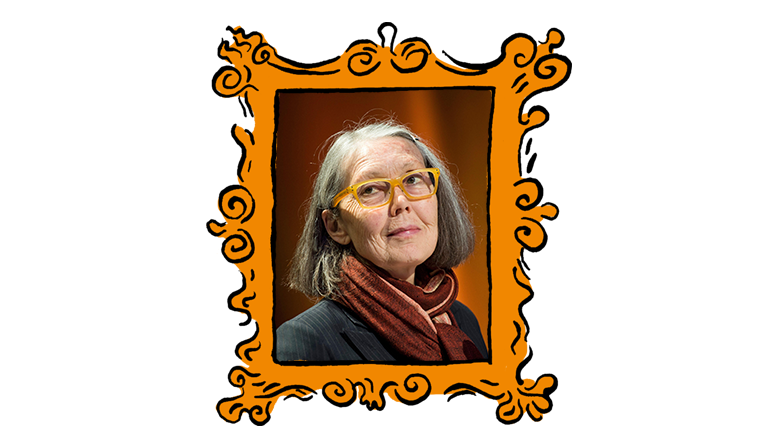
“If prose is a house, poetry is a man on fire running quite fast through it.” This was Anne Carson’s reply to the Observer ten years ago when she was asked for her definition of poetry. But it might also serve as a useful tip for writers aspiring to the Nobel Prize in Literature, which Carson was awarded last week: kindle poetry in prose form.
Every literary critic has their pet theories, and this is one of mine: that the Nobel has been awarded to an unusually high number of poets who have strayed out of the lane of the line-break into the wide, page-filling world of the paragraph. I first noticed this curious ratio when compiling my anthology The Penguin Book of the Prose Poem: from Baudelaire to Anne Carson (2018). The premise of the book was that the prose poem—that is, the poem without line-breaks—had been a marginalised form in modern literature, to be retrieved from neglected corners. Yet there in the table of contents were 13 Nobel laureates.
One explanation for this anomaly might be called the Voice of Prose Wisdom. When TS Eliot wrote his philosophical sequence Four Quartets (1944), he adopted a long, prosy line suitable to the musings of the sage who had risen above the fanciness of other poets. “That was a way of putting it – not very satisfactory,” he reflected: “The poetry does not matter.” It would be his last major poem; his next book, in 1948, was pure prose wisdom: Notes Towards the Definition of Culture—and, the same year, Stockholm came knocking.
The wisdom of prose appeals to a world of prose. Although a recurring theme of Nobel citations is engagement with the classical heritage of Latin and Greek literature, this does not mean poets who adhere to (say) strict dactylic hexameter. Rather, poets who purge their work of the technical complexities of rhyme and metre in favour of looser prose modes, such as the surrealist fable or the lyric essay, create an oeuvre that lends itself to seemingly frictionless international translation. The storyteller’s ability to cross literary borders was an important factor in the popularity of Eastern European poets in the West during the Cold War, producing two Polish Nobel laureates who both mastered the prose poem: Czesław Miłosz and Wisława Szymborska.
Louise Glück, the last poet to win before Carson (in 2020), arrived late to prose. But Anne Carson embraced it from the start, collecting her early writings in Plainwater: Essays and Poetry (1995). This led to some confusion among readers who liked their literary genres well separated by bookshop shelves (“What do ‘shelves’ accomplish, in stores or the mind?” Carson asked in response). But it also won her influential support from those who believed in the value of defying formal classification, such as her fellow Canadian Michael Ondaatje, author of the acclaimed verse novel The Collected Works of Billy the Kid (1970).
Her breakthrough work was Autobiography of Red (1998), subtitled “A Novel in Verse”. A reimagining of the Greek myth of the monster Geryon, killed by Herakles, the book recasts its protagonist as a modern young gay man in a coming-of-age narrative told in alternating long and short lines, which is framed by mercurial scholarly prose concerning the original Geryon poet, Stesichorus. The book was nominated for the TS Eliot Prize, which Carson would win with her next hybrid narrative, The Beauty of the Husband: A Fictional Essay in 29 Tangos (2001)—making her not only the first woman to receive the award, but also the first winner to bring poetry and scholarship into imaginative combination, as Eliot himself had with his notes on The Waste Land (1922).
These ingredients were already present in the academic book Carson published before she had any reputation as a poet: Eros the Bittersweet (1986), a study of love in ancient Greek literature, based on her PhD thesis at the University of Toronto. The book’s critical prose takes stylistic and structural liberties that a doctoral candidate in Classics could not, reflecting the high tide of the influence of French poststructuralists such as Roland Barthes on literary studies at the time. Theoretical statements suddenly ring out with the plangency of poetry—“Your absence from the syntax of my life is not a fact to be changed by written words”—and Carson’s range of allusion freely mingles Sapphic fragments with modern novelists such as Franz Kafka and Virginia Woolf.
It’s no coincidence that Carson’s rise from university Classics instructor to Nobel laureate tracks the rise of Creative Writing in the academy, and its relaxation of the formal boundaries between humanities disciplines. At the University of East Anglia, where I teach, her blending of critical prose and lyrical verse has made her one of the most popular touchstones among Poetry MA students who have gone on to produce their own original hybrid works. And although Carson came second in the Oxford Professor of Poetry competition in 2004, her influence lived on in the successful candidacy of Alice Oswald, elected in 2019, whose recently published Rhapsody: A Manifesto (Jonathan Cape)—based on her Oxford lectures—mingles Homeric scholarship, poetry and personal reflection.
Praising Carson’s narrative verse in Autobiography of Red, the novelist Colm Tóibín commented: “If she was a prose writer, she would instantly be recognised as a genius.” It now seems a prophetic remark. Wrong Norma (2024), Carson’s latest collection, is mainly prose pieces, and all the more enjoyable for it—my main reservation about her verse being that her line breaks can feel too heavy, her occasional rhymes occasionally awkward.
Like one of her heroes, Gertrude Stein, Carson’s genius is for the sentence that flies fluent as a lasso to reel in the far edge of a half-felt thought. To quote “Short Talk on the Sensation of Airplane Takeoff”, one of her earliest prose poems, in full: “Well you know I wonder, it could be love running toward my life with its arms up yelling let’s buy it what a bargain!”