East of Eden (1952) is John Steinbeck’s most ambitious novel. An allegorical, multigenerational saga inspired by his family history and the Book of Genesis, it tells the story of the Trask family—who leave Connecticut at the turn of the 20th century and settle in California’s Salinas Valley. It has primal drama, striking characters and a rich sense of place. It explores free will and determinism, good and evil, and the ambiguities in between. It may be 600 pages, but it’s ripe for the screen.
The novel was first adapted in 1955 by Steinbeck’s friend and collaborator Elia Kazan. Kazan’s film, which runs under two hours, focuses on the Trask twins Cal and Aron, whose story is East of Eden in miniature. Kazan makes wise choices—such as minimising the neighbouring Hamilton family—but he also omits Lee, the Trasks’ housekeeper-cum-surrogate parent, and the philosophical heart of the novel. Like Steinbeck, he under-develops Cal and Aron’s mother Cathy, the story’s antagonist.
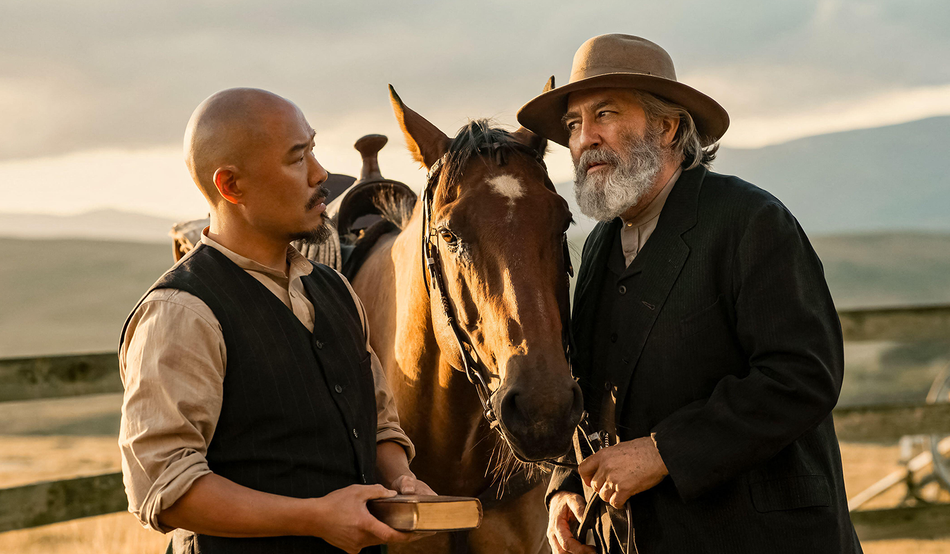
Seven decades later, East of Eden has been adapted by Elia Kazan’s granddaughter, Zoe Kazan. A seven-part series for Netflix, Kazan’s production is suitably grand in theme but intimate in style. A faithful yet creative drama, it fills some of the gaps left by Steinbeck and her grandfather.
Kazan’s vision is immediately evident. Whereas Steinbeck starts the novel with a nostalgic description of the Salinas Valley, she begins with Cathy, hideously beaten, crawling and slithering across the Connecticut dirt. The opening signals a shift in emphasis—one that makes Cathy (who is fundamental to the novel, but mostly in the background) the key player in the drama. At the same time, the reptilian imagery echoes the novel’s narrator, who describes how Cathy’s “tongue flicked around her lips” and wonders if she is a “monster”. In a letter, Steinbeck calls her “a total representative of Satan”.
Readers often find Cathy (widely believed to have been modelled on the author’s ex-wife Gwyn) a one-dimensional femme fatale with no redeeming qualities. It’s a fair critique, but the journal Steinbeck kept while writing East of Eden reveals that he was aware of the risk. Towards the end, he paraphrases his editor, Pascal Covici: “You make Cathy too black. The reader won’t believe her.”
Zoe Kazan’s Cathy (Florence Pugh) is greyer. She is still a psychopath, a thief, an arsonist, a sadist, a Machiavel and a murderer, but—thanks to Kazan’s script and Pugh’s subtlety—she is also a human being. She can be courteous, affectionate and honest—despite her manipulation and deceit.
A more believable Cathy makes for a more believable Adam—her gentle husband who, according to the novel’s narrator, would not “inflict any hurt on anything”. Adam (Christopher Abbott) encounters Cathy in the opening scene, when she seeks refuge at the Trasks’ farmhouse. Moved by a blend of paternalism, chivalry and her beauty, he helps an unknown young woman convalesce.
Cathy’s nature is quickly grasped by Adam’s often-aggressive half-brother Charles (Mike Faist). Charles, a farmer and a frequenter of the local brothel, identifies her immediately: “Kind,” he says, “recognises kind.” Their exchanges have first-class tension. When Cathy, her arm in a sling, brings Charles supper as he loads his wagon, there’s a near-perfect blend of conflict, subtext, and threat:
Cathy: Do you find me so repellent?
Charles: (flicks tongue around his lips) You may have been able to turn my brother’s head, but he’ll come around. Even if I have to lick him.
Cathy: (pause) Could you lick him? He’s a big man.
Charles: (pause) Well, why don’t you just ask my brother what I’m capable of? (long pause) You know, when you had all that dope [morphine] in you, you talked a lot in your sleep.
Cathy: (long pause) Everyone has bad dreams.
Kazan often incorporates Steinbeck’s original dialogue and removes redundant words to maintain a scene’s pace. The effect isn’t as strong, however, when she repeats Steinbeck’s grander monologues almost verbatim. There’s the Trask patriarch Cyrus bragging about his political power—“I can have senators defeated and pick appointments like apples. I can make men and destroy men.”—and Lee—the Chinese-American housekeeper, who studied at the University of California—explaining why he speaks in pidgin: “Mostly we have to use it to be understood at all… English from me they don’t listen to, and they don’t understand.”
These lines—though good in themselves—sound a little out of kilter. It could be their relative length, or the actors’ more affected delivery, but they contrast with the dominant, simpler tone of Kazan’s mostly superb script. The same could be said of the superfluous, if occasional, “voice of God” narration, which opens the series: “I believe there are monsters born in this world to human parents… It [evil] can come cloaked in beauty, or goodness, or power, or love.”
After beginning in media res, Kazan rewinds from Cathy’s arrival at the farmhouse, to Adam and Cal’s youth under the domineering Cyrus. She doesn’t waste time, and the short scenes do have their own drama, but they’re expository and feel like a necessary exercise. It’s hard to get invested in the characters of Adam and Charles when they are each portrayed by three actors in the first half hour.
However, once we get past that staccato start, the production is compelling. It’s driven by Pugh’s Cathy and Kazan’s script. Steinbeck tried to make Cathy realistic and—whether technically or temperamentally—he couldn’t do it. Kazan doesn’t change much, but she does enough. At the same time, she relishes the power of her antagonist. In a moment of genius, when the teenage Cathy goes home after church to finish the baking, a parishioner describes her—with sumptuous dramatic irony—as “an angel”.
Like East of Eden itself, the story of the Kazans’ adaptations is one of a younger generation confronting its genealogical inheritance. Whereas Elia Kazan’s film cuts branches from Steinbeck’s plot, Zoe Kazan’s series prunes the novel and spurs growth. Quibbles notwithstanding, this is an excellent production—one that touches the gold standard for literary adaptation.