“I don’t start with wanting to say something,” the Polish director Paweł Pawlikowski told a gathering of young scriptwriters this summer as a way of explaining his films. “I just look for stories. If you start with people and relationships, and their situation, suddenly history comes alive in a much more interesting way.” That is certainly true of the films he makes, but it isn’t all they do.
Pawlikowski’s latest film, Fatherland, focuses on a trip Thomas Mann made back to his native Germany after the Second World War. Mann, feted for Buddenbrooks, Death in Venice and The Magic Mountain, and already a Nobel laureate, had spent most of the war in California and taken American citizenship. In 1949, he visited Weimar in the Soviet-occupied zone of Germany to receive the Goethe National Prize and honorary citizenship during the celebrations for Goethe’s bicentenary. It was his first visit to his native country since he went into exile in 1933.
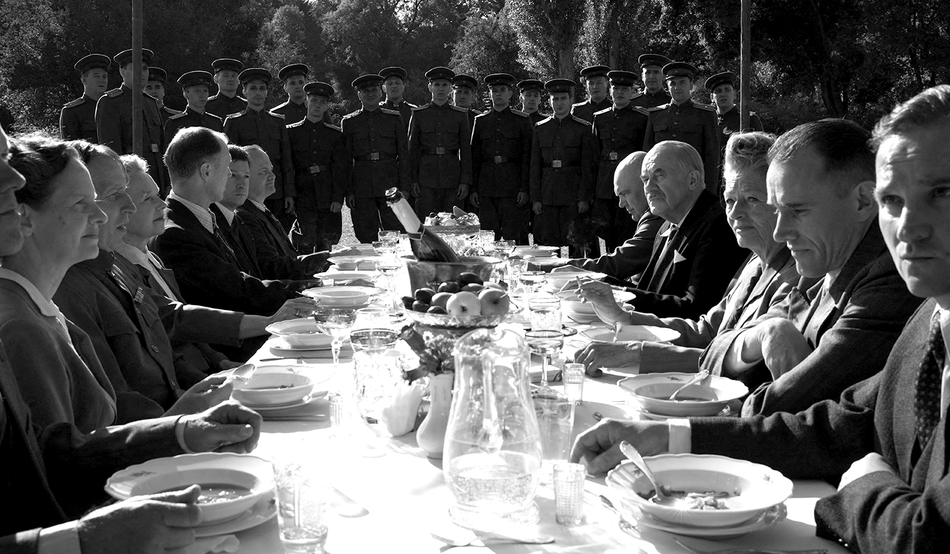
Fatherland is the third in a loose trilogy of films Pawlikowski has made about post-war Europe. Like its predecessors, Ida (2013) and Cold War (2018), it is shot in an elaborate series of black-and-white compositions that aim for a photographic, documentary-like style without any conventional handheld camerawork or excessive cutting. Running to under 90 minutes, each of the three seems as rich as films that are three times as long.
Unlike the first two in the series, Fatherland is set in Germany rather than (largely) in Poland, Pawlikowski’s homeland. But it is only when you see all three films together that the significance of that difference becomes clear. “Germany is a horrible country, with horrible people,” Mann’s son Klaus says at the start of the film. Yet, the common argument goes, there are also good Germans, raised on music, art and poetry—on Goethe and Bach. But Fatherland, which won Pawlikowski the best director award at the 2026 Cannes Film Festival (and a standing ovation at its premiere), is an unforgiving finger-pointing at history.
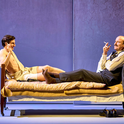
Accompanying Mann, as chauffeur as well as chaperone, is his daughter Erika. The granite-faced Hanns Zischler, who plays the author, sits in the back seat of their car, almost as if he were a child being taken on an outing. Up front sits Erika, played by the wonderful Sandra Hüller, her spirit resilient even as her face remains puffy with heartache and worry. Absent is her brother, Klaus (August Diehl), pictured naked on the floor at the start of the film, a cigarette in one hand and a phone in the other, pouring his heart out to his sister about his father and his own fatherland.
‘Fatherland’ is an unforgiving finger-pointing at history
Germany in 1949 may have been shorn of swastikas and emptied of the Feldgrau uniforms of the army and the stark black worn by the SS, but in Fatherland it still looks like wartime. Thomas and Erika drive into Frankfurt through cratered streets and bombed-out buildings, the crowds hungry and tattily dressed.
Most of the people the Manns meet are trying to cover up what they were doing just four years earlier. “The crème de la crème of the new Germany,” one comments. Everyone, whether in the west or the east, wants Thomas Mann’s help. Richard Wagner’s grandsons, Wieland and Wolfgang, are trying to re-establish the opera festival at Bayreuth just as soon as they can “remove the refugees who are camping in the auditorium”. Gustaf Gruendgens (Joachim Meyerhoff), Erika’s former husband, tells her that Klaus libelled him in his satirical novel, Mephisto. “I was never a friend of Goering,” Gründgens insists. “I’m just a German-speaking actor.” “Nonsense,” she replies, “you’re the worst careerist I ever met.” When Gründgens points out that, in California, Erika was protected by her talent, by the many languages she spoke and by her father’s money, she slaps him across the face. Much of what he’d said, of course, was true.
Pawlikowski tells the many sides of this story in a series of images made of squares and rectangles: framed by roads, verges, doorways, glazing bars, railway tracks, burning candles, nuns’ wimples and the sharp angles of a naked shoulder blade in bed.
There’s a clarity to the way the director thinks, which contrasts with the spirals of cigarette smoke that fill the film. Smoking is a leitmotif and a metaphor for private tension, public uncertainty and the fug of pollution.
By the time they reach Weimar, father and daughter are at breaking point. Klaus, whom Pawlikowski never shows again after the opening scene, is dead. He has taken an overdose of barbiturates. “He shouldn’t have done that to his mother—or to you,” says Mann, who refuses to attend the funeral. Instead, the author waxes lyrical about Goethe, whom he calls “a poet of the open gaze”, a symbol “of the good Germany [whose] strength is blessed by art”.
Erika erupts at the senselessness of his response. Even so, at the end of the film the pair wander into a bomb-damaged, sun-filled church. A lonely organist plays the first chords of Bach’s “Jesu, Joy of Man’s Desiring”. Father and daughter reach out to each other and tears spill down’s Mann’s cheeks. A chink seems to have opened in Pawlikowski’s heart. Even weak, self-interested artists are human beings.
Fatherland is in cinemas from 23rd October