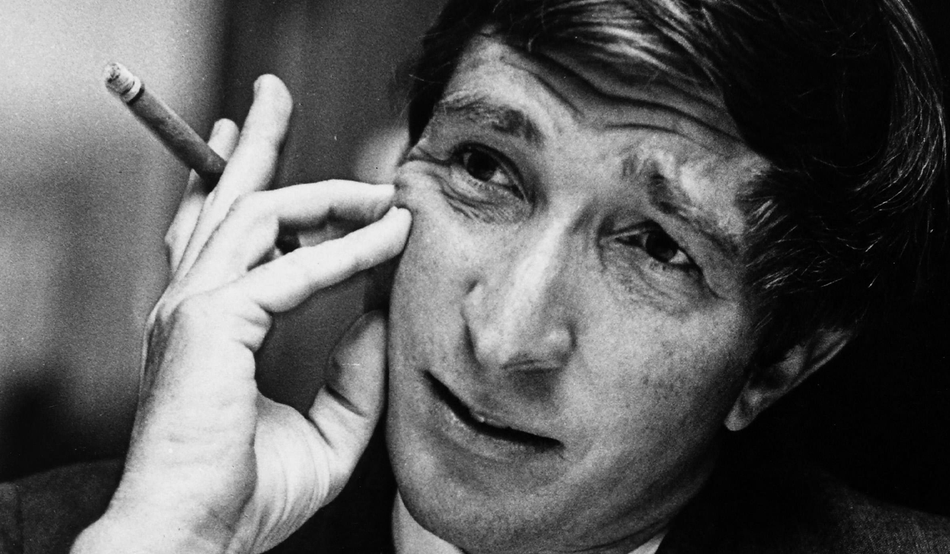
Is there any way back for John Updike? In a famous panning of Toward the End of Time, David Foster Wallace canvassed the views of some of those “spleen-venting, spittle-spattering Updike-haters one encounters among literary readers under 40”, an exercise that produced such memorable brickbats as “Just a penis with a thesaurus” and “Has the son of a bitch ever had one unpublished thought?” That was in 1997, some 40 years and 40 books into Updike’s career, when, however out of fashion, the two-time Pulitzer winner was still unignorable. Now, almost 18 years after his death, it is difficult to find anyone under 40 who has heard of Updike, let alone read him. And if they have heard anything, none of it is much good. Racism, misogyny, wife-swapping, microscopic descriptions of genitals: these are what we think of when we think about Updike.
Yet, of course, they only partially describe him. In the four novels and a novella about his former-high-school-basketball-star everyman, Harry “Rabbit” Angstrom, he told “the mild, middling truth of average American life” with unmatched honesty. In his early short stories, he turned the humblest things—packed dirt, a thimble—into some of the most beautiful. In his book reviews and essays, collected at roughly eight-year intervals in 900-page wrist-breakers such as Hugging the Shore (1983), he brought literature alive as few critics have. In almost everything, he wrote sentences to die for.
But what of the man himself? In a poem written while he was dying of lung cancer Updike wondered whether “Perhaps / we meet our heaven at the start and not / the end of life”. By this he meant Shillington, the small Pennsylvania town in which he grew up and, in a sense, never left—returning to it again and again in his fiction, often thinly disguised as “Olinger”. But leave it he did, aged 13, when his mother moved her son, husband and parents to where she grew up, a remote farmhouse 11 miles away in a hamlet called Plowville. This was “the crucial detachment of my life”, Updike wrote, an expulsion from Eden which he never got over, yet without which he might never have become a writer. For what was an isolated only child born before television (in 1932) to do but read, in Updike’s case mystery novels, PG Wodehouse and, crucially, the New Yorker?
From his first sight of the magazine Updike’s “sole ambition in the world was to make The New Yorker myself”. For a long time, he thought this would be as a cartoonist: at Harvard, he was cartoonist-in-chief for the college’s humour magazine, the Lampoon. But it was in fact with a poem that he made his breakthrough, followed within weeks of his graduation by the story “Friends from Philadelphia”.
By the time the story was published, he was in Oxford, on a one-year scholarship at the Ruskin School of Drawing and Fine Art. On his return, a staff job at the New Yorker was awaiting him, a role he took to with great ease but little enjoyment, feeling out of place in the big city and creatively stymied. Quitting after 19 months, he moved with his wife and children to Ipswich, a small town in Massachusetts, where he began to write stories in earnest, the best of them—“The Happiest I’ve Been”, “Pigeon Feathers”, “Flight”—set in and around Olinger.
Yet novels were Updike’s ultimate ambition. His first, The Poorhouse Fair (1959), made little impression; his second, Rabbit, Run (1960), rather too much of one. In the novel, Rabbit abandons his wife and son to live with a prostitute, a relationship described with extraordinary sexual frankness. Faced with making cuts or incurring obscenity charges, Updike bowed to his publisher’s lawyers, though this did not deter him from the subject in future. As attitudes relaxed, he pushed the sexual envelope further and further, achieving with his wife-swapping novel Couples (1968) a prodigious bestseller that landed him on the cover of Time.
Updike’s next three decades are a story of almost unqualified success. There were the two Pulitzers and a National Book Award across Rabbit Is Rich (1981) and Rabbit at Rest (1990). There were more than 20 other novels, short story collections and works of criticism. And, but for a divorce and remarriage, there was little friction in his personal life.
Then came the backlash. An early criticism of Updike, mistaken at the time, was that he had nothing to say; yet now there was a case for it as he rehashed the same old stories of suburban adultery and Pennsylvania childhoods in Licks of Love (2000). There was also the misogyny charge, long defended as reflecting the worldview of his characters but one that the embarrassingly masculine Villages (2004) made hard to contest. And as for the accusations of racism, an ill-judged novel about a would-be suicide bomber, Terrorist (2006), did him no favours at all. When Updike died in 2009, the many eulogies were but minnows in the tide of opinion. He was a white male dinosaur of no lasting relevance.
When Updike died in 2009, the many eulogies were but minnows in the tide of opinion
A Life in Letters, just published in paperback, retells this story in a different, deeper way to Adam Begley’s superlative 2014 biography. In a brazen early letter to the cofounder of Random House, the extent of Updike’s New Yorker obsession is revealed in his idea for a book of its cartoons. “The New Yorker has achieved a new stature in these last eight years,” he writes, as if a spokesman for the magazine. “I feel that at this time, an anthology of the best cartoons in the world, in an attractive book, with (and this is important) a fetching dust jacket, should sell.” This is sent from Plowville on 7th September 1950. By the 25th, he is writing home from his freshman dormitory at Harvard, sounding every bit the poor scholarship boy: “I am rather frightened by the immensity of intelligence and variety of talents displayed here.” Cut to a week later, however, and he can report that, of the “five poems I typed and three cartoons I inked in Sunday night, the Lampoon was considering printing one (possibly two) of the former, and one of the latter”. He is on his way.
Although these letters are to everyone at the farmhouse (“Dear Plowvillians”), it was his mother Linda who replied. A writer herself, Linda has always figured prominently in the Updike story, albeit rarely divorced from his fictionalised versions of her. Here we see her unfiltered, with her side of the correspondence generously footnoted. In her letter of 1st December 1950, she writes of Updike’s Shillington girlfriend Nancy—a relationship she thought was holding him back from greatness—“I am no longer amused by [her] flutterings. They are like the broken-wing act some of the other little birds put on when they are in danger and I certainly hope you see them as such.” On 24th February 1951, Updike tells her he has stopped writing to Nancy.
Another mother figure was New Yorker fiction editor Katharine White. On receiving his first cheque from her, Updike writes giddily: “[$55] seems huge, and the honor of appearing in The New Yorker looms titanic.” Yet as the cheques keep coming, so his reverence diminishes. When White changes his colon to a dash, he retaliates with this little piece of brilliance: “A colon is compact, firm, and balanced: a dash is sprawling, wishy-washy, and gawky.” And when he comes to write books, he ensures nothing is changed without his say-so again, hassling his publishers about everything from typography to cover design.
This may explain why he took reviews so personally. “What a bummer it is, to hunch for months over a desk trying to make a beautiful thing and then have some old self-aggrandizer like [Gore] Vidal come along and shit all over it,” he grouches to Nicholson Baker after Vidal’s evisceration of In the Beauty of the Lilies (1996). Yet he is only touchy about his own work. In a typically generous letter to Harold Brodkey, he admits to being a “stunned admirer” of Brodkey’s latest story. On reading a book of Joyce Carol Oates poems, he tells her: “they are very like your prose, all air on fire, fluidly, somehow, with always a phrase or two… to make us taste urgency.”
His letters to other writers are indeed some of his best. Jane Smiley said that Updike was the only person she had ever known to have “a bona fide twinkle in his eye”, and these letters convey something of that. A thank-you note to Philip Roth for his praise of the Rabbit novels, for instance, begins: “You’re going to spoil me rotten, with your generous post-opus letters, that so uncannily zero in on the point of it all, and so jubilantly rejoice with me over the sections that I liked as well.” Or this to John Barth: “what most moved me in your book was your talk about maximalism and your wonderful appetite, in a world mad for less, for more. Follow that? I’m writing like John Barth.”
Updike was the only person she had ever known to have ‘a bona fide twinkle in his eye’
His love letters are more testing. Writing to his first wife Mary in the prudish 1950s, he gets no more racy than, “I love you, I shall have you. You are mine.” Come his marriage-destroying affair in the mid-1970s, however, and one might wish the 1960s had never intervened. “How nicely you blow”; “I thirst for your cunt”; “My cock is yours”: I know now what Kafka meant when he wrote that “writing letters [is] to denude oneself before the ghosts”.
Yet the affair does raise two points of interest. It is well known that Updike wrote autobiographically, but not perhaps how quickly he could fictionalise his experience. In “Separating”, a husband and wife tell their children they are splitting up, a story these letters reveal to have been written within weeks of the heartbreaking real events that inspired it. The other point concerns Updike’s temperament. In refreshing contrast to your Hemingways and Fitzgeralds, this clean-living churchgoer was relentlessly cheery, able even at the height of their marital trouble to begin a letter to Mary: “The ides of August are upon us! Enclosed various amusing or depressing stuff, including an amazing card to your father and a typical note to me from your son.”
Whether or not any of this can rehabilitate Updike, A Life in Letters is a magnificent achievement. Assembled from some 25,000 items of mail, editor James Schiff’s scrupulously glossed selection of some 700 brings readers closer to Updike the man than anything previously published. The first “new” Updike writing in more than a decade, it is also a reminder of what a jaw-on-the-floor-brilliant writer he was—so playful, so energetic. Even his legal correspondence dazzles.