The Bayeux Tapestry tells many stories. As an artefact, its very history goes from post-Conquest drama and then medieval obscurity, through the French Wars of Religion and the Revolution, to the German occupation and now the priorities of cross-Channel diplomacy. What has happened to the embroidery is itself an index of what has happened in western Europe over the last 1,000 years. That it has even survived is remarkable.
The Tapestry (as we must call this embroidery by convention) also tells a story in a more straightforward, linear sense. It is an extraordinary work of sequential art, about one hundred steps long, providing a visual and written narrative of the lead up to a battle and the battle itself. The Tapestry cuts off with the battle won and the vanquished fleeing, but many historians believe there was a final section, since lost, showing the consequence of what we now call the Battle of Hastings.
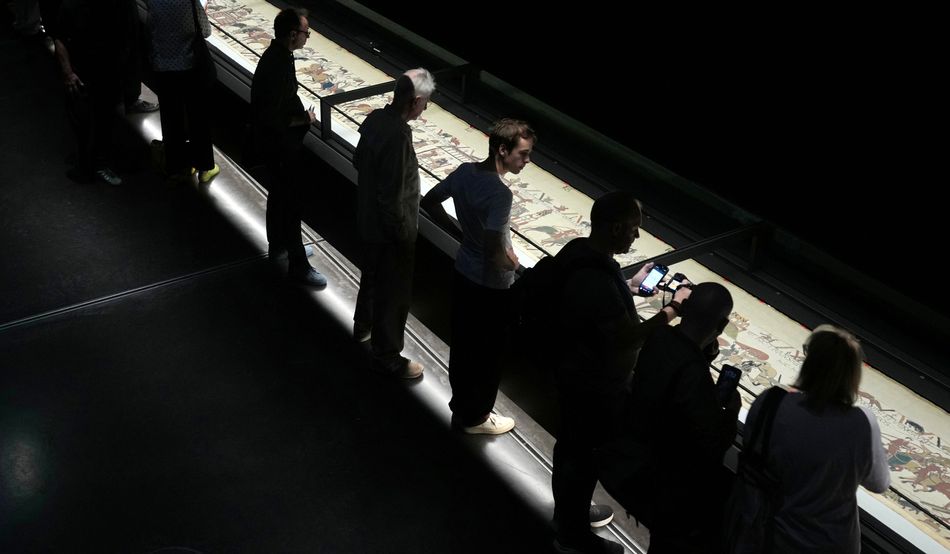
The work is currently on display at the British Museum. And if you go along and can somehow find a clear path to see it from beginning to end, from left to right, you realise that the Tapestry’s story is best appreciated at slow walking speed. There is great use of what we would now call “white space” and directional art. We are so accustomed to seeing the work set out on so many plates of a history book, or perhaps on a computer screen, we forget that it was not intended for these other media.
But what story does the Tapestry tell?
If it was merely an exercise in Norman propaganda, then it was not obviously successful. Although most historians agree that it was probably made in Canterbury not long after 1066, there is no evidence it was ever shown in England or that it was intended to be. Indeed, there is no firm evidence of the Tapestry’s existence at all until centuries later. And by the time what the work showed was widely known in England, in the late 1700s and early 1800s, the Norman Conquest was some 700 years old, which was rather too late for it to win anyone over to the merits of Duke William’s claim.
Nor does the Tapestry tell the story of how the invasion so firmly established the conqueror as the new king of England that there has been no comparable conquest since. Even the part that has been lost probably only would have taken the story to William assuming the English throne, to bookend it with Edward the Confessor on the throne at the beginning, and with Harold on the throne midway. Even the director’s cut would not have shown how William imposed his power on his new kingdom.
Indeed, those who devised and compiled the work had no particular reason to believe that England would not face further upheavals and invasions. There had been another successful conquest of England 50 years before, by Cnut, and western Europe in the 11th and 12th centuries was not especially known for its political stability. The makers of the embroidery had no idea that there would then be 1,000 years without another such incursion.
And the Tapestry was presumably not created as a simple and convenient aid for later historians, but as a work to be appreciated by those at the time. That we can gain knowledge and understanding from a close examination of it is a fortuitous accident. But there is no reason to see the embroidery as a form of time capsule, with the helpful Normans intending it for the benefit of generations of historians unknown to them.
So if the Tapestry was not created for these purposes, what was it for?
The work tells a morality tale. It is the story of what happened when the English nobleman Harold Godwinson made an oath and then broke it. How he came to make the oath is set out in detail, and so are the consequences when he reneged on it. And what is perhaps significant is that he may have made that oath on relics associated with Bayeux—where William’s own half-brother Odo, who is widely thought to have commissioned the Tapestry, was bishop. If so, the Bayeux Tapestry is about why the relics of Bayeux should be respected.
The first part of the work is about the relationship of Harold and William, almost more Brokeback than Bayeux. The Norman duke arranges the release of Harold from capture, and Harold then rescues two of William’s men from quicksand. They go to battle together and William presents the English nobleman with arms. At this point, you have walked some 20 paces from the start of the work, and the story is about relationships.
Harold then swears an oath to William on two portable reliquaries (the cathedral of Bayeaux would not be consecrated until 1077). This seems to take place either at Bayeux or close by. The reliquaries may have contained remains of British saints who had come to what later became Normandy. In the context of what has happened so far in the story, the oath seems to be voluntary and sincere. The two men have been getting on.
And the oath would have to be given without coercion. For if there had been duress, it would have been invalid. Besides, the story so far only makes sense if the oath was made freely. The Tapestry depicts a valid and binding agreement being made. And although oaths are oral, they are as solemn and effective as any written instrument.
What is the content of the oath? The Tapestry does not tell us expressly, but it would seem that Harold swore to support William as Edward’s successor. On the face of it, that would be an unlikely vow for Harold to make. He was in the running to become the next king himself and he had no obvious interest in promoting William’s claim. So not only does the Tapestry insist that the oath was voluntary; it also seeks to explain why Harold would do so something against his own interests. This part of the story is not incidental: it is doing a lot of work.
The implication is that Harold has broken the oath
Harold then becomes king of England on the death of Edward. The implication is that he has broken the oath. The Tapestry indicates William was not expecting this, for it is only now that he prepares his forces for invasion. The trees have not been felled and the ships not built in advance. William is depicted as being taken by surprise.
That William has to improvise an invasion points against the Tapestry being an exercise in glorifying the duke. It does not tell the story of a well-planned campaign but a sudden one. Of course, the logistics of such a successful invasion, especially the transit of cavalry, suggest a great deal of preparation, but that is not the tale the embroidery is telling.
(There is also the interesting legalistic question of the basis on which William was able to quickly mobilise so large an army, as feudal service often did not include going overseas. Here the rewards and spoils set out in Domesday Book are a better guide to the motives of the invaders than the Tapestry.)
The English army is then shown being defeated, though we would not know from the Tapestry about Harold having only just defeated the Norwegians at the other end of England. William appears to win convincingly, with right on his side. His old friend Harold is shown being killed, either by an arrow or by being hacked, or both. The story of the oath-breaker ends with the oath-breaker being himself broken: it is the Rake’s Progress of its time. One should not take swearing on the relics of Bayeux lightly.
And not only is it a morality story, it is also a constitutional tale. In particular, the Tapestry tells us about the nature of political legitimacy. William had a weak to non-existent claim to the English throne by birth: he had no English royal ancestry—his only link was that Edward’s mother, Emma of Normandy, was his great-aunt—and he was illegitimate to boot. There is a possibility that Edward promised the throne to William directly, but the Tapestry does not explicitly show this. William’s claim is depicted as deriving from Harold’s oath.
Of course, William had available a right of conquest—and, indeed, he was afterwards styled “the Conqueror”. But the Tapestry does not emphasise this right; it emphasises Harold’s breaking of his oath. The message is that, but for this betrayal, the invasion would not have taken place.
Interpreting the Tapestry as the story of what happens when the relics of Bayeux are taken in vain explains a great deal about its setting at the cathedral and its early history. It explains why William is shown as reactive to events rather than planning them. And it also explains why so much effort goes into showing that the oath was voluntary and without duress. As such, the Tapestry is the story of a loser and not a winner: the tale of the FAFO of Harold Godwinson.
The Bayeux Tapestry is at the British Museum until 11th July 2027. The author is greatly indebted to the historian Marc Morris for stimulating much of the above.