The modern market for ancient wisdom has become very crowded. Old ideas are repackaged and resold with the contemporary reader in mind, shorn of anything embarrassingly out of sync with our dominant mores and values. Most notably, from the west we have pseudo-Stoicism, ersatz Aristotle and sanitised Socrates; while from the east we get domesticated Daoism, Buddhism-lite and, targeted at those of a more New Age bent, the I Ching (Book of Changes).
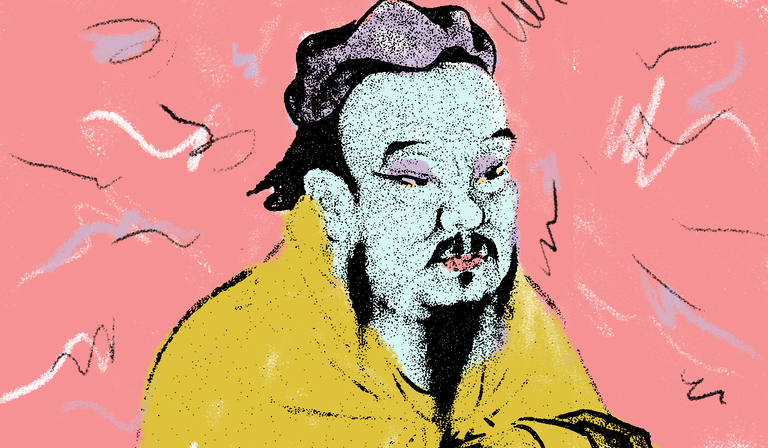
There is one giant of world philosophy, however, who has never been invited to this party: Confucius (circa 551–circa 479 BCE). This is despite him having a credible claim to being the world’s most influential philosopher. His thought has dominated state policy and daily life in China for millennia and continues to hold sway there today. Mao’s attempt to eradicate it as part of his attack on the Four Olds during the Cultural Revolution was as futile as trying to stop the English playing cricket or the French eating cheese. The Chinese Communist Party (CCP) realised it was better to claim Confucius for itself, a change signalled internationally in 2004 when it started to roll out its Confucius Institutes to promote Chinese language and culture overseas.
It’s easy to see why the 21st-century west has not embraced Confucian thought. As a philosophy, it is extremely conservative and hierarchical, stressing the importance of the “three bonds” between father and son, husband and wife, ruler and subject. One of its most important values is Li, traditionally translated as “ritual”. Its major works spend a lot of time discussing the right kind of cap to wear for certain occasions, or how many times one should bow, if at all. And the Analects, the canonical Confucian text, is largely concerned with how imperial leaders should rule their subjects and how their officials, vassals and subjects should serve them. In short, Confucianism seems to belong in an utterly alien time and place that is both inegalitarian and misogynistic.
So a new translation of an ancient Confucian text that was long seen as a forgery but is now widely accepted as authentic might seem to be of mere scholarly interest. That would be a mistake. With their lucid translation of, lengthy introduction to and helpful commentary on The Dialogues of Confucius, comparative philosopher Brian Bruya and Confucian scholar Wenwen Li have given us an opportunity to reappraise the most consequential and longest-surviving school of philosophy in the world. If we do, we might see that the core Confucian ideas around the relationality of human beings, the need for social harmony and the importance of character provide a much needed corrective to the failures of liberal individualism.
If Confucius seems irrelevant to us today, it is only because we do not read him with the same charity that we read the Ancient Greeks. No one dismisses Aristotle because of his support for slavery or his belief in the intellectual inferiority of women. Plato is not rejected as unphilosophical because his protagonist, Socrates, repeatedly talked of gods, myths and daemons. We take it for granted that we have to leave much of what they said behind and focus instead on the truths and insights that stand the test of time. The Confucian classics may come loaded with more archaic baggage than their Greek equivalents, but it can be unloaded just as easily.
No one dismisses Aristotle because of his support for slavery or his belief in the intellectual inferiority of women
There is also an appeal to equal treatment in the authors’ case for the authenticity of the Dialogues, which draws on a wealth of recent scholarship. They concede that the debate is not definitively settled, describing one scholar’s painstaking attempt to end the argument as “akin to reconstructing the dating of a fifty-two-card deck of playing cards with just ten randomly appearing cards, only five of which are datable”. Like the canonical Analects, no one believes that Confucius actually wrote the Dialogues. Rather, they are more or less contemporaneous accounts of his teachings, written by followers. The same is true of all the extant texts of Aristotle, which are generally believed to be edited lecture notes made by students, even though this is far from proven. “Authenticity” in these contexts is not absolute, but a question of how faithfully the texts capture the ideas of the thinkers in question. Without a primary source with which to compare them, we can only judge that by the consistency of ideas across the works. By this test, the Dialogues are as Confucian as the Analects.
It is hard to overstate how little understood Confucianism is in the west. Even the name fundamentally misrepresents it. In China, the school is not synonymous with its most important thinker. Rather, it is known as Ruism, “ru” meaning simply a scholar or learned person. We call it “Confucianism” simply because the Jesuits who first brought Ruist ideas to the west followed the template of their own Christian religion and named it after its apparent founder. They also took it to be a religion, unable to even comprehend that the dominant ideology in China was actually a philosophy.
The misnaming was no trivial error. In placing a specific person at the heart of Ruism, the Jesuits were betraying their western bias toward individualism. Confucius himself—or Kongzi, as he is more authentically known—didn’t claim to have founded anything. He saw his task as to preserve and pass on the wisdom of the ancient sages. This was not false modesty. Aristotle said that the human being is a social animal; Ruism goes further and says we are relational beings. We don’t just need other people to flourish, we need them to be. Those who came before us and surround us make us who we are.
That fundamental insight remains powerful and important, even when we reject the power dynamics of the three bonds. Today, husbands rightly have no authority over their wives and rulers no absolute power over their subjects. Still, if we do not recognise how our relationships define us, we cannot understand ourselves or others. For example, it is not a mere biographical fact that one man went to Eton and the other is the product of a council estate. One will always be an Old Etonian, while we say of the other that you can take the boy out of the estate but you can’t take the estate out of the boy. Our social relations constitute much of who we are.
Relationality offers a more attractive alternative to the much-lamented atomisation of western society than vague appeals to community, stifling collectivism or a return to old class structures. The relational framing shows individualism and collectivism to be two sides of the same coin. It allows us to recognise both our interdependence and the unique role each person has to play. This requires encouraging differences and individuality, not suppressing them. Society needs to be like a jazz band, in which the virtuosity of each player can only be fully expressed in the interplay with others.
Of course, there is a deliberately positive spin on that analogy, since jazz is much more egalitarian than traditional Confucian society. But jazz, too, has hierarchies, with bandleaders calling the shots. This illustrates how hierarchy should not be a dirty word—it all depends on how it is constructed. Outside the family, Confucian hierarchy is not based on blood or birth, but merit. The earliest of the semi-mythical three sovereigns and five emperors of Ancient China did not inherit power but earned it. One of those most revered by Confucius, Shun, built his reputation as a potter and fisherman.
A Confucian society is first and foremost a well-ordered one, and hierarchy is only justified to the extent that it promotes social harmony, which in turn requires social variety. Hence the Dialogues begins with praise for Confucius’s rule as mayor of Zhongdu, when he ensured “elders and children were fed according to their distinct needs” and “the strong and the weak were accorded labour according to their abilities”. The CCP distorts Ruist thought when it seeks harmony through sameness and servile obedience. Confucius argued that “there has never been a successful ruler who didn’t have ministers of differing opinions to help him rectify his errors; likewise for a father and his sons, an older brother and younger brothers, and an up-and-comer and his friends.”
In a similar way, li, or the rules of propriety, are there to serve virtue, not the other way around. On many occasions, Confucius suspends or ignores established li for the greater good. On one occasion, he refuses to say which crown Shun wore because the “question does not prioritise important matters”. Li, tradition and hierarchy matter for Ruists, but only because they are important for maintaining virtue and harmony, which are what give Ruism its moral core.
The importance of virtue is evident in the stress placed by Confucius on the cultivation of character. Confucian self-improvement is very different from the dominant forms of self-help we have today. The goal is not to be fitter, healthier or happier, but to be a better human being, whether or not that leads to worldly success. “What happens to someone depends on timing,” he said, explaining why he and his disciples were once trapped and hungry. “How great one is depends on one’s abilities.” The only thing you can control is your virtue, an idea the Stoics also hit upon a few centuries later, taking the credit for it in the eyes of many westerners.
Those who succumb to greed, vanity or indolence are castigated, but we are encouraged to focus more on our own virtue than the vices of others: “A junzi [exemplary person] attacks his own faults, not the faults of others.” Confucius did not seem himself above improvement. In one passage, he says that his student Yan Hui surpasses him in trustworthiness, Zigong in intelligence, Zilu in bravery and Zizhang in seriousness. Yet it is right that he is their teacher because while each betters him in one respect, they fall short in several. Virtue is holistic and always a work in progress.
The emphasis on character is especially striking because much of the Dialogues, like the Analects, is a kind of manual for leadership. The vital importance of integrity contrasts with the cynicism of the western urtext on political leadership, Machiavelli’s The Prince. It is not that Ruists pretend that maintaining purity is always possible or desirable. “When it is allowable to stoop to indignities, then stoop,” Confucius said, talking of the need to sometimes get your hands dirty for the greater good. But such Machiavellian manoeuvring is the exception, not the rule.
For Ruists, the best leadership is almost invisible; the use of force or coercion is a sign of failure
For Confucius, leadership must first and foremost be by example. In the Analects, Confucius famously said, “The virtue of a leader is like the wind; the virtue of the common people is like the grass. When the wind blows over the grass it will surely bend.” This idea recurs in the Dialogues where, for example, he says, “When the people above shun corruption, contentiousness becomes shameful among the people below. When the people above are scrupulous and deferential, the people below become moderate.” For Ruists, the best leadership is almost invisible. The use of force or coercion is a sign of failure. A sage “institutes a system of criminal punishment, but the highest achievement in governing is never having to use it.” The effect of upright leadership on the populace may not be as deterministic as Confucius claims, but—as we discovered during the pandemic—when leaders do not live by the standards they preach, the standards themselves become undermined.
There is certainly much in the Dialogues that has as little relevance for today’s world as a horsedrawn plough. There is a whole chapter on how to conduct the capping ceremony, another on reading omens and auguries, and a bizarre section which explains the different gestation periods for various animals on the basis of absurd numerology. Ruism certainly needs updating and adapting, but so did Athenian democracy.
But the three pillars of Ruist thought stand as firmly for us today as they did in China during the Zhou dynasty. Confucius calls on us to recognise our essential relationality and to live accordingly; to work on our character above all else; and to understand that no society or individual can thrive without social harmony, which is achieved by each playing their particular role, with the duties and obligations that come with it. Liberalism needs to learn how to incorporate these values without going the whole hog with Confucian conservatism, if it is to stand up to the challenges of nativist populism.