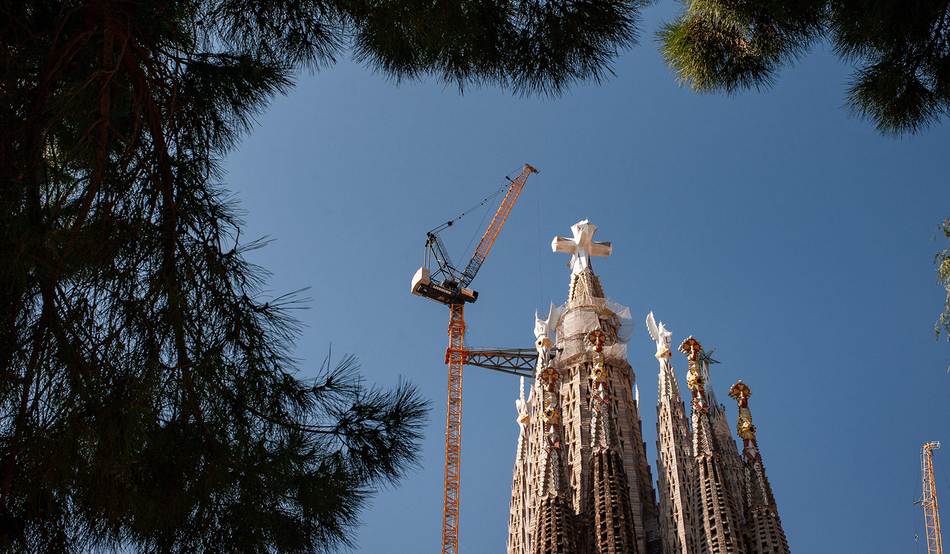
In March 1882, work began on a temple outside the old city of Barcelona. Today, it is an architectural wonder, instantly recognisable and the most-visited tourist site in Spain. Yet, after more than 140 years, it is still a building site.
Sagrada Família, designed principally by Antoni Gaudí, is the classic example of a curious artistic phenomenon: the unfinished masterpiece. For nearly a century and a half, the church’s masons, administrators and architects have had their progress interrupted—be it by shortages of material, the civil war, clashes with local residents, or the pandemic. It was hoped that Sagrada Família would be finished for the centenary of Gaudí’s death on 10th June 2026—tomorrow—but, rather appropriately, it isn’t ready.
Generally, we admire art—whether a novel, a piece of music or a painting—not only because of its vision, but also for its execution. However, works left unfinished, especially those by renowned artists, command our fascination. As Pliny the Elder commented: “It is highly unusual and worth remembering that artists’ [unintentionally] unfinished pictures are more admired than their finished works.”
Pliny outlines two explanations, the first of which is that incomplete works provide insight into the artist’s craft. One such example is Michelangelo’s early panel painting Madonna and Child with St John and Angels, also known as the “Manchester Madonna”. Michelangelo finished depicting the Christ-child and St John the Baptist, but two of the angels are only outlined, and Mary’s mantle needs several licks of blue paint.
In particular, the “Manchester Madonna” reveals the young Michelangelo’s command of the techniques necessary for working with egg tempera—a yolk-based paint chosen for its lustre and durability, but that dries almost immediately. To achieve a precise colour from egg tempera requires an arduous process of repeated undercoats, typically with fine hatched brushstrokes (most evident on Mary’s mantle). Unfinished, the painting provides a rare chance to see these lower layers without the need for radiography. Besides, knowing that Michelangelo used egg tempera highlights his mastery of certain effects—such as the delicate folds in the Christ-child’s tunic—which would have been nearly impossible to rework once the paint had been applied to the panel.
Pliny’s other theory is that unfinished works are more human. Incompletion—which might be because of death, illness, loss of inspiration, or a change in personal circumstance—invites us to find a story, and a person, behind the art. It can also provide the work with a mythology.
A classic case is Kubla Khan, which finishes mid-thought. According to Coleridge, he dreamt the Romantic poem under the influence of “two grains of opium”, and was scrambling to write it down when he was interrupted by “a person on business from Porlock”. Coleridge’s story is disputed, at least in part, but it attests to one of the key tenets of Romanticism—that completion is not as important as creation. For Friedrich Schegel, one of the movement’s pioneers, “The true essence” of Romantic poetry is that, unlike other traditions or genres, it “is in a state of becoming”.
Kafka died leaving the unfinished manuscript of ‘The Castle’ with his literary executor
Incompletion is similarly appropriate to Kafka’s The Castle. The novel describes a land surveyor, K, who tries to inspect the eponymous property, but is continually frustrated by the local bureaucracy. Kafka died leaving the unfinished manuscript with his friend and literary executor, Max Brod, who wrote that the intention was for K to receive the permit on his deathbed. It would have been a fitting twist, but Kafka’s unplanned finale is eerily satisfying because it leaves K to wander the village in eternal pursuit of his quest.
On the other hand, works left unfinished are sometimes completed by the artist’s friends or confidants. When Alexander Borodin died (in national dress, at a ball), Alexander Glazunov and Nikolai Rimsky-Korsakov decided to finish his opera Prince Igor. Because the often-nonchalant Borodin had composed the overture but not written it down, Glazunov transcribed it from memory, “roughly according to Borodin’s plan”. The finished score, which is usually credited only to Borodin, raises the question of how much recognition we should give to editors and collaborators.
The phenomenon of retrospective completion even extends to holy scripture. The clearest example is the gospel of Mark, whose canonical text ends at chapter 16, verse 20. However, Bibles normally acknowledge that the gospel’s final 12 verses are not in the oldest manuscripts. Mark’s previous endpoint might thus have been verse 8: “So they [Mary Magdalene, Mary the mother of James, and Salome] went out and fled from the tomb, for terror and amazement had seized them, and they said nothing to anyone, for they were afraid.”
Scholars dispute whether this was the original, deliberate ending; whether succeeding verses were lost; or whether the gospel had been left unfinished. It’s most likely that verses 9-20, which have a different style and tone, were added decades later by scribe-editors keen to provide a more convincing finale.
What scribe-editors did in early Christianity is now being done by AI. Mozart’s Requiem, which was unfinished at his death, has been completed by various composers—and now by computers. The same is true of Beethoven’s Symphony No10. Filmmakers working on Orson Welles’s once-unfinished satire The Other Side of the Wind used machine-generated content to fill gaps of missing footage.
Even Sagrada Família uses AI. Drone imagery of the church is fed into algorithms to identify structural damage and weaknesses. Artificial intelligence is also speeding up construction. The church’s general manager, Xavier Martínez, told the Chinese press agency Xinhua: “If we had continued with traditional methods, we would have reached the end of the 21st century before finishing the Sagrada Família.”
One wonders what Pope Leo thinks. He will visit Sagrada Família this week to celebrate Gaudí, and officially open the Tower of Jesus—a 172.5-metre turret that makes the church the tallest in the world. Mercifully, it remains unfinished.