I first came across the violinist and conductor Fabio Biondi in the late 1990s. I picked up some freebie CDs from my record company (the late, lamented EMI Classics, victim of the villainies of private equity in all its pomp). Among them was Vivaldi’s collection of concerti entitled L’Estro Armonico (harmonious inspiration). I hadn’t known them before. Here they were played with incredible passion and vigour and tenderness by Biondi and his group, Europa Galante. Prime minister Gordon Brown famously, and to much mockery, declared that the Arctic Monkeys woke him up in the morning; L’Estro Armonico, in Europa Galante’s rendition, really did that for me—and more.
♦♦♦
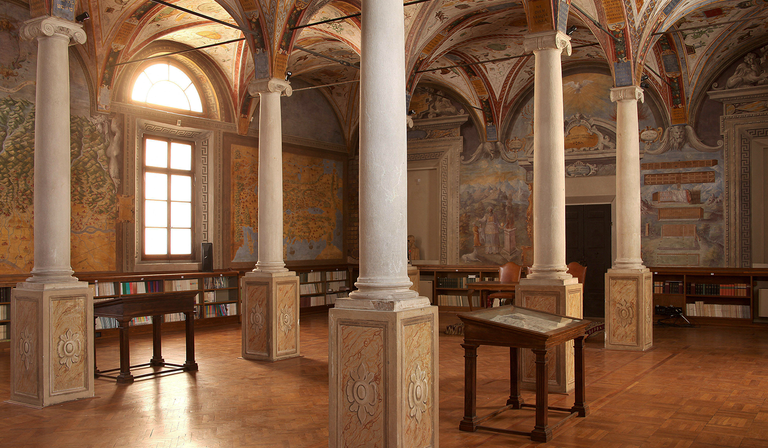
I was putting together a collection of Bach solo cantatas and arias for a new disc (including the sublime “Ich habe genug”) and was convinced these musicians would have a new take on the music, an italianità, a vibrancy all too often missing from Bach playing. Bach was, after all, deeply influenced by Italian music. We made the recording in the library of San Giovanni Evangelista in Parma, gorgeously frescoed in the 1570s by two Bolognese artists, Giovanni Antonio Paganino and Ercole Pio, with allegories of truth and wisdom on the vaults and bays. It was Parma, so of course we ate well between sessions, and the musicians endeared themselves to me with their praise of my faltering attempts to order in Italian. Apparently, my “cappuccino”—with those two crucial double consonants—was perfection.
We toured the programme and, towards the end, made it to a late night Prom in the Albert Hall. My wife came, nine months pregnant with our first child. We went boldly to the after-concert party, and it’s my last professional memory before the epochal change to life that children bring. Three days later, our son was born: I cancelled the next and final concert of the tour.
Fabio and his band have been a vital part of my musical life ever since, despite that brief interruption, an interruption which lends our continued friendship a special glow. We’ve toured Europe, we’ve been to Korea, we’ve taken Monteverdi to Moscow. That was back in 2018, before history started accelerating, but now we’re back with the same piece, “Il combattimento di Tancredi e Clorinda”, in Linz’s Brucknerhaus, in Hamburg’s Laeiszhalle and Vienna’s Musikverein.
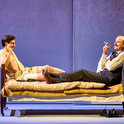
“Combattimento” is a strange, hybrid piece; half song, half opera. It’s 20 minutes long, scored for single strings and continuo (in our case, a theorbo and a harpsichord) and sets a passage from Torquato Tasso’s long narrative poem Gerusalemme Liberata, first published in 1581. The story of Tancred and Clorinda is choc-a-bloc with gender and racial confusions. Tancred is, on the one hand and quite straightforwardly, a Christian knight fighting to conquer Jerusalem during the 11th-century first crusade. Clorinda is, on the other, a tangle of complexity: the miraculously white-skinned, blonde-haired offspring of the dark-skinned Ethiopian king, Senapo, raised as a Christian but now fighting, kitted out in male armour, for the Saracen cause.
In Canto 12, Tancredi and Clorinda meet and fight to the death in a sequence of verses that Monteverdi set as the “Combattimento”. Only at the end of the piece does Tancredi remove Clorinda’s helmet and realise that she is the woman he has seen from afar and fallen in love with. She receives an improvised baptism at his hands and dies.
The poem is full of an ambiguous slippery sadomasochistic eroticism, as well as battle scenes for which Monteverdi invented ingenious string sound effects of which he was very proud. The story is told by a narrator, Testo, and the two protagonists speak only briefly—to challenge each other, to spur each other to fiercer combat and to achieve resolution in the final pages. It’s best to think of the performance being given by a sort of ballad singer who takes on all the parts, a cantastiore, part of a long tradition which continues fitfully to this day. While the modern cantastiore (you can find one from 1950s Sicily on YouTube) uses comic-strip images to illustrate the action, Monteverdi had actors or dancers come on “performing steps and gestures in the way expressed by the narration” as they imitated the “blows and steps” of the players.
♦♦♦
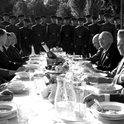
It’s especially piquant that this all happened, in 1624, in a building that still stands today, the Palazzo Dandolo/Mocenigo in Venice, now remodelled as the famed and luxurious Hotel Danieli. Mocenigo and his guests sat at dinner in a chamber of the palace when suddenly—“unexpectedly”, as Monteverdi writes—this extraordinary drama burst in upon them. Eroticised death at close quarters, a very avant-garde experience, and one we won’t be replicating as we’re giving the piece in concert.
The Danieli has a host of musical associations. Richard Wagner, in his own way as radical an operatic innovator as Monteverdi, was a guest (as were Goethe, Dickens and Proust). The mortally ill Benjamin Britten stayed at the Danieli in November 1975 and wrote his third string quartet there, recalling in its final movement, “La Serenissima”, themes from his recent opera Death in Venice.
I was in Venice in February and thought of going to the bar at the Danieli to soak up what remains of the Monteverdian atmosphere, but it’s closed for renovation as a Four Seasons. An idea sprang to mind: an “unexpected” performance of “Combattimento” for diners on the evening it reopens.