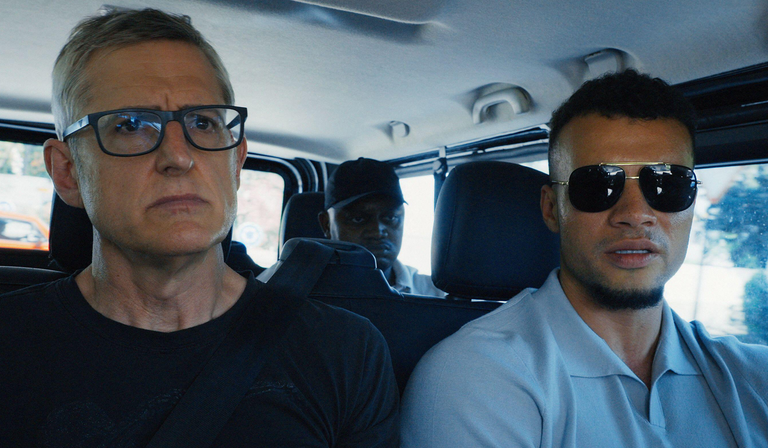
In a perfect world, nobody would have to think about the so-called manosphere, the online subculture of men promoting “traditional masculinity”—aka, misogyny—to other men that has crept into the mainstream over the past few years. Unfortunately, the enormous and terrifying popularity of these chumps means that we do have to think about it. To help us, Louis Theroux has waded into their world with a new documentary called Inside the Manosphere, out now on Netflix.
Over 90 minutes, Theroux tags along with figures such as Harrison Sullivan, a 23-year-old “content creator” who goes by the handle of HSTikkyTokky, and the podcaster Myron Gaines. They do things like show off their muscles and cars, while opining on how women should be subservient to men and claiming that gay people are repulsive. Sullivan introduces his girlfriend as his “dishwasher”—and more than one of the featured influencers describe being in a “one-sided monogamous” relationship, of which I’m sure you can guess the parameters.
All of these men have managed to leverage their public profiles to make money. Saying shocking things brings people to their social media channels; and then they can sell, say, dodgy financial advice to impressionable young men who believe that, if only they were more like these guys, they too could become rich. Sullivan, in particular, is very open about his goals. He owns an agency that manages OnlyFans models, but tells Theroux that women who make content for OnlyFans are disgusting. When Theroux presses him on whether that’s a double standard, he brushes off the question. He’s happy to make money from the situation, end of story.
The documentary is, frankly, horrible viewing. You want to reach through the screen and shake these arseholes by the shoulders. Theroux, in his classic style, remains unruffled by the attitudes they espouse and politely hands over enough rope for his subjects to hang themselves with.
But I’ve been interested in the variety of the responses that I’ve seen online. There are those who say the documentary doesn’t break enough new ground—that “we” already know that the manosphere exists. I think we do actually need a film of this type, which explains clearly and for a wide audience how toxic sexist ideology is being propagated online; who by; and, crucially, for what reason—which is to make money. Theroux is a household name, and people watch his programmes, regardless of the subject matter, because they trust and respect him. None of this may have been news to me, but it will be news to people who are not internet natives, such as many older people whose grandchildren are being sucked into the orbit of these monsters. Some of the most disturbing parts of the film are when the influencers are out and about in New York, Marbella and Miami, and they’re recognised in the street by teenage boys—and lauded as heroes.
None of this may have been news to me, but it will be news to people who are not internet natives
There are also people saying that Theroux doesn’t do enough to focus on the young men being led astray by these grifters, or on the impact the manosphere has on women, or that he fails to challenge the abhorrent views of its participants. In short, plenty of viewers seem to have been left unusually frustrated and dissatisfied by Theroux’s foray into this world.
It is frustrating to have to sit and watch these men say things like, “I dictate when I wanna put my dick in you, bitch,” and have nobody punch them in the face immediately afterwards. But Theroux is doing what he has always done: listening to what people have to say, then questioning them calmly when what they say does not add up. This is how he’s previously dealt—to great effect—with Nazis, Westboro Baptist Church members and child molesters, for example. Naturally, a few hours in Theroux’s company was never enough to change the beliefs of any of these people. But now, for some reason, that isn’t enough for many viewers.
I think this speaks less to a deficiency in Theroux’s approach and more to the times we’re living in. The manosphere seems like an intractable problem. It’s a byproduct of so many things that are wrong with our world: the amoral accelerationism of the attention economy; governments that have failed again and again to tackle violence against women; male loneliness; patriarchy that harms men as well as women. Where do we even begin dismantling something with such deep roots? Beneath some of the criticism of this documentary, I sense an understandable despair about the documentary’s subject matter.
We want someone—Theroux, in this instance, but really anybody would do—to do something about this fast-metastasising cancer. But what more can a documentarian do than document?
“We are all increasingly inside the manosphere,” as Theroux puts it, “and it’s up to us how we get out.” Does anyone know how we’ll do that?