“The movies!—The movies!—We want the Movies!” So goes the cry in William Burroughs’s famously disorientating anti-novel The Soft Machine (1961). The movies, too, have always wanted William Burroughs. Nova ’78, newly restored and released, centres on a three-day convention staged in punk-era downtown New York to honour the writer. Directed by Aaron Brookner and Rodrigo Areias—from footage shot by Brookner’s uncle Howard (then a student)—it was partly filmed by the young Jim Jarmusch. Its cast of rambunctious celebrants include John Cage, Merce Cunningham, Patti Smith, Laurie Anderson and Anne Waldman. And Frank Zappa reading aloud from the “talking asshole” section of Naked Lunch (1959). Burroughs himself is introduced on stage by Dr Strangelove screenwriter Terry Southern as “great, groovy and beloved”.
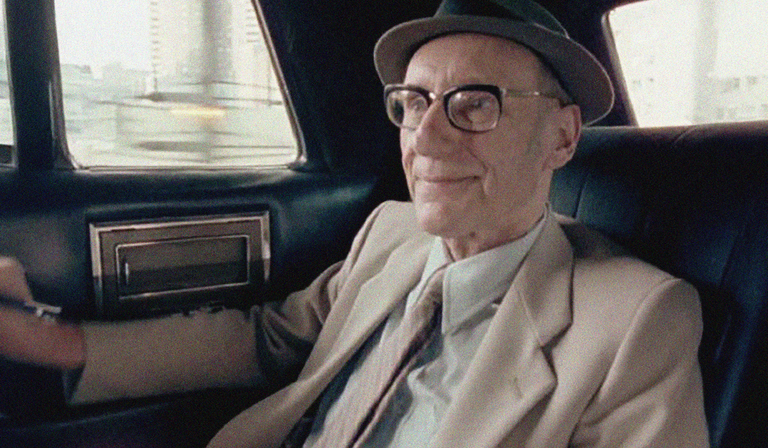
Beloved? The writer, born into a wealthy St Louis, Missouri, family before the First World War, had his enemies—unsurprisingly so given that he killed his common-law wife Joan Vollmer in a drunken William Tell act. (For much of his life he slept with a loaded gun under his pillow.) His work was routinely described as vile, pornographic, unreadable. Joan Didion, an admirer, believed him to be “uninfected by any trace of humanist sentimentality”. Yet there he is, part of the Beatles’ pantheon of greats, on the cover of Sgt Pepper’s Lonely Hearts Club Band. And here he is, in Nova ’78, suited and booted, a dandy with a Southern drawl, ruminating on solar power, homosexuality and fundamentalism, as well as the relative strengths of the mullahs and the Shah in Iran.
Mexico, Tangier, London, Paris: Burroughs spent many years outside the States. A homosexual, a heroin addict: his was a life of “Un-American Activities”. “In the US,” he said, “you have to be a deviant or die of boredom.” German filmmaker Klaus Maeck’s restless, entertaining documentary William S Burroughs: Commissioner of Sewers (1991) features him giving a public reading of his poem “Thanksgiving Prayer”. (“Thanks for the wild turkey and the Passenger Pigeons, destined to be shit out though wholesome American guts”.)
Thanksgiving Prayer was turned into a short film by Gus Van Sant who, while best known for Good Will Hunting (1997), has a long history with Burroughs. Still at art school, he adapted a short story into The Discipline of DE (1978); in 1985 he wrote the music for their collaborative record, The Elvis of Letters; he cast him in Drugstore Cowboy (1989) and Even Cowgirls Get the Blues (1993).
The novelist wasn’t interested in the language of pride, respect, visibility
Was Burroughs an icon of gay cinema? Queer, an autobiographical novella about the doomed infatuation between an American expat and a former GI in 1950s Mexico City, was brought to the big screen in 2024 by Luca Guadagnino and featured a sweaty, spirited performance by Daniel Craig. The novelist, though, wasn’t interested in the language of pride, respect, visibility. As the director John Waters, interviewed in Yony Leyser’s Williams S. Burroughs: A Man Within (2010), observed: “He opened up to me not gay culture; he opened up gay rebels who couldn’t fit in gay culture.”
Burroughs’s enduring appeal has much to do with his outlaw biography, but it can’t be reduced to it. For me, his key appearances are in two films, one English, the other German: Antony Balch’s Towers Open Fire (1963) and Muscha’s Decoder (1984). The former is both seizure-inducing and proto-psychedelic, an occult- and voodoo-infused fantasia in which the Wall Street crash of 1929 prefigures a gas-mask-wearing Burroughs bursting into a living room with an orgasm gun. To hell with “culture” might be its message. An alternative title might be Accelerate Now. Its concussive editing, blitzkrieg sound design and intense fascination with media technologies anticipate 1960s auto-destructive art and feedback-heavy rock music. (“Heavy metal” was a phrase he coined.)
Decoder is set in wintry, rubble-strewn Berlin where a cadaverous government agent (played by Bill Rice) deploys surveillance technology to track and quell social dissent. His nemesis is a burger-chain employee (FM Einheit from the band Einstürzende Neubauten) who repurposes recording machines to produce distorted, riotous noises he piratically broadcasts via his restaurant’s muzak system. A cyberpunkish thriller, Decoder is also a hacker’s manifesto that, drawing on Burroughs’s 1970 essay “The Electronic Revolution”, wants its viewers to cultivate paranoia, be alert to cultural forms that lobotomise and amuse us to death, see society as a circuit board in need of rewiring.
Burroughs himself shows up briefly—a disabused, cantankerous prophet of a dystopia to which we’re still waking up.