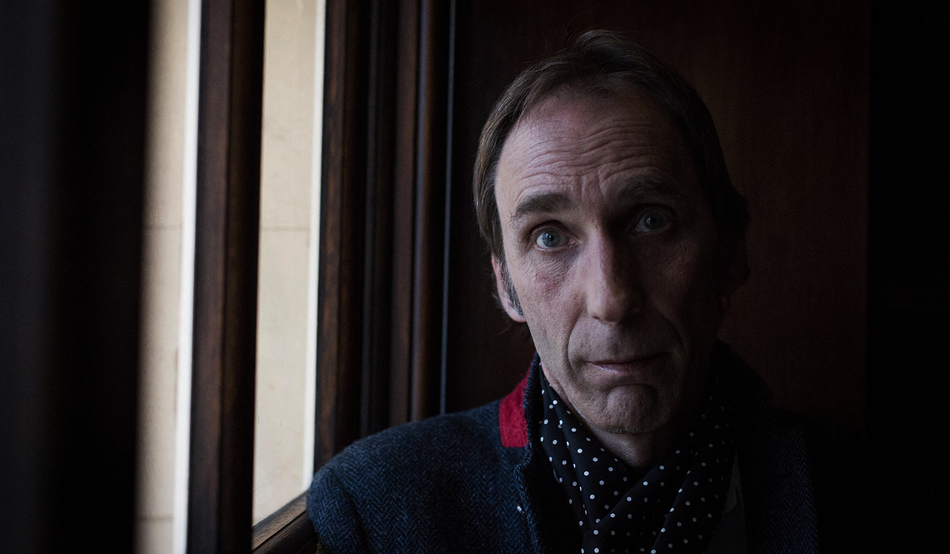
Will Self has been unwell, seriously unwell, and our interview, at his south London home, must take place a week after we’d initially scheduled to meet. The last occasion I talked to Self was in 2014, around the publication of his novel Umbrella, the specifics of which—Audrey De’ath lies in hospital suffering from a sleeping sickness, encephalitis lethargica, and questions are posed about how time passes when the mind is trapped inside illness—feels curiously prophetic. Self is now dealing with advanced secondary myelofibrosis, an advanced form of the rare blood cancer polycythaemia vera, with which he was diagnosed in 2022 and which led to a stem-cell transplant in 2024. Once a ubiquitous presence on Question Time and Channel Four News—famously issuing television’s most notorious glare to hapless Tory MP Mark Francois—with his byline everywhere, Self suddenly became bedbound himself and evaporated from view as his life became a procession of medical appointments, surgery and dodging infection.
“How will you feel when you know you’re about to die, Phil?” Self asks during our opening exchange. “No, don’t avoid the question—tell me how you’ll really feel.” And it’s a fair enough challenge because Self’s latest novel, The Quantity Theory of Morality, penned in a 12-week creative frenzy (“typing like a wind-up tin toy”) ends with a vision of his own funeral. The jamming of Audrey De’ath into the continuous present in Umbrella resulted in a book realised as a single paragraph stretched over 600 pages, time a slow burn. Quantity Theory also recalibrates time. Each chapter replays the opening chapter from the perspective of another character, the same scenes shot from different vantage points, as though the book is hallucinating its own reality.
Self’s characters wallow in middle-class decadence: an endless round of dinner parties, villas abroad, trips to Glyndebourne. A thoroughly unlikeable, disengaged bunch for sure, and the book lands somewhere between Hogarth and William S Burroughs. “It’s theme and variation,” he reveals, “the same basic thing happens in each chapter, but I give each variation a different instrument. There’s essentially Bettina, Phil, Rob and Will. The only one who doesn’t get the solo is Will, who, as he himself observes in the book, is the least fleshed out; he doesn’t even have a last name.” And it’s not Self? “Only a couple of times you could plausibly say he’s me. There’s a scene where Phil, at a garden party, pisses himself in front of Prince Philip and ends up chiding Will for not writing him as a better character, with a proper physical appearance and backstory—but that can’t be me, can it, because a writer would never say that about himself?”
The thesis underpinning Self’s new book is that society has marooned itself in moral deficit
The new novel has its roots in the 2010 short story, “The Minor Character” published only in a US anthology, The Undivided Self, which Self subsequently adapted for a Sky Arts film, with David Tennant as “Will”. But the short story felt like unfinished business, and the new book reached back also by riffing on the title of his first book, The Quantity Theory of Insanity, published in 1991. The thesis underpinning this newer Quantity Theory is that society has marooned itself in moral deficit. There’s not enough morality to go around, and compounding—and in many ways causing—the problem is the fact that society has lost its anchor in the book and print. Nobody reads, so we’ve squandered the ability to critique and see further than the nearest screen.
“This book does not present positive ethics, it presents negative ethics,” Self explains. “It’s a satire, until after Will’s funeral, then it becomes an elegy, but who for? Not for Will, clearly, but for satire. It can’t be an elegy for Will, because writing the book I’ve done my job properly as a satirist, who must be someone who afflicts the comfortable and comforts the afflicted. We’re unacknowledged legislators, writers, and we should take our job really seriously—I care, I really care, and I think the world has gone to hell in handcart.
“Satire has died. It was intertwined with what we thought parliamentary democracy was, where we put our belief in discourse as an engine of moral decision-making within the political, social and economic realm. It’s never been wholly right, I don’t have any rose-tinted view of any past—but now it’s been punctured.”
Self tells me that, given how sick he’d been, he had assumed his previous novel, Elaine, about his mother, would be his last. “Which actually would have been an appropriate and moving way to end, and had I died during the transplant procedure I could have signed off feeling very satisfied with my oeuvre.” He’s now working on a book about his father, as well as various essays on subjects ranging from music to religious ethics. He’s up and about, but tires easily; he is, he admits, not out of the woods yet.
“The great solecism of them all,” Self screams, “is when people say, ‘You look well!’ Oh, oh… your eyes are a diagnostic tool for a fucking allogenic stem cell transplant, are they?” We laugh and embrace the darkness—the very essence of Will Self.