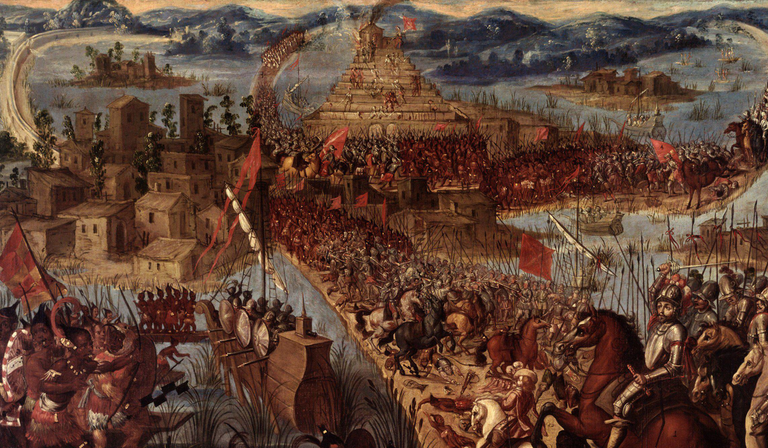
The history of Mexico is epic. There are the Maya and the Aztecs; the meeting of two continents, with Moctezuma and Cortés; a cry for independence led by a priest-turned-general; the loss of more than 525,000 square miles of land to the United States; a Habsburg emperor contrived by the French; a bloody revolution; a 30-year explicit dictatorship and a 70-year implicit one.
Epic—but also paradoxical. Mexico has been piously Catholic and violently anti-clerical; it has cherished its indigenous past but overlooked its indigenous present; and been a one-party state where the anointed candidate might lose an election. To borrow a line from Where the Air Is Clear by Carlos Fuentes, “You can’t explain Mexico; you have to believe.”
Paul Gillingham, author of a new history of the country, is a believer. He is also critical, astute and even-handed. He tells the grand narrative but is suitably careful to explain it. His thesis, however, is more extravagant—that “Mexico has been a dynamic and vital shaper of world affairs”.
Gillingham begins on the cusp of the Spanish conquest, when modern-day Mexico was populated by diverse societies living in villages, city states and empires. The most powerful civilisation was that of the Mexica (or Aztecs). Their capital, Tenochtitlan (later, Mexico City), was founded circa 1325 in a valley in the central highlands. When the Spanish arrived, in 1519, Tenochtitlan was an island city on a lake. It had dams, causeways, aqueducts, canals and even a system of public toilets. It was possibly four times larger than Henrician London, and much cleaner. The Spanish compared the city to Venice.
The Mexica—skilled administrators, urban planners, leaders in bioengineering, hydraulics and sanitation—were also ruthless expansionists. At the start of the 16th century, they became an imperial power and used violence and terror to collect taxes from other societies. Gillingham, somewhat glibly, compares the Mexica’s hegemony (as well as the subsequent Spanish empire) to a mafia state.
The Spanish exploited ethnic tensions and the Mexica’s unpopularity. They also used superior weaponry and—unknowingly—bacteria. In 1521, they captured the emperor Moctezuma and took Tenochtitlan. Gradually and incompletely, they established the viceroyalty of New Spain, a mammoth territory that stretched from Oregon to Texas, through modern-day Mexico to Guatemala, and extended across the ocean to the Philippines.
New Spain’s Atlantic and Pacific coastlines put it at the centre of the empire’s overseas interests. Voyages and commerce between Seville and the Gulf port of Veracruz, and between Manila and Acapulco, made 16th-century Mexico a trading hub of the nascent global economy. Most of the economic rewards, however, went to Spain.
Mexico’s commercial importance was reinforced by the extraction of silver from the central highlands. Together with mines in Peru, they doubled Europe’s supply of coinage. This silver—which the Spanish minted into the peso—became the world’s first reserve currency. The coin (known to English-speakers, and their parrots, as the “piece of eight”) was durable and hard to shave. It was, writes Gillingham, “a global standard accepted by everyone from sixteenth-century stockbrokers in Amsterdam to peasants in China”.
It wasn’t just silver. Mexico’s crops travelled across the world, propelling population growth and transforming cultures. Maize is more calorific than wheat or rice and, together with South America’s potato, it stimulated the near 50 per cent increase in the world’s population from the mid-17th to the mid-18th century. According to one estimate, maize underwrote a 20 per cent rise in the population of 19th-century China.
The intercontinental exchange also left a demographic legacy in Mexico, which became a melting pot of indigenous peoples, Spaniards, east Asians and enslaved west Africans. Gillingham points out that, until the 20th century, Mexico “was more profoundly, globally hybrid than anywhere else in the prior history of the world… its ethnic diversity unmatched”.
The Spanish conquest created vast upheaval, but it also allowed for remarkable stasis. As Gillingham writes:
In Mexico the sixteenth century was a time of dramatic shifts: the alien arrivals of Europeans and West Africans; the mass dying; the ecological lurches of clear-cutting forests with iron axes and desertification by sheep; the ideological revolution of Christianity... But surprisingly little changed in the basic structures of life until the last decades of imperial rule. Technology didn’t develop much at all. Communications remained a matter of mules and sails.
This is testament, in part, to the fact that Spain was never able to claim thorough control over its huge dominion. Not only did many villages retain their customs and hierarchies, but much of the land in the south, as well as the desert-plain areas of the north, remained de facto autonomous until after independence.
The viceroyalty of New Spain collapsed in the wake of Napoleon’s invasion of Iberia in 1808. Napoleon deposed the Spanish monarchy and appointed his older brother Joseph as emperor. In Mexico, this created a crisis of legitimate government—and a potential power vacuum. Members of the local Spanish elite led a coup that installed a viceroy who would preserve the status quo, a manoeuvre that fomented demands for Mexican sovereignty.
It was the start of more than half a century of convulsion, as Mexico both gained its autonomy and struggled to maintain political stability. Between 1821 (the year of independence) and 1855, there were seven constitutions, and the head of state changed 48 times. Mexico also had to fight off Spanish attempts at reconquest and, after the annexation of Texas, it went to war with the US (1846-48). Militarily overwhelmed, Mexico was forced to concede over half its land. A week before the peace treaty was signed, gold was discovered in California.
Foreign powers continued to arrive. In the 1850s, US filibusters conducted mini-invasions on both coasts. President Antonio López de Santa Anna, who wanted money to support an army to face domestic and international foes, sold 30,000 square miles of land to the US. Then, in 1864, amid a conflict with Mexico’s Liberals, the French-allied Conservatives installed Emperor Maximilian, an idealistic and out-of-work Habsburg. This propelled another civil war. Three years later, the Mexican Republic was reborn and Maximilian shot by firing squad.
The man who ordered his execution was Benito Juárez. Juárez, the leader of the Liberals, was a president in internal exile during the reign of Maximilian, and reassumed the role formally in peacetime. Juárez implemented agrarian reform, dismantled the privileges of the Catholic Church and subjected the army to civilian control. He is Mexico’s preeminent political figure, although his disputed re-election in 1871—against another Liberal general, Porfirio Díaz—has led to questions over his long-term democratic commitment.
Juárez died a year later, and Díaz seized power in 1876. His tenure, known as the “Porfiriato” endured—with a four-year hiatus—until 1911. Díaz secured foreign investment, oversaw major industrialisation and repressed opponents. His refusal to stand down following the election of 1910 was one of the causes of the Mexican Revolution, a multisided set of civil wars and regional uprisings that lasted a decade.
The revolution led to the deaths of nearly 1.5m Mexicans, almost a tenth of the population. Although it was a series of internecine conflicts, it also had a geopolitical dimension—in particular with respect to the US. When nine of its navymen were arrested at Tampico, the US occupied Veracruz for seven months. And after the guerrilla leader Pancho Villa raided a border town in New Mexico (an operation that killed 18 people), the US launched an unsuccessful mission across the border to capture him.
These incursions, together with the history of foreign invasions in the 19th century, helped develop Mexico’s signature foreign policy: diplomatic and military non-intervention. The doctrine was formally proclaimed in 1930, at the start of the seven-decade rule of the Institutional Revolutionary Party (PRI). It’s a policy that—with notable exceptions, such as sending volunteers and weapons to Spain to fight Franco—endures to this day.
From the 1930s onwards, Mexico became known as a place of political asylum. President Lázaro Cárdenas received 30,000 Spanish refugees, including Luis Buñuel—who made several of his finest films in the country and contributed to the first golden age of Mexican cinema. More controversially (especially in the leftmost wing of his party), Cárdenas welcomed Leon Trotsky, who would go on to have a brief affair with Frida Kahlo.
The PRI was, typically, hard to explain. In power from 1929 to the end of the millennium, it owed its longevity to popularity, despotism and an ability to change. At times, it was reformist or technocratic. Its presidents were almost all civilians and, although there was only one party, Mexican voters had choices ranging from the communists to the synarchists (a Falange-style organisation whose slogan was “Faith, Blood and Victory”).
This peculiarity persisted because, as Gillingham describes, “anyone could enter a party primary, and many winners were party men for the day, joining the PRI being akin to registering to vote elsewhere, a bureaucratic nicety rather than a profession of faith or loyalty.” Gillingham even argues that, at some points in the PRI’s hegemony, “whether it was a dictatorship at all was debatable”.
Which is not to say the PRI could not be brutal. In 1962, the country’s main peasant dissident was murdered along with his family. Thousands were “disappeared”. Just days before the Mexico City Olympics of 1968, army snipers opened fire on student demonstrators in the capitral, killing hundreds.
The PRI’s final major act was to take Mexico into the North American Free Trade Agreement (Nafta). Nafta—which has been much-criticised in the US for haemorrhaging manufacturing jobs, suppressing wages and exacerbating a trade deficit—was also detrimental to Mexico. According to Gilligham:
NAFTA brought most Mexicans something between disappointment and devastation. GDP per capita didn’t grow faster. Export manufacturing output rose but inflation-adjusted wages did not, and nearly half of the growth was in the tax-free, foreign-owned factory sweatshops where low-paid workers pieced together foreign-made components.
Then there was maize, the emblematic Mexican crop that sustained the rural economy. After Nafta, small-scale Mexican farmers had to compete with US growers who benefitted from state subsidies. When Mexicans went to the supermarkets, they had to suffer the indignity of buying US corn.
Like its subject, Mexico: A History is perplexing. Gillingham’s book is generally nuanced, but its clear and provocative thesis (a ploy beloved of publishers and marketers) does it a disservice. It is tempting to think that a book of 750 pages needs a thread, something to guide the reader through the labyrinth, but history rarely allows such conveniences. The idea that Mexico has been integral to world history, while certainly true in a few cases, is unsustainable in a study of this length and scope.
Gillingham’s focus is almost all political history. Ironically, more coverage of the country’s culture—its many influential artists, novelists and filmmakers—would strengthen the argument for Mexico’s importance. On five occasions in the last 12 years, the Oscar for Best Director has gone to a Mexican.
Gillingham’s analysis of historical moments is superb, but it is often obscured by incongruous prose. His sentences can be long and scholastic, and he mixes this formality with offhand comparisons to jihadis and the mafia. It’s a book whose elements of rhetorical virtuosity and bombast aspire to a large audience, but whose density will mainly appeal in the academy. There is great potential in these pages but, as it is, Mexico: A History is for those with a deep interest in the country, and the patience for a tome that—although not exhaustive—is often exhausting.