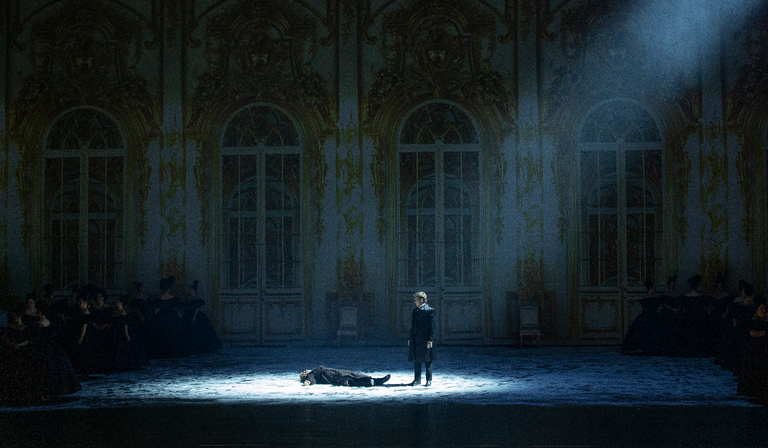
When a young Russian singer suggested to Tchaikovsky in 1877 that he compose an opera based on Eugene Onegin, Alexander Pushkin’s famous novel-in-verse, he dismissed it as a “crazy” idea.
“Then, during dinner on my own at an inn,” he wrote to his brother a few days later, “I fell to brooding about it, began to see the possibilities, got quite carried away and by the end of the meal was determined to take it on.” The composer rushed off in search of a copy, raced home, read it through without stopping, and passed a totally sleepless night. The reward? “The scenario of a wonderful opera on Pushkin’s text.”
The story of Eugene Onegin that so gripped Tchaikovsky is, on the surface, simple. So simple, in fact, that the composer worried audiences might be put off by the lack of plot. A young girl, Tatyana Larin, lives with her mother and younger sister in the country. They are visited by her sister’s fiancé, a young poet called Vladimir Lenski, who brings with him a friend from the city, Eugene Onegin. Tatyana, an introverted girl who loves reading, falls head over heels in love. Quite spontaneously, she opens her heart to Onegin in a letter. He replies: “Believe me, our married life will be a torture. No matter how much I love you, when I get used to it, I will fall out of love in an instant.”
At a party in celebration of Tatyana’s name day, Onegin, grumpy as well as disdainful, turns on his friend Lenski and provokes him. The two men determine to fight a duel, Lenski is killed and Onegin flees into exile.
Some years later, he is once again in St Petersburg. At a ball, he catches sight of Tatyana, now married to an older general and quite changed. Onegin feels his heart open to her, but too late. Tatyana, still filled with feeling for him, refuses to leave her husband.
The debates over whether Onegin is a selfish, entitled dandy who gets a well-deserved comeuppance or a tragic, maligned figure, and over whether Tatyana is merely sticking to social convention, making a terrible mistake in not following her heart, have raged ever since.
Tchaikovsky identified with Tatyana. “She became a living person to me,” he wrote. “As real as everything around her. I loved Tatyana, and I was furiously angry with Onegin, who seemed to me a cold and heartless cad.” Those who are unfamiliar with Tchaikovsky’s biography may not know that, in those very weeks, the composer himself received a similar love letter from a former student, a young woman named Antonina Milyukova. But Tchaikovsky was gay, a fact he kept secret from almost everyone.
Milyukova knew nothing of this. A few days later, she wrote again to Tchaikovsky, this time in even more ardent terms. “I am dying of longing for you. I burn with desire to see you, to sit and talk with you, though I am also terrified I would be struck dumb. There is no human failing that would cause me to fall out of love with you…”
Despite his personal misgivings, Tchaikovsky was determined not to behave like Onegin. The composer bowed before Milyukova’s declaration and asked her to marry him. What followed, for both of them, was nothing short of catastrophic. The couple separated a few months later, Tchaikovsky had a nervous breakdown and died in 1893, aged 53. Milyukova would spend the last two decades of her life in an asylum.
The tribulations suffered by the composer were more than matched by those of the author of Eugene Onegin. Pushkin, like Lenski, died days after being wounded in a duel, aged just 37. For Russians, the abject suffering of these two men only adds to the power of the opera. “From the very first note, you know this is Russian music,” says the conductor Semyon Bychkov, who, with Ralph Fiennes, will unveil a new production of Eugene Onegin at the Opéra national de Paris (OnP) in January—and who, it has just been announced, will become the company’s next music director. “You have to go slow, to drink it. You have to drink the language of the music, or the music of the language.”
Complex emotion, then, lies at the heart of this work. But teasing it out for an audience in a way that is neither too melodramatic nor lacking in heart is no easy challenge. It takes the skill of a real dramaturge and an abiding belief in the existence of the Russian soul.
Ralph Fiennes was deep in the Moroccan desert, filming The Forgiven, an adaptation of Lawrence Osborne’s biting British satire about race and class, when he took a call from Bychkov shortly before lockdown in 2020. The two had known each other for nearly a quarter of a century. “‘Rafik,’ he said—he always calls me Rafik—‘would you be interested in doing a new production of Eugene Onegin?’ I was shocked. I couldn’t believe it.” Fiennes had directed three films, but nothing then for the theatre, and never an opera. “I felt a very gut response: yes! But then also: what the fuck?! This was a whole new territory for me.”
Bychkov’s credentials for Eugene Onegin were obvious. Born in Russia and educated at the prestigious Glinka choir school in St Petersburg, Bychkov had two teachers, close friends, who liked to set the boys parallel classes: one studying Pushkin’s Eugene Onegin, the other, Tchaikovsky’s opera. “The debates we had! Tatyana stays with her husband. She doesn’t follow her heart. Was that the right choice or not? Imagine this bunch of boys, full of energy and testosterone. The debates were ferocious, violent even.”
In 1972, aged just 20 and a student of the legendary Russian conducting teacher, Ilya Musin, Bychkov was asked to lead 20 performances of Eugene Onegin. It was the first opera he ever conducted.
Bychkov is Jewish and he refused to join the Communist Party, which limited his chances of promotion. He left Russia in 1975, a beneficiary of Gerald Ford’s unwavering support for Soviet Jews who wanted to emigrate. Bychkov made a new life, first in the United States and then in France, after he married Marielle Labèque, the younger of the two piano-playing Labèque sisters who always perform together.
It was well over a decade before Bychkov was able to return to conduct in the Soviet Union. But the Russian music he is steeped in, especially Eugene Onegin, has followed him across the world. In 1992, he conducted—and also recorded—a new production at the Châtelet in Paris with the legendary Russian Onegin, Dmitri Hvorostovsky. Eight years later, he conducted another, at the Maggio Musicale in Florence. And in 2015, Hvorostovsky joined him for the last performance of his life, singing the lead role in Eugene Onegin at London’s Royal Opera House.
With the passing of the years, though, Bychkov became increasingly conscious that he might never conduct the work again. So when Alexander Neef, director of OnP, asked him what he’d like to conduct next, “I said to myself, I want to come back to Onegin.” Neef’s only condition was that it should be a completely new production, which set Bychkov thinking who might direct it.
Bychkov remembers sitting next to Fiennes at a dinner in London in 2003 after a concert. “We were talking and I was observing him, and I see this gentle, quiet, a little bit shy person. And finally I said, ‘Ralph, explain to me. How can someone like you, as I see you now, be such a beast like in Schindler’s List?’ He looked at me, and then he smiled. He said nothing. It’s what they do. It’s their job to become someone else all the time. From there started a connection.”
Bychkov knew that Fiennes had played the lead in a 1999 film of Onegin directed by his sister Martha. “I loved his performance. It was authentic in spirit, even though it was not in the Russian language. Doesn’t matter. I’ve seen his performances on stage. The film Nureyev, which he directed and in which he played Nureyev’s teacher, I found it incredibly sensitive.”
While filming Onegin, Fiennes had steeped himself in Russia. He visited Mikhaylovskoye, Pushkin’s estate. He went to the site of the duel, and to Pushkin’s apartment where he learned that, as he lay mortally wounded in his study, the poet turned to all his books and said: “Goodbye, my friends!”
“Ralph has a connection to the culture, [even if it is] a foreign culture for him,” Bychkov observes. “It has to do with his character, his curiosity, his sensibility.”
Fiennes, for his part, has long had a connection to Eugene Onegin. Even before he starred in his sister’s film, he was introduced to Pushkin’s work by Lloyd Trott, the librarian at the Royal Academy of Dramatic Art. “I became very compelled by Onegin the character. He still compels me. I think he’s very complex, a highly intelligent man who is exposed to high society, but who is [then] suddenly bored by it. I keep saying he’s a watcher. He looks. He notices everything. I love his provocative sense of humour. I think he’s also got a cussed side to him. At the Larin ball, when he hears he’s being gossiped about, he suddenly thinks, ‘Fuck this ball. I’m going to fuck it up.’ I think it’s a lot to do with his deeper unhappiness, his lack of sense of location in himself.”
As a piece of musical theatre, Eugene Onegin demands much of its singers and directors. Peter Brook’s 1957 production, especially romantic, featured Tatyana in the letter scene, walking through a carpet of autumn leaves; it lasted, unchanged, for 40 years. Robert Carsen’s production succeeded it, and was more stark. Kasper Holten’s version, conducted by Bychkov at the Royal Opera House in 2015, focused on the importance of memory and regret.
Fiennes promised no “provocative concept” to jolt the Paris audience into seeing the opera anew. But trying to understand what exactly he did want takes some teasing out. Fiennes doesn’t like being interviewed. He squirms, he stammers. He starts a sentence over and over. But if you just let him talk, his ideas slowly come into focus. It is clear that Fiennes and Bychkov took the piece completely apart before putting it back together.
Helped by Michael Levine, the Canadian costume and set designer who worked closely with Robert Carsen on his 1997 production at the Met, they first conceived the staging.
“I came to the table with the sense of the countryside being the foundational arena,” Fiennes says. “That’s Tatyana’s life, that’s the Larin life. The country. The feeling of the life lived outside is strong.
“I wanted the feeling of trees. And so we have a suggestion of these very tall silver birch trunks that will be very, very high. That evocation of the beryoza, the silver birch, is always there.
“The sets have a sort of pictorial simplicity. They show: ‘This is a wood. This is someone’s country ballroom.’ But the sense of nature is always present.”
The three began workshopping their ideas, sometimes staying at Bychkov’s villa near Biarritz. “Semyon [gave] the singers [the Russian-Austrian baritone Boris Pinkhasovich who plays Onegin and his Armenia-born Tatyana, Ruzan Mantashyan] very detailed notes about tempo and changes of tempo to help them understand the feeling of conversation. That was one of the key things about Semyon. I say this to people when they ask me. He kept saying: ‘You know, Ralph, they are talking to each other, but they just happen to be singing.’ And when he said that is when I felt, ‘Ah, yes, okay, we’re on the same page.’
“And that was because I felt I could come to it with my sense not of drama, not of film drama, but just of the job of recreating worlds and people and relationships as they happen in the present moment. It’s a challenge with opera, because there’s the line of music that’s taking you there, but when I see it happening, I get incredibly moved.”
“None of us knows what echo chambers exist inside us,” Fiennes says, “that certain events can unlock. Because I think, as human beings, we’re full of rooms that we don’t know we have. Or we’ve closed the door on them and done that when we’re young.
“Onegin is a complex, difficult character. He’s a very modern character. So what happens to him? He’s killed a man. He’s killed his best friend. I think it’s shaken him. Something in him is already uneven or off-balance. So when he comes back—and this is not anything you can rationalise, but I can understand it emotionally—he sees her. Suddenly, she’s no longer this young, vulnerable person, and she carries herself socially with ease. She looks amazing. So something in him is opened. One of the rooms that I’ve described, the doors are opening in him. I think he’s made vulnerable by killing Lenski. And suddenly, at some deeper, intuitive, instinctive level, she can heal him. ‘The girl I rejected can heal me,’ he thinks. He wants that purity of love. He wants it. He wants her. But it’s too late.”
Inside the opera house, several floors beneath Paris’s street level, it is easy to forget that Fiennes is an international movie star. But in the local Bastille metro station, the familiar domed head rears out of a huge poster shaded in orange and black, announcing a new film, 28 Years Later: The Bone Temple. “It’s a zombie film, a sequel,” he tells me, laughing, a few moments later.
In the rehearsal studio, dressed in a roomy black shirt and comfortable trainers, Fiennes watches the singers run through each of the three acts. He moves sinuously from spot to spot, taking in different vantage points, followed by his assistant who takes notes of his copious observations. In between acts, he exhorts the singers to think of those in the audience who don’t know the work and about the psychological importance of showing motivation as a way of giving the opera added depth and contemporaneity. Pinkhasovich as Onegin (in a white T-shirt adorned with three teddy bears) listens as Fiennes talks to him about his rejection of Tatyana after she writes the letter. “It’s a sort of Onegin apology. There’s a tenderness in the gesture as he approaches her. If you don’t know the opera, you think, ‘Oh, he might change his mind.’”
Later, he explains: “I think a lot of the time that when they sing, I just have to stand back, because they know what they’re singing with such intelligence and musical understanding. It’s really the connecting tissue of people being in a room, listening, responding, and often there’s moments when they have to be alive with life, when they’re not singing. And it’s those moments that I think, I hope, I can nurture.”
“My experiences of opera that have moved me the most are when I have felt taken out of my world by the force of music and emotion that reminds us of the beauty, the craziness, the complexity and the madness of being human, you know. And when we go to great theatre, whether it’s dramatic theatre, opera or even dance, it should have this effect on us, that we are… our hearts are opened and we don’t… our thinking brain goes away, and our hearts and our souls are touched, and we can’t speak. The best experience is when you can’t speak for some time, because you’ve been opened and changed.”
Opera, it is said, calls for the audience to suspend their disbelief. But what fills the disbelief gap? Fiennes also talks of the afterlife he imagined for the characters. “I think perhaps Tatyana outlives her older husband and remains a widow to the end of her days.” And Onegin? “He could even kill himself or go away, live alone, away from people in a sort of living death.”
As he says that, I am taken back immediately to the end of the rehearsal, the very final moments of the opera. Tatyana has fled the stage, having made her decision. Onegin picks up her shawl. Sobbing as he breathes in the only thing he has left of her, he falls to the ground, curled up and utterly alone. Bychkov guides the music to its end, and all I feel is Onegin’s living death take hold. That’s directing.
Eugene Onegin is at the Opéra national de Paris, Palais Garnier, until 27th February
Images courtesy of Elena Bauer and OnP