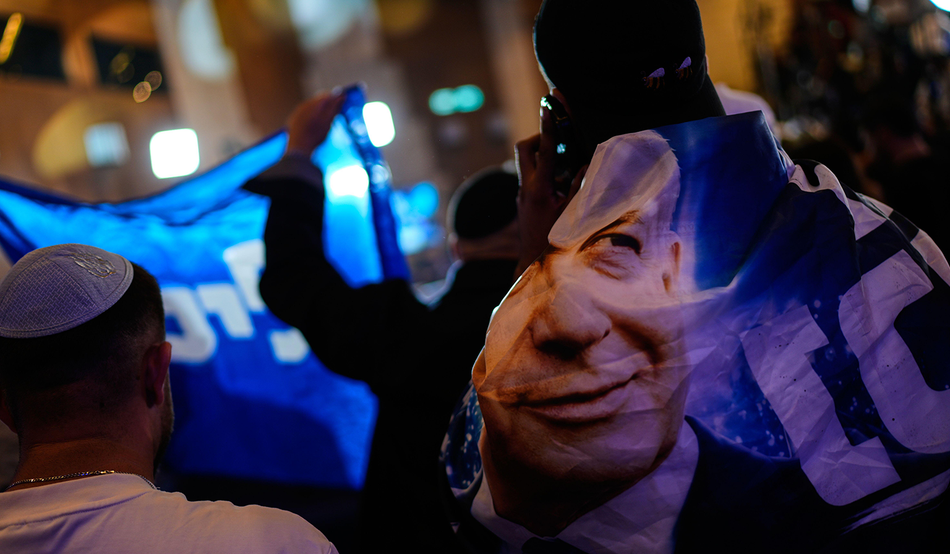
Israel’s election results have so far been as fractured as expected, but so far there appears to be an opportunity to remove Benjamin Netanyahu from power if the opposition bloc is willing to take it.
At around 2.39pm Israel time, with 85.6 per cent of the vote counted, the prime minister’s bloc of far-right, ultra-Orthodox and hard-line right was on 53 seats, eight shy of the 61 needed to form a governing coalition in Israel’s 120-seat Knesset parliament, though Netanyahu’s party Likud was the largest, with 26 seats. The opposition parties are on 67 seats, including the Palestinian parties with 19 seats between them: a historic high that surpasses predictions.
Yesterday’s poll was record-breaking in other ways, too. The voter turnout, at 77.7 per cent, was the highest at this point in proceedings since 1999. High turnout among Palestinian and Arab citizens—reportedly more than 75 per cent; a rise of nearly 20 per cent on the last election in 2022—led to a historic result for the Joint List, a slate of three parties (Hadash, Balad and Ta’al), and the traditionally Islamist party Ra’am. The full results may not be in until Thursday, and with such a high turnout, the maths could well change.
The tragedy for Israelis who want Netanyahu’s government to fall is that the path to victory is blocked by the very division between Arabs and Jews that Netanyahu has so expertly exploited over the past decade, if not longer.
On election day in 2015, the prime minister famously warned in a video posted to social media that Arabs were going to the polls “in droves”, and in cahoots with leftists. Yesterday Netanyahu similarly declared an “emergency” over high Palestinian voter turnout.
And throughout this campaign Netanyahu ads have implied that the opposition parties were plotting to work with their Palestinian citizen peers. In one AI slop ad, the leader of the left-wing Democratim, Yair Golan, sits with Mansour Abbas, leader of Ra’am, inside a Trojan horse. But rather than reject this narrative, the opposition have mostly gone along with it, with all but one of the leading Jewish politicians in that bloc pledging not to form a government with the Arab parties.
While for Israelis these elections were about the future existence of their country, for Netanyahu they were personally existential. On trial for fraud, bribery and breach of trust, if he leaves power he also faces accountability for the failings that led to the 7th October attack, alongside various other scandals that have engulfed his leadership.
After the exit polls last night, he was triumphant. With messaging expertly calibrated for his base, Netanyahu talked about bringing down the Iranian regime and listed the various Hamas leaders Israel had assassinated since 7th October, as well as Hezbollah’s Hassan Nasrallah and Iran’s former supreme leader, Ali Khamenei. He thanked God. At one point he broke out into song with the crowd at Likud party HQ.
With his party’s result to date ahead of what most polls had predicted, he accused his opponents of attempting to mislead the public. But as his bloc didn’t, on the exit polls, have enough for a majority, his message was also that the results were a victory for the right, and the country therefore needs a national, right-wing government. This was an invitation for right-wing opposition parties to join him in coalition.
Gadi Eisenkot, whose party, Yashar, is on course to be the second-largest in the Knesset, also claimed victory. Standing on a stage flanked by party members now heading into the Knesset, the colour scheme a nationalist blue and white, the former IDF chief of staff declared that Netanyahu had been rejected by the public. It would be a mistake to go to elections again, he said, pledging to work to form a “Zionist, conscription” government. (The two ultra-Orthodox parties in Netanyahu’s present coalition are fighting legislation that would force ultra-Orthodox Jews, currently exempt from IDF service, to join the army; all together they have 14 seats, on the latest results).
It was quite something to watch Israeli TV pundits cope with the success of majority-Palestinian parties. On Channel 12—a fair representation of mainstream Israeli public opinion—it was mostly painted as a problem. One pundit described it as “too big a win”. As on Channel 14, Israel’s pro-Netanyahu Fox News equivalent, the argument seemed to lean towards a unity government, with the thinking being that Eisenkot would consider joining Netanyahu on the condition that Itamar Ben-Gvir’s far-right Jewish Power party, on seven seats, wasn’t included.
The coming days and weeks will be excruciating, as Netanyahu works fast to spin the results in his favour. In a deeply divided society, there is fear of violence as coalition negotiations get underway. Yesterday, a man was arrested with a knife at an event with Yair Golan.
And forming a coalition could take many weeks. Under Israel’s proportional representation system, after the full results are in, the president will nominate a party leader likely at some point next week, to assemble a coalition. They will have 28 days, and can extend for another 14. If they fail to herd the necessary cats, the president will nominate another candidate. If that fails, the parties can nominate someone else to try.
And if everyone fails, Israel would be looking at another election—a win for Netanyahu, who would stay as PM until that second race. Given the momentum behind yesterday's poll, it is unlikely a bitterly disappointed electorate would turn out again in such great numbers. Certainly, the tens of thousands of Israelis who flew to Israel to vote yesterday wouldn’t return so quickly.
On the current results Netanyahu can’t easily form a government, despite having the largest party in parliament—though everything is possible. Eisenkot meanwhile, does have the numbers if he is willing to work with the Arab parties in some way. That could mean support from outside the coalition, as former prime minister Yizhak Rabin did in 1992, when he formed a coalition supported externally by Arab parties. (Rabin, a joint Nobel Peace Prize winner with Yasser Arafat for the Oslo peace agreement, was assassinated by a Jewish extremist in 1995 whose ideology was not much different to Netanyahu's more extreme coalition partners).
It could even, in theory, mean a government of true partnership between Israel’s Jewish and Arab citizens, if Eisenkot were a brave and bold enough leader—with Ra’am in government, and some outside support from the Joint List. Ra’am entered a coalition with Jewish parties in 2021, the last time Israeli voters put Netanyahu out of power. Ahmad Tibi, leader of on the Joint List factions, said today that the opposition bloc can form a coalition “if it wants to, if it is brave enough to”.
Opposition bloc voters aren’t completely opposed to this. An election night survey by aChord Center at the Hebrew University found that 61 per cent of opposition bloc voters would like Eisenkot to form a government with Ra’am. Of the rest, 20 per cent preferred new elections, 12 per cent unity government with Netanyahu and 7 per cent government with the ultra-Orthodox parties.
So far, the only Jewish opposition leader to have explicitly rejected this racist politics is Yair Golan, who urged Israelis not to “accept Netanyahu’s racist division between Jewish and Arab votes”.
This division also poses “a fundamental question about the character of Israeli democracy”, as Gershon Baskin, the veteran hostage negotiator and peace activist, wrote last night. In rejecting the political legitimacy of Palestinian citizens, Jewish Israelis who see themselves as liberals—who believe they are in clear opposition to Netanyahu’s illiberal, populist, destructive politics—are gifting his government a chance to cling to power.
And so, surely, the biggest winners of the night were the Palestinian citizens of Israel. They voted decisively against a government that has neglected, repressed and brutalised them, that has incited against them, and that was waged a war of annihilation against their fellow Palestinians in Gaza. And they voted decisively against an electoral race which featured much campaigning at their expense.