I wake up to find smoke engulfing the area where I live, in Brazil’s Pará state, the most deforested in the Amazon. When I check satellite images, I see that the forest fires that are currently ravaging the rainforest are concentrated in areas that supporters of the Bolsonaro family want to invade and steal. It reminds me that Brazil is facing no ordinary election.
I begin to fear that the fires will reach my house or be used as a weapon against us, we who are fighting to defend the planet’s largest tropical rainforest. Burning down the homes of those who resist deforesters has long been used as a tactic in the Amazon, but it has been taken to a whole new level by Bolsonarism.
I still remember Fire Day, when landgrabbers from Novo Progresso and other cities in Pará mobilised on WhatsApp to set fires in different parts of the forest as a show of support for then Brazilian president Jair Bolsonaro. On the 10th and 11th August 2019, there were 1,457 fire hotspots in the Amazon. Now, after the first round of the presidential elections on 4th October, the number of forest fires have doubled. Again, I remember that these are not normal elections.
Even before the first round, I was receiving messages on my mobile phone warning me that armed intruders are gathering at the borders of Indigenous territories, ready to invade if the far right wins. Between round one and two, an informant warned me that gold miners were readying machinery to move into the forest as soon as they hear that Bolsonarism has prevailed.
I think about the rivers that illegal mining has poisoned with mercury, about the Indigenous mothers who are breastfeeding their babies with mercury-contaminated milk—and remember that these are not normal elections. Right now, many of us are reinforcing our home security measures and making escape plans, while allies abroad try to offer exile options. I know for certain these elections are not normal.
I think about the Indigenous mothers who are breastfeeding their babies with mercury-contaminated milk
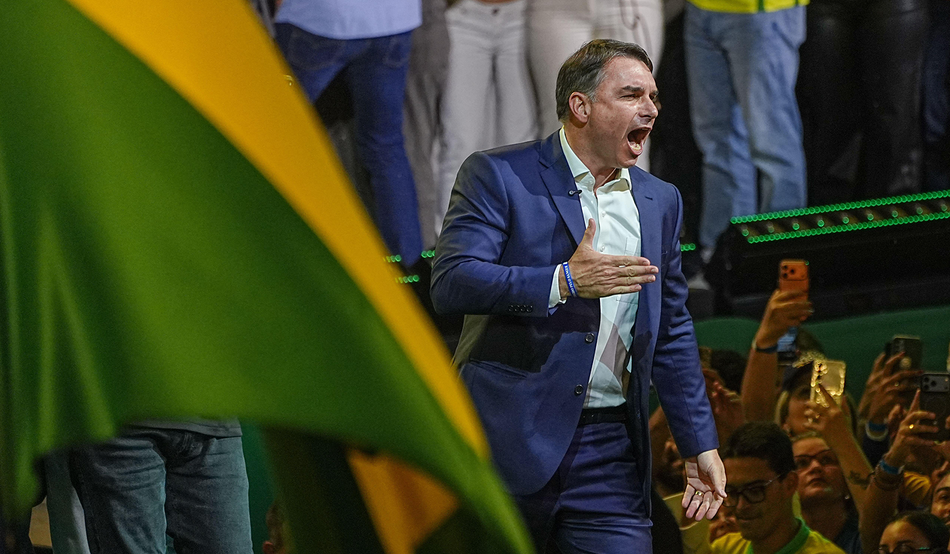
For Brazilians who oppose the advance of destructive forces in the Amazon, this has been our reality ahead of the runoff elections on Sunday. In round one, Flávio Bolsonaro, son of Jair Bolsonaro—currently in prison for attempting a coup d’état—garnered 2.2m more votes than president Luiz Inácio “Lula” da Silva, who was seeking reelection. This was enough for Bolsonaro’s allies to believe victory was all but assured.
Landgrabbers, deforesters, and loggers have been destroying the globe’s largest tropical rainforest for decades, but with the rise of Bolsonarism, they have found their political channel. Under Jair Bolsonaro’s administration, which governed between 2019 and 2023, they were granted impunity and given permission to march into protected areas.
The current Lula government succeeded in reducing Amazon deforestation by nearly 50 per cent. Now, a presidential win for Jair’s son would all but guarantee increased deforestation, with a free-pass for exploitation, because conditions in Brazil today are more favourable to those who would tear up the constitution.
To understand what is at stake in the Brazilian elections, we must understand that Brazil lies on the Amazon’s periphery. The country’s greatest relevance to the world, and itself, is the fact that it harbours 60 per cent of the planet’s biggest tropical rainforest—a vital carbon sink and climate regulator. Without it, halting global heating and biodiversity loss will be much harder. Many people haven’t yet grasped that this makes Brazil’s elections among the most important for the world.
“Without wanting to sound alarmist, I’d say that Lula’s reelection is the only barrier between us and the end of the Amazon,” Cláudio Angelo, who works with the Climate Observatory, a network of climate organisations in Brazil, told me.
After Jair Bolsonaro was elected, Erasmo Theofilo—leader of smallholder farmers in Anapu, the city in Pará where US missionary Dorothy Stang was murdered in 2005—was forced to leave his territory and enter a protection programme for forest defenders because attempts were made on his life. Confined to a wheelchair due to polio, he says he has faced his greatest limitations since the rise of Bolsonarism, because he can’t move due to these threats and is trapped at home to avoid being killed. “May God protect us, may the orixás protect us, if the Bolsonaro family returns,” he told me this week. “We’ll lose our last remaining rights.”
It is clear that a Flávio Bolsonaro victory would accelerate forest destruction, quite probably to the point-of-no-return, producing repercussions for all humanity. It would also mean nearly all of South America would be under Donald Trump’s tutelage, with consequences stretching far beyond the continent.
A Flávio Bolsonaro victory would accelerate forest destruction to the point-of-no-return
The first-round results have already brought a defeat: the newly elected Congress will be dominated by Bolsonarism and more predatory than the previous one. Even in the case that Lula wins in the runoffs, governing would present an enormous challenge. At a state level, the first-round outcome was also a blow to the forest and its peoples: seven of the Amazon’s nine governors have ties to Bolsonarism. One of them, Daniel Santos—who likes to go by “Dr Daniel”—was fined roughly $275,000 for deforestation. Santos was elected governor of Pará while pledging to cancel environmental fines.
This whole scenario is even more encouraging for forest destroyers—who self-identify as the “productive sector”—because Brazil’s supreme court has been mired in the worst crisis of its history since certain justices came under suspicion of involvement in the Banco Master scandal, Brazil’s largest-ever case of financial fraud. Over the past four years, the court has blocked some of Congress’s unconstitutional moves and excesses, but a divided, weakened, and demoralised judiciary will find it hard to play guardian of the constitution in the coming years.
Between the first and second voting rounds, the forest destroyers have been almost uncontrollably euphoric. At a pro-Lula rally packed with children in Altamira, where I live—one of the epicentres of Amazon deforestation—one of them even aimed his pickup at the crowd and brandished a gun, signalling what will happen to his opponents. All they need is to win the presidency to raze what remains of the forest. Since Lula’s first-round underperformance roused progressives—who took to the streets and social media with revived energy—tensions have only grown.
No, these elections are not normal. The choice is not between two options compatible with democracy. Nor is this by any means a contest between right and left. If it were, nobody would need to fear for their life, or the end of democracy, or the collapse of the Amazon rainforest. Bolsonarism is a fascist project that aims to perpetuate itself in power and transform part of the population into an enemy to be destroyed.
In this sense, what is happening in Brazil is a lesson for the world. Those on the global right who believe they can align themselves strategically with extremists in order to gain ground need to understand, before it’s too late, that the far right does not share power. This is a good lesson in how not to become Brazil tomorrow.
Translated from Portuguese by Diane Whitty