“They all want firing after a cock-up like that,” Oxfordshire farmer James Alexander tells me over the phone. The fallout over the Sustainable Farming Incentive (SFI) debacle continues to send shockwaves across the farming community. It may have already bankrupted some of them.
On 22nd September, the long-awaited funding window for the SFI opened at 10am with £253 million available. It closed at 3.48pm with the budget fully allocated. Spent. Gone. Farmers compared it to the mad rush for Glastonbury tickets. It may sound to a casual observer like a dash for cash, with farmers scrambling for government payouts. But the SFI is not a subsidy—it’s a payment for services, many of which farmers had already undertaken as a long-term investment. Existing agreements were worth more than £520 million. That leaves a funding gap that even the £253 million did not plug, according to the National Farmers’ Union.
The SFI replaced the European Union’s Basic Payment Scheme, which before Brexit simply gave farmers a subsidy for farming. Rather than doing more of the same, the SFI was designed to reward farmers for adopting nature-friendly farming as a public good, such as planting six to 12-metre flower-rich grass margins around their fields, sowing winter bird feed, agroforestry and improving soil health.
It could have led to the best of both worlds, helping farmers maintain food production yields while also improving the wildlife and biodiversity. And it worked. Until March 2025, when the SFI was abruptly closed and farmers were left in the lurch. The reopened funding window this September was therefore highly anticipated, and an opportunity for the Department for Environment, Food and Rural Affairs (Defra) and the Rural Payments Agency (RPA) to put things right. Boy, did they miss that opportunity.
“I had one farmer tell me that he wasn't going to [apply] until the following day,” Alexander said. “But then he suddenly saw a ping on his phone saying that 50% of [the funding] had already gone.”
Robyn Munt, vice-president of the NFU, said that his union had warned Defra that their budget would not meet the demand from farmers wanting to deliver for both the environment and sustainable farming. “It has further damaged business confidence that is already at rock bottom,” he said. The Tenant Farmers Association, a group that helps non-land-owning farmers, added that farmers already dealing with drought and disease had been left “devastated”.
Some reading this may feel they have no skin in this game. Farmers being unhappy with the government is a story as old as time. But the UK’s food security situation is increasingly dire and we need more locally produced food.
Even more dire is the state of nature in the UK, with some species declining by an average of 19% since 1970. Farms cover 69% of total land area. So how farmers farm is the British landscape; it is British biodiversity. A failure of government agricultural policy that causes wide-scale ripping up of wild bird seed, meadows and field margins would be a horrendous outcome. Forget the government’s ability to meet its legally binding target to restore 30% of nature, and halt the decline in species populations, by 2030; that may have just been undone in six hours on a Tuesday in September.
As Cambridgeshire farmer Peter Hatley told the Guardian, “We’re at breaking point. We can’t ride this storm. I will undo all the hard work over the last 20 years and move to a mono crop with maize… The skylarks, the lapwings, they’ll [all] go.”
Farmer Ally Hunter Blair told the fortnightly Meet The Farmers podcast that “the inadequacy of the system is just painful”. Missing out on this may tip some farmers over into bankruptcy, he argued, while others may survive by ripping out nature-friendly meadows, field margins and hedgerows to make way for cash crops. Farmers want to continue farming in a way that’s beneficial to both nature and food production, says Blair. And the demand on Sep 22nd is proof—with around 12,200 applications submitted on the day. “The government need to actually look at whether they are willing to fund that.”
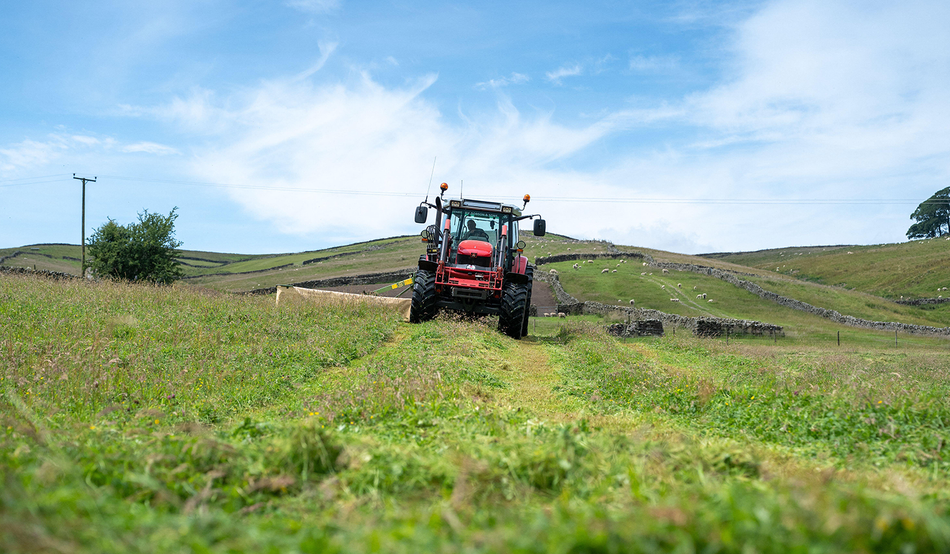
Alexander also told me he’s heard farmers saying they're going to remove grass margins, which provide an important habitat for insects and small mammals, and “farm wall-to-wall again just to get by”. I’ve visited his farm before: It’s nestled within rolling hills and lush green cropland interspersed with wildflowers, buzzing with insect life. That is what’s at stake.
“I just think somebody's got their numbers very badly wrong,” Alexander said. “They know how many farmers are in the country, they knew how many farms would be applying. So surely they could see what was coming.” If they did, or if they did not, are both very bad looks for the government. Defra Minister Angela Eagle apologised at an NFU event at the Labour party conference for the “frustration and anger” caused by the SFI debacle.
Agricultural researchers at Leeds University recently said that the government “must recognise the realities farmers face” if it is serious about transitioning to a more sustainable farming system and create a more “practical, predictable, accessible and equitable” process.
Farmers are clearly willing, as the overwhelming demand for SFI demonstrates, but they have felt excluded by the process. Wildlife will suffer.
There is an awful lot riding on how the SFI will return in 2027. Some farmers won’t bother waiting and will plough “hedge-to-edge” again, as Alexander put it. But those that do return in good faith need to be treated in good faith. Eagle has promised to put the scheme “right” before opening it up again. But ultimately the government needs to decide whether it values nature in the British countryside, and if so, by how much.