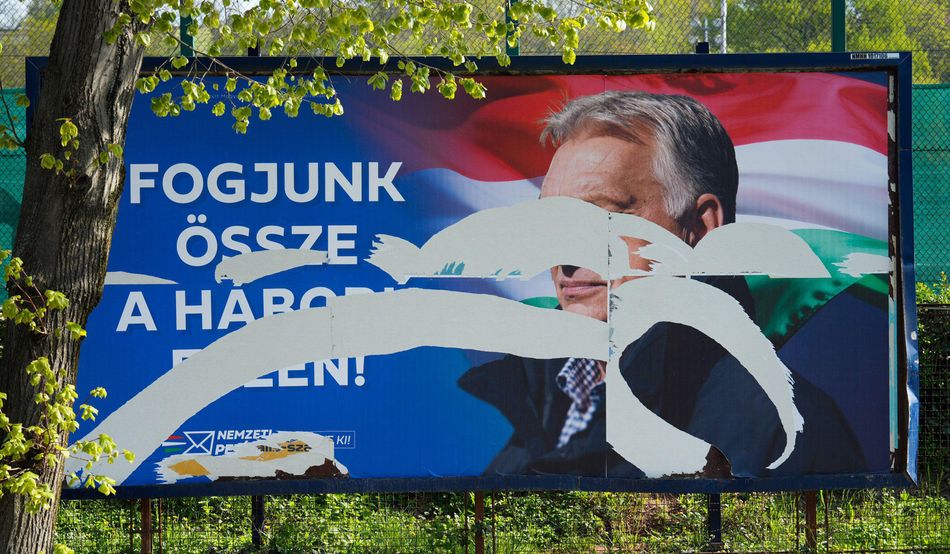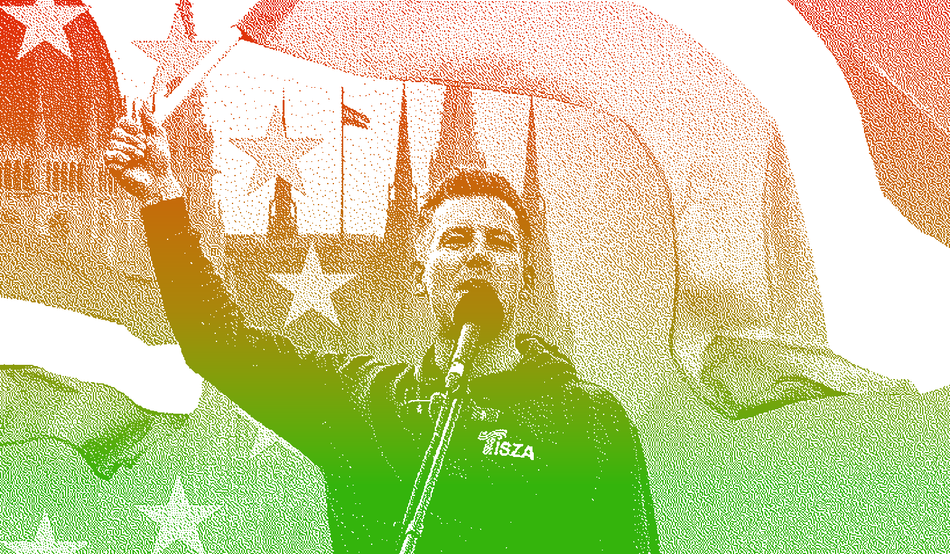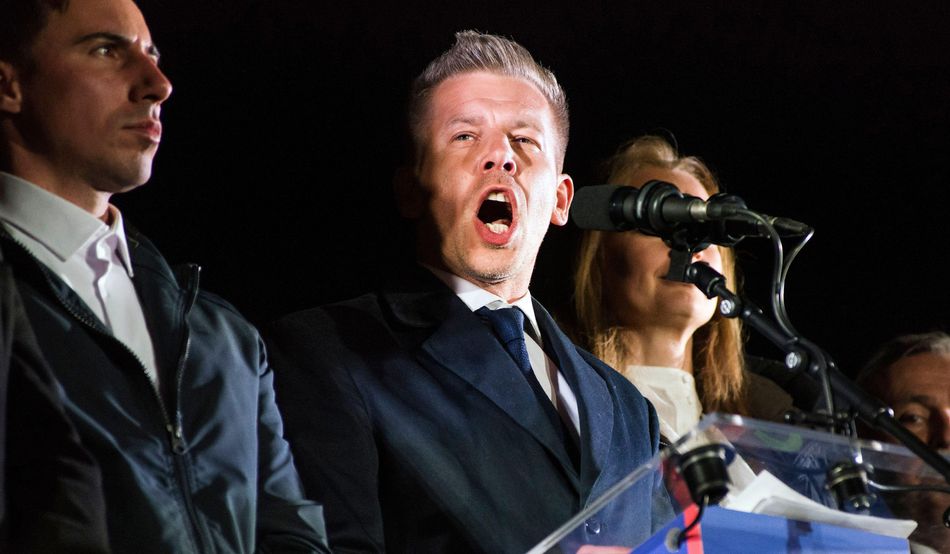
On the banks of the Danube on Sunday night, the leader of the new Tisza party and the next prime minister of Hungary, Péter Magyar, celebrated his victory in the general election over Viktor Orbán. Orbán, who had held office since 2010, presided over what he proudly called a movement towards “an illiberal democracy” in Hungary, which in truth amounted to an illiberal turning back of democracy.
This was no ordinary election, for the reasons that Michael Ignatieff sets out here in the latest edition of Prospect and here, in conversation with Ben Clark. What do the words chosen by Hungary’s new leader reveal about what lies ahead? Below are Magyar’s first remarks after the scale of his victory became clear. They are available in full in this transcript.
We have liberated Hungary
My fellow countrymen! Hungarians! We did it! The Tisza and Hungary have won this election. Not just by a little, but by a lot. In fact, by a great deal. Together, we have ousted the Orbán regime; together, we have liberated Hungary…Our victory is visible not only from the moon, but from the window of every Hungarian home. Whether it’s the smallest mud-brick house or a high-rise apartment building, in a big city or in the countryside, it’s visible from every Hungarian window.
There are two echoes in this opening. Magyar’s line, “Our victory is visible not only from the moon…”, subverts Viktor Orbán’s pronouncement, after his 2022 election victory, that: “We won a victory so big that you can see it from the moon, and you can certainly see it from Brussels.” Magyar, a former member of the European parliament, used to live in Brussels and he has no desire to turn a moonshot into something so parochial. Indeed, later in the speech he promises closer ties to the European Union.
The second echo is in the reference to the windows of every Hungarian home. When Czechoslovakia, as it then was, shook off the Soviet Union, Václav Havel, who would serve as the last president of the country before its dissolution, gave a famous speech in which he described being able to see the houses of the nation from the air as he flew in. This is Magyar’s domesticated way of being a man of the people. The great claim of the populist Orbán was that he alone understood the minds of the people, by a process of intellectual osmosis. Magyar instead has been on a tour of the nation, actually talking to people.
The struggle ahead
Never before in the history of democratic Hungary have so many people voted, and no party has ever received such a strong mandate as Tisza… Tisza not only won this election, but all signs indicate that we will have a strong two-thirds majority in parliament. This mandate will enable the most efficient and peaceful transition.
The outgoing prime minister surprised his critics with the grace of his concession. The fear that Orbán would subvert the will of the people by clinging on to power proved to be unfounded. That said, his people are well entrenched in all the institutions of the state, so Magyar stresses the scale of the victory for good reason. This is not just triumphalism, which would be forgivable in the circumstances. It is a warning that things are going to be difficult. Magyar’s first acts were to tweet that the president—an Orbán stooge—is not fit for office and to tell the state broadcaster, live on television, that it was a propaganda machine. At his moment of triumph, he is conscious how hard the road ahead will be.
The history of the Magyars
My friends, you have brought about a miracle today; today, Hungary has made history. The Hungarian people have said “no” to deception, lies, misdirection, and betrayal. My dear friends, two years ago, a few people set out, and in the battle much like the one between David and Goliath, love triumphed—because in the end, love always triumphs. Thank you all for heeding the biblical advice not to be afraid…There have been moments of grace in Hungarian history; 1848 was such a moment, and so was 1956. And let’s declare: 12th April 2026 is now also one of them… Our country has decided: it wants to live again, it wants to be a European country once more. [The crowd begins chanting: “Russians, go home!”]
Any novelist devising this story would surely resist calling the main character “Magyar”. It sounds like an allegorical passage out of John Bunyan. But Magyar’s tour of Hungary has been a pilgrim’s progress of a sort, and he appeals here to biblical authority which is then swiftly arrogated to the great sweep of Hungarian history. It is quite a stretch to suggest that love always triumphs, in Hungary or elsewhere, but this is an important rhetorical prelude to the claim that Hungary has decided once again to embrace its destiny as a European nation. Note the tension in the claim: it is an independent choice but it is also destiny, which must in some way be the true choice.
The end of corruption
Today, the Hungarian people have decided in favour of regime change. Therefore, those who have been puppets and pillars of the system must leave public life… From now on, we will no longer be a country with no consequences. Those who have stolen from the country must be held accountable. [The crowd begins chanting: “To prison with them!”] [The] Tisza government will liberate the justice system and establish the National Asset Recovery Office, where the country’s best investigators and lawyers will work.
In the end it was the corruption that did for Orbán. The populist can defy gravity for as long as the people are prepared to believe that he serves their cause. As soon as the corruption and self-serving nature of the populist becomes plain, the spell is broken. This is a pithy summary of, and an extension of, Magyar’s central campaign theme. Rather like Keir Starmer, Magyar is a former lawyer who ran hard on due process and legal rectitude. Again, his rhetoric here echoes Havel’s from 35 years before. The rhetoric serves its purpose but it carries risks. The first is that, unless Magyar wants to waste a lot of time on a process of truth and reconciliation, he will have to tame public anger, and the second is that no politician is ever above suspicion. There is an obvious risk attached to posing as the sea-green incorruptible.
The State of the Union
My dear Fidesz-supporting compatriots! I know you are disappointed today; I know it is hard to accept defeat, especially a major and well-deserved defeat; I know you are angry with us, and with me personally, because being in the opposition is difficult. But I, Péter Magyar, promise you today that I will be your prime minister as well, and I will work to heal the wounds so that we can accept one another even when we have different views. Dear three million three hundred thousand Tisza voters! I'm asking you to begin the process of reconciliation by extending a hand to every Hungarian. From now on, there are no better or worse Hungarians, only Hungarians; from now on, this country is alive again. In the words of József Antall, “I serve, and I will serve as long as it benefits the nation.”
Suddenly Magyar sounds like Thomas Jefferson, JFK and Barack Obama, all of whom used this same formulation in their inaugural addresses. The appeal for unity is a standard device of American presidents before Trump, but not something Viktor Orbán would have said. It is an important part of Magyar’s appeal that he was himself a member of Orbán’s party, Fidesz. The retort to the defeated leader has turned out to be a palace revolution, from within the right, rather than a revival of the social democratic left. It is a salutary moment and Magyar’s final words cleverly evoke the difficulty of what will follow. His plea for unity is put in the mouth of the first democratic Hungarian prime minister after the fall of communism who forged closer ties with Europe.
Hungary is a long way from the position bequeathed to it by Antall. It will not be easy to take Hungary back towards the democratic ideal while retaining the unity of the people. But it is a notable and a welcome thing that, on the banks of the Danube on Sunday night, such a sentiment could be spoken and heard.