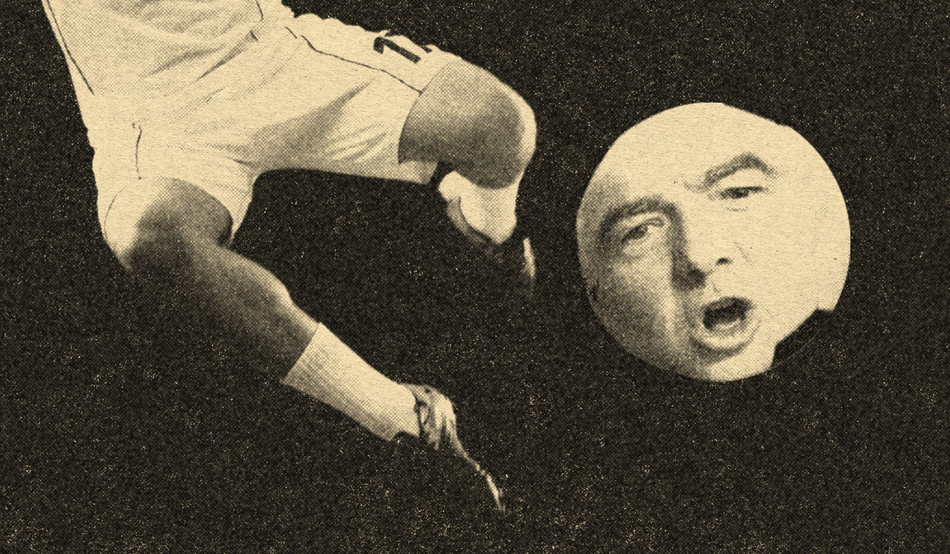
There’s a reason why Gianni Infantino, president of Fifa, appeared a lot on our screens during the World Cup. Broadcasters were, it was reported by the New Yorker and others, contractually obliged to show him once during each half and not when he was on his phone (according to Copa90 presenter Eli Mengem, this was not replicated in the stadiums due to the risk of a chorus of boos). His private jet, supplied by the Qatari government, flew in effect more than twice around the Earth to ensure his presence at matches across North America.
It can be dangerous to believe your own propaganda. Perhaps Infantino felt that the world needed more of him on its screens to alleviate our post-World Cup blues. Or perhaps his pact with the global super-rich and authoritarian states has generated such diabolical energies that he just couldn’t stop himself; thus his plan—launched just weeks after the tournament ended—to hive off Fifa’s tournament-organising work to a new company and sell off 20 per cent of that to an American venture capital company, run by Jared Kushner’s brother Joshua, for about $4bn. Somehow this would deliver even more money for Fifa, and just to show you how it would all work, Infantino was going to use that money as a time-limited $40m “no questions asked” handout to every football association in the world that backed the plan.
It appears that this farrago was cooked up entirely by Infantino and a selection of Trumpland bankers and chancers. Since then his closest adviser, who knew nothing of the scheme, has resigned; the Asian Football Confederation and Concacaf—its North and Central American and Caribbean equivalent—have condemned both plan and process; Andy Burnham has called for Infantino to step down; and many football associations, including the Welsh and English FAs, have withdrawn their support for his re-election in 2027. Most importantly, Uefa made it clear its members would boycott the World Cup if the plan goes ahead. You might have a kind of World Cup without Europe, but you won’t have any money.
Infantino has withdrawn the plan and is fighting for his political life. But whether his opponents can force an emergency Fifa congress and election on him now, rather than wait until next March, and whether they can find a candidate to defeat him, are moot points. We have been here before so many times, and in the absence of structural reform to football governance, we will be doing it all again soon.
In 1974, under the presidency of Stanley Rous, Fifa was a cottage industry: 12 full-time employees, and a president and board who received only paltry expenses. The organisation was located in an old chintzy Swiss chalet, if not cottage, on the banks of Lake Zurich. It had quaint governance and oversight arrangements to match; no external oversight, no independent presence on its committees, and just the thin skeins of Swiss law that regulated international NGOs as a legal framework.
Everything changed that year when the Brazilian João Havelange mobilised the Global South and anti-apartheid sentiment to defeat Rous, who was both a colonial relic and friend of the South African regime. Havelange, perhaps the most important person in the history of modern football, revolutionised Fifa, commercialised the World Cup, and elevated the status of the organisation and the game in global political culture. He also built a deeply embedded network of transactional politics in which tickets, committee places and eventually money were exchanged for silence, support and votes; and to top it off he normalised corruption too. The ISL scandal of the late 1990s revealed kickbacks to Fifa executives for the sale of TV rights, but because the Swiss then had no criminal offence for such bribery, there was no case to answer.
Havelange’s bag man and hand-picked successor was the impish Sepp Blatter, who during 17 years in power from 1998 to 2015 oversaw a steep rise in the money in football and in the World Cup’s value, and who then institutionalised and bureaucratised Havelange’s often highly personalised system. Blatter was brought down in 2015 by the US federal justice system, which orchestrated raids on the fancy hotels of Zurich prior to a Fifa congress, rounding up a collection of federation presidents and broadcast executives. In nearly every case the offence was outside of Fifa itself, involving kickbacks on the sale of regional TV deals, but it highlighted the organisation’s wider malfeasance: vote buying for World Cup hosting rights, and hidden payments to executives—to choose two crimes from a dozen.
In the election to replace Blatter the then little-known general secretary of Uefa, Infantino, extraordinarily, cast himself as the reform candidate. In governance terms, he has been, like his predecessors, a disaster. Power and decision-making has been massively concentrated in his office. The organisation’s executive council and wider congress are rubber-stamp operations where no debate occurs. The organisation’s internal checks and balances, such as the Fifa ethics committee, have been emasculated, and independent judges and minds banished. Hardly surprising then, that Infantino should think it within his remit to personally negotiate the break-up and sale of the World Cup, and to present it as a fait accompli and loyalty test.
If we are to break this dismal cycle of megalomania and malfeasance, there are four preconditions for change. First, Fifa has to be brought within the jurisprudential ambit of something a bit tougher than Swiss law governing NGOs. One option would be for the European Parliament and Commission to extend their acquis and build on existing alignment between Swiss and EU law to effectively cover Fifa. Despite Fifa being in Switzerland, any such agreement would still have some purchase, given Fifa’s activities in Europe—forcing a degree of external accountability and scrutiny.
Second, Fifa cannot just be composed of “representatives” of football federations. An external and independent presence on its committees and boards is the bare minimum. Third, Infantino’s proposal that Fifa might be split up in some way is not in itself a bad one. The organisation is currently, among other things, a regulator, a representative body, a tournament organiser and a development agency. Part of the problem is the conflicts of interest that produced by these diverse roles.
Finally, we come to the constituent parts of Fifa—the world’s football federations. They are, at best, a motley crew. Some are completely dominated and controlled by state institutions—a total transgression of Fifa’s own rules—but who is going to argue the toss with Pyongyang or the Chinese Communist Party on this? Some are personal fiefdoms, commandeered by a range of bullying, self-aggrandising and narcissistic politicians—or by factotums of major political figures. Nearly all are closed, opaque and unaccountable organisations with barely any oversight from government, or any input from the people who actually play and watch football.
A rare exception is the Norwegian Football Federation, where representatives of every affiliated club—not just the president and the boards—vote for the president. Consequently, you have real politics rather than phoney, transactional politics. Candidates have to articulate political positions on contentious matters, defend their arguments in public, and show a modicum of concern for their voters’ concerns and interests—not merely during the election, but while in power and when representing them in international forums. The pay-off is that Norway also has the happiest, most child-centred football culture in the world, a great elite development programme, made the quarter finals of this year’s World Cup, and has given us all the magnificent pleasure of watching Erling Haaland in full flight.
Norway has also given us Lise Klaveness, the most interesting, progressive and articulate figure in international football governance, and, as a women, a very rare and welcome presence. She has been among the most vocal trying to hold to Fifa to account from within, and many (including, incredibly, Sepp Blatter) have called for her to stand against Infantino. She has, so far, and not unreasonably, demurred.
But regardless of the fate of Infantino, what is required now is not new and better leaders, but new, better and more democratic institutions that make Fifa’s leaders accountable and that empower their constituency.