The brief hailstorm that pulverised our hire car in Switzerland was truly biblical. In the space of a few minutes it had shattered our windscreen in more than 20 places and brought traffic on the A1 outside Zurich to a standstill, with over a hundred vehicles stranded on the side of the motorway.
On seeing the damage, friends said it looked as though we’d survived an assassination attempt. And, indeed, the front window looked as if it had been sprayed with a light machine gun by a vengeful hitman.
What followed next were two instructive lessons: one about the car hire business and one about attitudes to climate change.
When you’re marooned by a motorway in a foreign country you need urgent help. Avis’s slogan through the years has been “We try harder”, but last Friday they didn’t seem to be trying very hard at all.
The so-called helpline numbers we’d been given were either wrong or unresponsive. I won’t bore you by detailing the multiple calls that went unanswered or resulted in dead ends. It was left to the Swiss police eventually to escort us off the verge and to deposit us at an anonymous Winterthur bus stop in torrential rain.
The Avis-Budget group (“we are a leading global provider of mobility solutions”) took nearly $12bn in revenue last year and paid its CEO, Brian Choi, a chunky $6m. As a mere customer, you can’t help wishing they’d invested a bit more in phone lines that work when trouble strikes.
The company’s SEC filing announces that its strategy for 2026 “remains centred on driving sustainable growth... [and] reinforcing our competitive position, delivering value to our stakeholders.” Terrific, but how about someone to, you know, answer the emergency helpline?
The filing further celebrates its “reimagined Avis website” and “a social media platform which allows us to engage with our customers... to drive customer loyalty.” Which sounds extremely promising, except that when I contacted its social media account to flag our precarious predicament it took their crack team the best part of 11 hours to respond.
Perhaps there’s a problem with morale in the US operation, which seems to be responsible for handling the X account? The SEC filing boasts: “In our Americas segment, the majority of our employees are at-will employees and, therefore, not subject to any type of employment contract or agreement.” I think that means that Avis can fire any employee at any time for any reason, or none. Which must put a spring in the step as you traipse into the office.
Reading the corporate filings, I was reminded of a famous 2007 piece by the American commentator Michael Kinsley, in which he looked at the 17 or 18 times Avis had been sold or reorganised since 1946. Each transaction generated fees for bankers and lawyers, executive bonuses, and a new theory about why the latest ownership structure was essential. “Modern capitalism has two parts,” he concluded. “There’s business, and there’s finance. Business is renting you a car at the airport. Finance is something else.”
In such organisations the customer must sometimes feel like an irritant.
Later in the day—once safely off the motorway and on a 27-hour journey back to London—I posted the picture of the dramatically shattered windscreen, together with a glancing reference to climate change. Which is when the heavens truly opened.
Firstly, I was told off for moaning about first-world problems, which was fair enough. But I was quite startled by the number of those who not only dismissed any possibility of a link between giant car-destroying 8mm hailstones in Zurich and the broader crisis of our rapidly changing climate.
I agree there may or may not be a connection. Hail has, after all, been a feature of life since the Book of Revelations. But it’s strange that suggesting a link between any extreme weather events today and global warming should make people quite so foamingly cross.
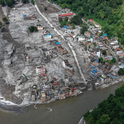
Forget my own minor misadventure, and look at the response to the recent catastrophic floods in Nepal. Most people seemed to accept that climate change might well have been a factor in the massive glacier collapse that caused the water levels on the Trishuli River to rise by as much as 27 feet in just half an hour.
Equally, there was a diehard bunch of culture warriors on standby to mock and denigrate anyone making the causal connection. Landslides and avalanches have—so the argument goes—happened in the Himalayas for millions of years. The climate alarmists are spouting bullshit. (This is a moderate paraphrase of the truly angry stuff that’s been generated in the past few days if you go looking for it.)
Same story with the warmest summer on record. Most people accept the overwhelming scientific consensus that links climate change with this century’s five warmest summers since records began. But, gosh, that drives the deniers and sceptics quite crazy.
Talking of crazy, for many years the leading loony voice on climate was the Spectator’s TV critic, James Delingpole, whose byline frequently graced numerous right-wing publications as he gushed nonsense about climate change. It was, he pronounced, “a bankrupt theory”. “A con job.” “ The biggest scam in the history of the world.” And so on.
I had imagined that editors had quietly decided that Delingpole had no idea what he was talking about, and that he should stick to reviewing midweek ITV dramas. But, no, a fortnight ago he was given 1,100 words by Michael Gove to pronounce that we should ignore the Met Office and the pattern of boiling hot summers. Climate change is still all a myth and he, Delingpole, with his BA (Oxon) in English literature, knows better than all the scientists in the world who see things differently.
He has allies at the Spectator, which also gave 1,000 words to Matt Ridley to rubbish the thought that global warming might have anything to do with the tragedy in Nepal. Ridley’s doctorate concerned the mating systems of the common pheasant. But then his editor is famously impatient with experts.
Don’t believe the scientists? Then how about the bosses of just about every insurance company on the planet—the ones who are actually shelling out money to compensate people for their climate-related losses. Munich Re, one of the largest reinsurance businesses, is quite explicit in linking the increasing pattern of storms, flooding and wildfire with mounting payouts.
The Avis SEC filing mentions climate change just once, in its “risk” section. It appears to be much more concerned about reputational risk, particularly “negative claims or publicity regarding our Company or our operations.” And why would it worry about that? “Damage to our reputation or brands could adversely impact our revenue and profitability.”
Well, we wouldn’t want that. But it would be nice if Avis really did try harder on behalf of customers in need, as well as investors. And if, every time there is a freak weather event, the Delingpole tendency suppressed the instinct to spew indignant hogwash. Whisper it, but climate change may actually be real. Even if it was—or wasn’t—blameless for ruining the end of my holiday.