“We drove here all the way from Glasgow,” said the lead singer of one of the bands at the FolkEast festival in Suffolk last month. “We heard you’ve been having much better weather than us, so we’re seeing this as our summer holiday.”
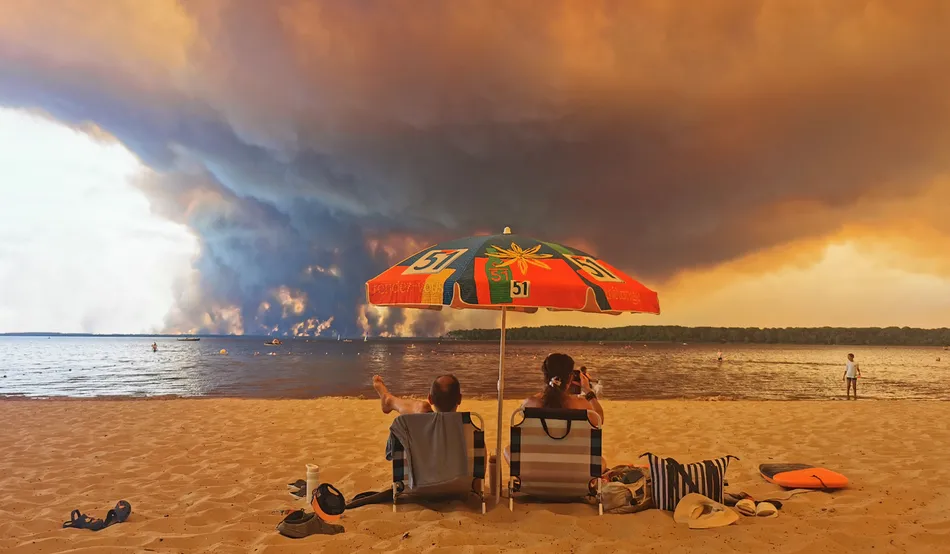
The crowd was silent; a few people looked down, or winced. A gentle quip about Scottish weather landed differently than it would have even a year ago, as much of England struggled to the end of a drought that saw thousands of people die, crops wither, water supplies threatened, and wildfires destroy houses and much-loved places—including, at the end of July, at Dunwich Heath, its smoke visible from my home. “Bad weather” used to mean rain. It doesn’t feel like that any more.
My diary for 10th June begins, “More thunder and rain! I got caught out in it on the Aldringham walk.” It was the last we’d have for nearly seven weeks, at which point there was a brief shower and then nothing again for a further three. At the end of June I describe heading west for book events and signings and getting stuck on trains without air-con in 37°C heat.
The third heatwave out of five comes a week into July, at which point I begin to worry seriously about my local wildlife. Slowly, from that point, the diary grows in fretfulness and then desperation as the sun hammers down, wildflowers stop blooming, trees drop their leaves and branches, and the ponds that dot the sandy Suffolk landscape, so crucial for wildlife, disappear.
In his classic 1949 book A Sand County Almanac the American ecologist and conservationist Aldo Leopold wrote that “to receive an ecological education is to live alone in a world of wounds”. This summer, I have wished I knew less about the suffering going on around me.
It has been difficult to bear: the unfeathered swallow chicks my friend tried to save that launched themselves repeatedly out of an unsurvivably hot nest; the hedgehogs, some pregnant, dying of thirst and exhaustion; the moles I see on social media, starving and dehydrated, running about desperately above ground and captioned with heart-eye emojis by people unaware of their plight.
Then there are the billions of insect eggs, larvae and adults killed by heat and by fire; the birds, shrews, reptiles and amphibians that won’t have enough invertebrates to eat next year, and the larger mammals and raptors that rely on them in turn. The reduction in flowers and in their nectar content because of the dry conditions, starving pollinating insects; the hedgerow fruit coming early, dropping unripe to the ground or not appearing at all, which won’t feed the huge flocks of wintering birds that arrive each autumn.
All of it rippling out and up, adding to the galloping losses that aggregate year on year: a 59 per cent drop in the UK’s flying insects between 2021 and 2025 and an average drop in species abundance of 19 per cent since 1970. So much is disappearing around us, the process hastened horribly by each successive drought. And with some weather models predicting an even hotter 2027, the forecast for many individual creatures, habitats and less resilient species is bleak.
There’s a grief that comes with bearing witness, but despair is something I can’t afford—not least because there are things I can do to help. All summer I’ve kept three low dishes of clean water topped up in my garden, which has helped the local house sparrows—a species on the Red List of Birds of Conservation Concern—raise three broods this year. I set up water stations in the village for hedgehogs, rabbits, foxes and anything else passing; deer and adult birds can travel to seek out water, but other creatures can’t. Wasps visited the dishes in great numbers and carried water to their underground nests. Some of those nests were dug out and the larvae eaten by our local badgers when their usual diet of worms and beetles vanished. Wasps are also a key food for dragonflies, which feed hobby falcons in turn.
In my garden, I focused on keeping nectar-producing plants and those valuable to wildlife going; next year I’ll replace what doesn’t recover with drought-tolerant species like wild carrot, yarrow and viper’s bugloss. I poured grey water from my kitchen and bathroom along the base of a hedge where the sparrows roost, and a molehill appeared there, its architect drawn to the damp soil and the worms it was able to retain. As I write I can see bees visiting the flowering Japanese anemone I’ve been giving the dirty bird-bath water to. I’m leaving the hips on all the roses for birds to eat, and I won’t be foraging for wild fruit this autumn: there isn’t enough to go around.
In the last week or so we’ve had 11mm of rain—nowhere near enough to fill the ponds or end the drought, but a relief all the same. On a grey and blessedly cool day I go to fill up my water stations. One of my neighbours says, “I hope the sun comes back before the end of the holidays, don’t you?”