I plunge my hand deep into our miniature pond to scoop some mud and water into my little sample pot. The water is winter cold and, apart from a few blood worms and a charcoal-coloured snail, it looks inert to my eye. On the way back into the house, I pick up a piece of moss that’s dropped from the roof and which I’ll soak for another sample. The world is in the palm of my hand: likely species from each of the animal kingdoms. Plantae, animalia, fungi, protista and prokaryotae.
I plug in the microscope and use a pipette to suck up drops of the water to transfer onto a petri dish. Switch on the light, focus the dials and descend.
The first animal I see is a rotifer. Imagine the snuffle of Mr Snuffleupagus—from Sesame Street—but pellucid and moving a little like a caterpillar. I zoom in to see its head—a crown with two wheels, like a jester’s hat, or the spiral-saw jaw of the long-extinct Helicoprion, spinning rapidly. Ciliates travel here and there, sacks of emerald, one pale orange with a bright red dot. These abundant, single-celled organisms look intentional, busy, as if running errands. Smaller ciliates move faster and randomly, hurtling, vagabonding across the landscape, like deflating balloons. Ooh. That’s strange. I zoom in. It’s a round spiked ball, like a medieval morning star; two of them, actually. Stunningly beautiful. Perhaps they’re diatoms. I make a mental note to try and find out later. Nematode worms—thin, see-through—thrash vigorously, as if trying to escape. I roam over hills and dales of sediment and algae, seeking claws that belong, I think, to the most interesting and mind-expanding animal in the microcosmos.
I try another drop of water. A stentor! Beautiful trumpet-shaped ciliate. Keep roaming, roaming. More nematodes, rotifers. Maybe it isn’t my lucky day.
Hold on, what’s that orange thing? Four pairs of legs. Claws. Pawing. Two black eyes. Gotcha! The animal is clambering around a piece of algae, moving so like a mammal that it’s no wonder the first person to officially record these creatures—the 18th-century German pastor Johann August Ephraim Goeze—called them kleiner Wasserbär, or “little water bears”.
Around 250 years later, you will no doubt have heard about water bears, or moss piglets, or tardigrades, to give them their scientific name. You might have even seen what they look like.
My introduction to tardigrades came with images I saw online, taken through a scanning electron microscope. I was immediately obsessed by the strange cuteness of a miniature bear with long stiletto nails and a mouth like a hoover bag. How could you not be? It gets better: tardigrades, I soon learned, live everywhere, hitch rides on snails or the feet of birds, can fluoresce blue to protect themselves. You need to watch a video to really understand their majesty—they plod, moving their heads from side to side (tardigrade comes from the Latin for “slow walker”).
Internet memes about tardigrades have proliferated over the years, often responding to stories about how supposedly indestructible and immortal these “extremophiles” (organisms who live in conditions inhospitable to most living things) are. Scientists—and space agencies such as Nasa—have subjected tardigrades to increasingly extreme challenges: high levels of radiation, noxious chemicals, high pressures, the vacuum of outer space, solar radiation, supposedly quantum entanglement and impacts at great speeds. Some have even ended up—accidentally, it seems—on the moon (survival unlikely).
Today, on Instagram and other platforms, you can easily find incredible footage of tardigrades and other beings in the microcosmos, often with millions of views.
Tardigrades have become a symbol of resilience and survival in the popular consciousness and, at our time of instability and ecological crises, a site on which human fears and fantasies are projected. Some people revel in their badass survival capacities (“Why Tardigrades Are IMPOSSIBLE To Kill”), while other memes are more along the lines of: “Just Because I Can Survive Harsh Conditions Doesn’t Mean I Should Have To.”
Tardigrades are invertebrates, closely related to arthropods, but in their own distinct taxonomic group, or phylum. There are around 1,800 known species, and they live all over the world, in bits of moss or lichen near wherever you are reading this, in oceans, rivers, deserts, Antarctica, hot springs, caves. Some tardigrade species are cosmopolitan, which doesn’t mean they carry handbags and drink cocktails; it means they live everywhere. Few are visible to the naked eye: on average, adults are between 250 to 500 micrometres long (a quarter to a half of a millimetre).
If you have access to a fairly ordinary microscope, you can easily watch one; just look up a guide online. They vary in colour—white, red, orange, yellow, green or purple—or can even be transparent. They are aquatic but mostly don’t swim. They eat plants, algae, sometimes rotifers and other tardigrades (but not in their own species). We know little about their evolution—the branch they sit on is just tardigrades—but they have lived on Earth for about half a billion years.
In comparison to other microorganisms, tardigrades look surprisingly complex. With respect to the nematode, it is, well, a worm, while tardigrades have a centralised brain, nervous system, guts, ovaries, legs and eyes, and look like pigs or bears or manatees with legs, rather than alien-like ball-pits or tubes. They have a distinct lumbering gait, shuffling their legs as they move. Some gallop. Some spin around algae wheels. Some marine species have suckers on their toes to cling to sand. Others have claws with extra spines and spurs.
Some tardigrade species carry their eggs around in a pouch, or kind of sac, on their backside, before the baby tardigrades—possibly even cuter than their adults—emerge. Some tardigrades lay their eggs in the exuviae, or exoskeleton remains, of water fleas. They reproduce sexually, or asexually, through parthenogenesis.
Tardigrades’ reputation as the great survivors comes from their ability to enter a “tun” state, or cryptobiosis, a mindboggling blur between life and death, in which they lower their metabolism rate to 0.01 per cent.
Some species—those that live, say, in clumps of moss on your roof or gutters—will frequently swing between active and tun states, depending on how wet or dry the weather. As a moss habitat dries and water evaporates, the tardigrade also dries out, folding itself up, retracting its legs and suspending itself until water comes along again and the sleeping beauty awakes and crawls off. Different tun states occur in response to temperature changes. In this completely dessicated state, the animal isn’t behaving in ways that would signal aliveness, but it can withstand insults: atmospheric pressure, freezing to -272.95°C, temperatures as high as 150°C, solar radiation. This extraordinary suspension of life as we know it challenges the idea of a hard boundary between life and death.
The research world of tardigrades, though global, is small and the number of scientific mysteries is high, as are the philosophical questions they generate—does using 0.01 per cent of energy mean that a being is still alive? Should we send tardigrades, or other life forms that might survive, to other planets? Or, in other words: is space ours to colonise? What is the moral status of sentient animals, even if we can’t see them? What can we learn about life, death and survival from the tardigrade?
Diane Nelson, a leading tardigrade biologist, or tardigradologist, got started with water bears in 1969. She was working on her doctorate at the University of Tennessee and her professor set the students to work on a project about minor groups of invertebrates. He went through the list of species and said, “We’ll skip tardigrades, because nobody’s been able to find one around here.”
But Nelson said she knew of a local man who worked for the fisheries department who had seen them.
She found out where the guy lived, knocked on his door and asked if he’d help her. He grabbed some moss from a big oak tree outside his house and they went to a lab, where he soaked it in water. With a microscope, they began to search for things that were moving.
“And then this little tardigrade came walking along, and he looked up at me, and it was just love at first sight,” she says. She started looking for tardigrades in different places, realised they were utterly abundant, and went back to tell her professor.
“Well, you may have them up there in Roan Mountain, but we don’t have any here in Knoxville,” he said. To which she replied: “You’ve got them on that tree out in the parking lot.”
Nelson went out, scraped a little moss, soaked it in water, showed him one, and he said—long dramatic pause—“Did you put that there?”
We still don’t know exactly how long they live for or how such complex animals exist
Nelson, now retired, 81 years old and speaking from Mexico, completed her doctorate on an ecological study of water bears on Roan Mountain at different elevations. Back in the early 1970s, people thought tardigrades were limited in where they lived, and only 800 of the now 1,800 known species had been identified. Nelson thinks the true number will be 10 times as many.
“People had never heard of them. They didn’t know why anybody would want to study them because, you know, what good are they?” she tells me. “But those are all of the reasons to study them.”
It’s still quite difficult to identify tardigrade species, even with new molecular techniques. But Nelson says that there has been an “explosion of knowledge” since the 1970s, augmented through a half-century of tardigrade conferences and symposiums, and an international community of scientists working together, driven by curiosity and the sheer love of water bears.
Now we know that tardigrades live from the depths of the oceans to the highest mountains. They can dry up and be blown on the wind, even across the sea, just as desert sand can travel from the Sahara to North America. But we still don’t know exactly how long they live for, how many cells they have, or how on earth such sophisticated and complex animals exist with seemingly few neurons or nerve cells (humans have 86bn neurons, tardigrades around 300 to 500).
But pioneering work by scientists, such as the Japan-based tardigradologist Ana Lyons, might be changing that.
In 2005, Ana Lyons was a high school student living in a small village in Michigan, planning what to do for a science fair project. She pulled a book off the shelf at her local library that would change the course of her life. It had a bright cobalt blue cover and was called Ecology and Classification of North American Freshwater Invertebrates. The cover was an image of a tardigrade with armoured plates, whiskers on its back known as “cilia”, luminous eyes and very pronounced claws. “It looked a little bit like an alien,” she remembers. “But then I saw the scale bar and saw this thing was actually microscopic.”
She started reading the chapter on tardigrades, struck that an animal so miniature could have eye spots, different organs and tissue types. “I just didn’t realise that it existed, and that really captivated me.”
The author of the chapter and the photographer of the iconic image? Diane Nelson, with whom Lyons began to correspond, aged 15 or so, as she started to find tardigrades in her garden. Nelson soon became a scientific mentor, inviting Lyons to spend a week in her lab to learn how to study tardigrades. The young scientist would go on to discover a new species of tardigrade in Michigan, work as a middle school science teacher and in a prison, and then travel the world as a scientist, studying tardigrades in various international labs and through different lenses: biodiversity, comparative physiology, molecular biology, philosophy and now systems neuroscience.
Lyons was working at the Hebrew University of Jerusalem, studying what happens to tardigrades when they are frozen, when something happened to entice her from molecular biology and into neuroscience. “We were able to visualise and see that the tardigrade’s body actually internally freezes,” she says. “But then we removed the ice, we thawed the sample and, within seconds, the tardigrade was able to move its limbs and walk away. I was struck that the tardigrade ran in the direction that was opposite to where the ice encapsulated it from. So it made me really curious: is it able to sense the thermal gradient? It’s really impressive that such a small animal would be able to do that. And then I thought: did it have any type of working memory about this, maybe even a very small form of metacognition, telling it, ‘Something very dangerous just happened to me. I need to go in the opposite way’?”
Lyons had already observed that some tardigrades seemed more averse and cautious, while others were more curious about different stimuli—and some even seemed to react to what was happening to another animal.
One of the main techniques used in Lyons’s current work with Yuka Iwasaki’s lab at RIKEN, Japan’s largest research institute, and Kazuharu Arakawa’s lab at Keio University, also in Japan, is genetically engineering tardigrades, which involves making a small injection into their abdomens. Some animals would climb onto the needle, as if “it was a tightrope in a circus”, but others were not keen at all and would run away. Fascinatingly, some tardigrades would try and scarper “if they notice one near them being injected”.
“I don’t know—this is me speculating—if, when tardigrades are injected, they release a stress pheromone,” says Lyons.
Over 20 years, she has seen how tardigrades avoid high temperatures or other stimulants that are harmful. They seem to perceive and react to their environment, perhaps through chemical cues, or their eyes, which we don’t really know much about.
The science of tardigrades could translate into solutions for human medical problems
“They also have these claws, and you can position things in front of them so that they’ll grasp it,” she says. “I know that I’m a giant organism, and they’re a microscopic organism, but it does feel like you’re interacting with them.”
I can believe it. I’ve only watched tardigrades in an amateur way at home, but they really look like mammals, teddies; in some way, us. It’s no surprise there are a lot of plush soft toys made in the shape of tardigrades, not to mention the keyrings, artworks, songs and tattoos.
The question of whether tardigrades feel pain divides researchers. “I think tardigrades have a certain type of sentience that living organisms have,” says Lyons. “They perceive their world in whatever level is necessary for their survival. So when people ask me, ‘Can they feel pain?’ I would say: yes.” Consequently, she advocates for the use of anaesthetic before carrying out any invasive or painful procedures on tardigrades, and that scientists treat them with care
Lyons is currently building tools and concepts for tardigrades to become a new model organism in neuroscience, to help scientists think about how animals sense their environments, how they model behaviour and what drives memory and behaviour. In short, how does the tardigrade’s tiny brain do so much?
Traditionally, the “workhorses” of this area of neuroscience have been the C elegans nematode worm (useful for the study of learning and memory) and Drosophila melanogaster, the fruit fly (to study genetics and behaviour). But Lyons and her fellow tardigradologists posit that tardigrades could be an important new model organism. “Tardigrades are very small and streamlined, like C elegans. But the tardigrades likely do more complex, maybe even more cognitive, behaviours.”
When we talked, Lyons brought up a screen with a tardigrade moving its head from side to side and which suddenly shifted into bright fluorescent green at various places in its body. The green is a molecular lantern called GCaMP, a genetically encoded calcium indicator, which allows scientists to see when neurons or other specialised cell types are active in real-time. Every time a muscle is activated, it glows brighter green. This pioneering technique, first implemented in tardigrades by Sae Tanaka and colleagues in Japan, is helping Lyons and the team understand both the basic neuroanatomy of tardigrades as a model organism and also their characteristic behaviours.
“The big thing that will be transformative for behavioural neuroscience is bridging the two: neural activity and behaviour, ” she says. “Because here we have an animal that’s tiny, but complex. They can manipulate their limbs to go over this difficult terrain, which I don’t even think I can do with 80bn neurons. Sometimes they’ll even crawl on the back of predators to try to evade them, which is pretty cool.”
The science of tardigrades might well offer findings on general principles of neural architecture or foundational biology, and could even translate into solutions for human medical problems. Studying tardigrade neurons could give insight into how to protect human brains from damage caused by radiation during cancer treatment, for example, or how low temperatures might be used to delay brain injury or disease. “By tweaking tardigrade genes to mimic diseases like Parkinson’s, we can study how networks of neural changes affect movement,” Lyons says.
Tardigrades, however, just like all life forms, are facing the challenge of a warming planet. Their Achilles’ heel, as Lyons put it, is heat, and most tardigrade species stop functioning and die at around 35°C. Of course, they also require different environmental aspects to survive—shade, trees, moss and natural habits—and so suffer from continual habitat destruction.
And they’re not actually extremophiles. “Tardigrades are rather ‘extremotolerant’ and usually only while in their dormant states. People have the misconception that tardigrades aren’t sensitive, but they’re very sensitive to their environment. That’s why they can prepare and survive and respond,” says Lyons. “Tardigrades have survived several mass extinction events, but I do feel concerned that, you know, there are limits.”
Back at mine, under the microscope, I watch as a tiny orange tardigrade begins to wake up, curved claws pawing, coming back to life. An enormous water flea zips across the screen.
Tardigrades are one of those groups of animals that suggests we don’t actually know that much. I think of the response Lyons gets when she talks to physicists and biologists about these creatures. The physicist cannot believe something so microscopic, that lives alongside single-celled microorganisms, might have more than 1,000 cells; the biologist cannot believe that an animal that can seemingly do everything has only around 1,000 cells.
At our time of human exceptionalism, chauvinism and ecological destruction, the tardigrade might offer us a needed humbling—and perhaps we can learn something from the way they survive.
“Resilience in nature isn’t brute strength; it’s flexibility, memory and timing,” says Lyons. “They remind us that some of the most resilient forms of life exist in the smallest pockets of habitat.”
Even if the scale is microscopic and the communities of life are unseen to human eyes, the tardigrade animates the small and unseen, suggesting that an ethic of care is required in even the tiniest, hidden habitats. If we know more about tardigrades, and love them—and how could you not? —we might protect the trees, the moss, the lichen and the waters in which they live.
Microscopy has become more popular than ever in recent years, especially with the growing accessibility of the technology used to capture and share footage on social media. I got into it during one of the pandemic lockdowns as a way to learn and see, when our own movement was constrained.
Tardigrades “remind us that some of the most resilient forms of life exist in the smallest pockets of habitat”
Since then, it has brought the world to life in an astonishing way. I look out at my town garden knowing that—even when it appears dreary and bleak—there are thousands, perhaps millions, of microfauna bumbling around, going about their business, hitching a ride on a worm or a snail, eating each other, balancing on algae balls, forming a crucial layer of the food web we all rely upon. It’s the same feeling I’ve had at the top of a mountain or seeing the back of a blue whale. Awe and wonder, but right there. A bountiful jungle in a drop of water you might wipe away on your trousers.
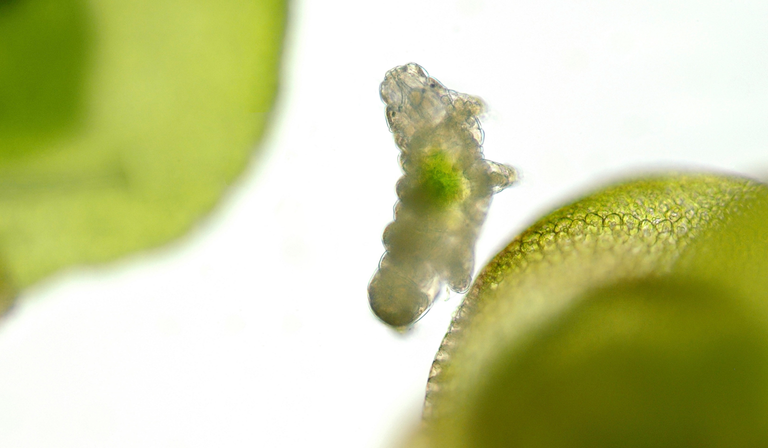
I know I should be writing this piece, but I tell myself I can look at just one more clump of moss. Lots have fallen off the roof and onto a paved bit just outside the back door. I take a small cushion from the ground, soaked wet from the heavy rain. I pipette the water and sediment into my petri dish and see, quickly, around 20 tardigrades, all different sizes, mostly light orange, but one that is transparent with a bright WhatsApp-green coloured stomach. It’s huge and active, with prominent eye spots, waving its little claws around, exploring a ribbon of algae. I show the tardigrades to my young children, and for days afterwards they draw the animals in all sorts of colours, create cartoons and stories about them.
Oh, and the exquisite, spiked globes that I saw, thinking they were diatoms? They were tardigrade eggs.