The student’s face was purple with rage as he pointed at a book on the desk. “How dare you?” he spluttered. “How dare you?”
It was March 1975. We were in a student dormitory at Fudan University in Shanghai.
The offending book was an edition of Mao Zedong’s speeches collected and published by the eminent sinologist, the late Stuart Schram.
The speeches had yet to be officially released, which I was guessing was the cause of the student’s indignation. It turned out he was not pointing to the book’s content, however, but to its cover: a close-cropped image of Mao’s face, taken from a contemporary Chinese poster.
I was mystified.
“It’s Chairman Mao,” I said.
“Yes,” he spluttered, “But where are his ears? You have cut off his ears! You would never dare to do that to your leaders!”
As it happened, I had in my drawer a copy of a recent issue of Private Eye posted to me by a friend back in the UK. On the cover was an image of a stripper with the head of the prime minister, Edward Heath, alongside a caption that read: “If it’s a woman you want, I’m your man.” It was a satirical reference to the Conservative party leadership contest going on between Heath and Margaret Thatcher.
For a brief moment I contemplated showing the cover to this enraged Chinese student, but decided discretion was the safer option. Nothing would have persuaded him that Mao had not been deliberately insulted by Schram and his villainous publisher.
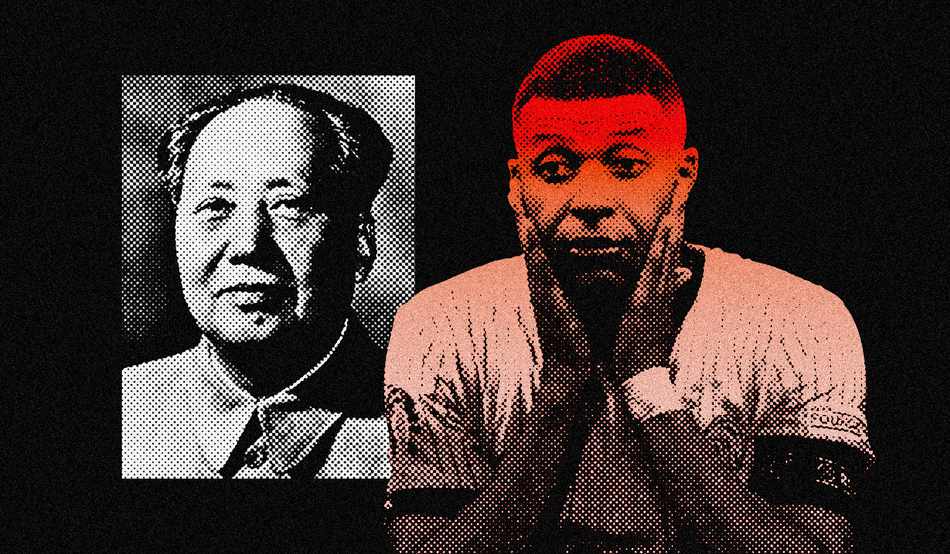
I was reminded of this distant episode by the news going around this week of the French footballer Kylian Mbappé, who has experienced his own bruising encounter with China’s peculiar sensibilities over the long dead Mao Zedong.
Long before even the World Cup this summer, memes have been circulating online showing Mbappé’s face superimposed on an image of Mao’s body. It is meant to be an allusion to how the footballer’s star status supposedly grants him unquestionable authority over his teammates at Real Madrid. Fans have also put his face on the body of Stalin, for example, or shown him decked out in military regalia.
The real offence wasn’t the image itself, however, but Mbappé’s response to it. In a clip from a recent interview discussing the meme, he appeared to have no idea who Mao Zedong was, beyond giving him the not inaccurate descriptor as a “Chinese dictator”.
As far as Mbappé was concerned it was he, not Mao, who was the butt of the joke. Yet thanks to that one throwaway comment his lucrative celebrity in China is in tatters. Brands have ditched him. He has been mauled on Chinese social media. The state broadcaster suspended broadcast of La Liga matches. In a hasty damage-limitation exercise, Mbappé has been obliged to offer a grovelling apology to the entire Chinese people.
It may be of little consolation to Mbappé as he surveys his own wreckage, but this disaster is only the latest in a long line of incidents in which foreigners have breached the limits of Official China’s sense of humour, particularly when it comes to the dignity of its leaders on the world stage.
Breaching this limit is not particularly difficult, although neither is it uncommon for slights to be perceived when none are intended. In 2010, one of Britain’s most pro-Chinese prime ministers, David Cameron, was the target of Chinese ire when he wore a poppy on his lapel during a visit to Beijing. It was November, a month in which any senior British politician spotted without a poppy risked being accused in the tabloid press of insulting the nation’s war dead.
In China, though, the poppy was seen as an intentional and humiliating reminder of the Opium Wars of the 19th century, when the declining Qing empire tried unsuccessfully to dissuade British traders from importing the narcotic to China. Cameron’s Chinese hosts reportedly asked their British visitors to leave the poppies at home, only to meet an equally firm refusal. The British explanation that wearing a commemorative poppy was unrelated to the Opium Wars fell on deaf ears.
Foreigners who do business in China are frequently offered a list of common hazards to avoid, including pitfalls associated with Chinese homonyms. These routinely cover popular superstitions—avoiding images of turtles, for example, which feature in salacious insults; or the number four in a brand name, because it sounds like the word for death; or the associated death-related hazard of white, the colour of mourning; even giving a hat as a gift or carrying chrysanthemums.
There are also political sensitivities which demand extreme caution over anything that features a map: a failure to affirm China’s claims on Taiwan can deal a near fatal blow to commercial ambitions. Approving references to the Dalai Lama are equally dangerous, as the German motor giant Mercedes Benz discovered to its cost in 2018.
Most of these blunders are avoidable with a little research, but sometimes they are impossible to anticipate. How was the late Italian filmmaker Michelangelo Antonioni to know that a shot of a barge in the foreground of the Nanjing River Bridge in his 1972 documentary Chung Kuo, Cina would trigger a national campaign of denunciation against him? His political crime, according to his highly vocal official critics, was that the barge had some laundry drying on a washing line. That image, harmless to western eyes, was seized upon as a calculated insult to the heroic Chinese workers who had laboured to complete the bridge on their own after the abrupt withdrawal of Soviet engineers in 1960, taking with them the bridge plans and essential supplies of steel. The completion of the bridge eight years later was a key element in Chinese anti-Soviet propaganda. The shot of laundered underwear in Antonioni’s film could not be allowed to undermine that triumphant message.
China does in fact have a fine satirical tradition that in more relaxed times has been richly reflected on the Chinese internet. But, as Mbappé has discovered, this is not one of those times.