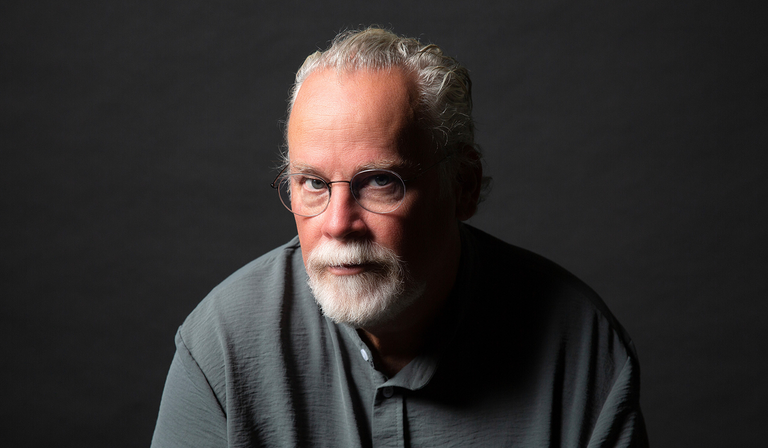
The sun hasn’t yet risen in Los Angeles when Michael Connelly first joins our call; a murky half-light is all that’s visible through the window in the background. If I’m worried I’ve forced him to wake up for our interview, there’s no need. “I’m an early person,” he tells me. “I like to start writing before the sun comes up, maybe 5am. If I sleep past that, I have a dog with a ‘clock’ who wakes me up.”
He’ll often get four hours of writing completed before he attends to any other daily business. “It gives me a little psychological edge that I got some stuff done before the world even woke up,” he says.
Those early starts have panned out pretty well. Connelly, who turns 70 this summer, has sold more than 90m books, including his Detective Hieronymus Bosch novels and The Lincoln Lawyer series, which have both been adapted for television. His latest (and 42nd) novel, Ironwood, is the second thriller with Detective Sergeant Stilwell: this one features a missing persons case and a night-time drug bust gone terribly wrong.
Other writers, from Lee Child to Stephen King, consider Connelly to be a master of crime writing. “I don’t know what the secret is,” he says. “But if you’re going to be a writer, you have to write every day, not just when you feel like it. I didn’t think ‘What do people want?’ I just wrote what I wanted to write.”
Connelly works quickly. “For me, momentum in writing translates to momentum in reading,” he says. His work ethic comes from having to meet tight deadlines when he was a crime reporter in Florida. “Because of my years as a journalist, I can get my groove on almost anywhere. They don’t have writer’s block at newspapers; I had to be able to write when I was short of time because the key headline was often my story. As they say, ‘If it bleeds, it leads.’”
That crime reporting background also helps give his novels authenticity, aided now by his “cadre of consultants”, including lawyers and “active or ex homicide investigators” whom he can text whenever he has a question.
Originally from Philadelphia, Pennsylvania, he describes reading Harper Lee’s To Kill a Mockingbird in a library at the age of 12 as a formative moment. “I had to read that to end up being a writer myself.” Decades later, it is books such as this, “books that explore gender questions, bring in religion or inter-racial subject matter”, that are often targeted in the culture wars, he says.
Connelly now divides his time between Florida and Los Angeles. He sees the leadership of President Trump and Florida governor Ron DeSantis as part of a rightward shift which has emboldened “people on committees infiltrating school boards with an idea that what people read should be controlled by [state] government”. In 2023, amid a surging number of book bans, he donated $1m to PEN America, a nonprofit for the protection of free expression and literature in the US. As a father, he is concerned about the effect of attempted censorship on young people, like his daughter: “I didn’t need someone to tell me what she could and couldn’t read.”
Passionate about protecting books and writers, Connelly is also one of nearly 20 authors, alongside John Grisham, George RR Martin and Jodi Picoult, involved in a class-action lawsuit against OpenAI for copyright infringement through their works being used to train ChatGPT. “It’s about the basic doctrine of fairness,” he explains. “I’m involved in this for all the writers who might not have the wherewithal that I do. I’m not looking for a windfall, but there should be a ‘cease and desist’ of scraping novels, or some kind of negotiation where people are compensated for their creative work.”
He doesn’t believe artificial intelligence is ready to replace writers, yet. “I’ve read some AI-created fiction, and it feels soulless. But AI will improve as years go by… With AI, if you can tailor books about characters you love, there’s going to be no publishing industry. Eventually it will all disappear—publishers, writers—and everything will be artificially created.”
But for now, Connelly—the real Connelly—will continue to get up before the sun, working on novel 43.