What happens when you no longer recognise the place you love?
Dorothy Tse’s most recent novella, City Like Water, paints an unsettling, dreamlike picture of a city overtaken by authoritarianism. A hotel where the floors are gradually sealed off, one at a time, the guests too distracted by the buffets to notice. A protest where the police turn demonstrators into lifeless bronze statues. A bookshop inhabited by roosting birds, and whose owner mysteriously disappears.
It’s a thinly veiled portrait of Hong Kong, an ode to a place Tse calls home, and which she has watched closely from within as Beijing has tightened its grip since 2014.
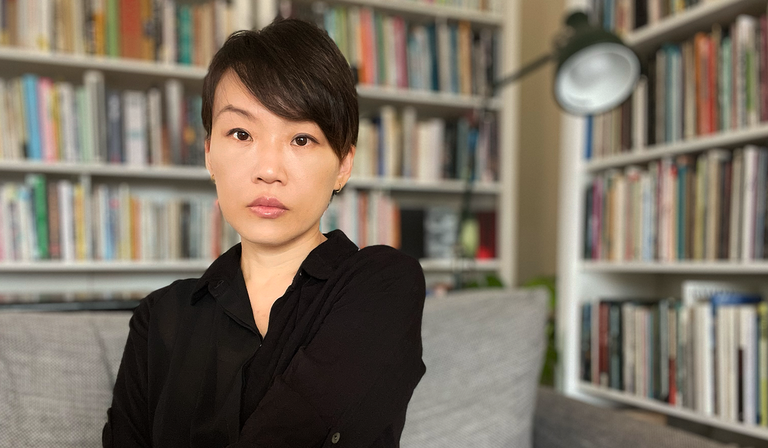
Born in Chaozhou, China, in 1977, two-year-old Tse migrated to Hong Kong with her parents in the wake of Mao’s Cultural Revolution. “My entire education and values were rooted in [Hong Kong],” she says. “I can’t imagine I would be the same person, or the same kind of writer, if I hadn’t grown up here.”
Tse is fluent in English but writes primarily in Chinese. Hong Kong’s multicultural and multilingual nature has resulted in a diverse literary scene; the city’s writers have taught her, she says, that “the most important thing in writing is to be in conversation with a larger world”.
Her own style is unsentimental, blending the surreal with mundane details, with a dark humour that undermines authority. Natascha Bruce, her Amsterdam-based translator, collaborator and friend, tells me that Tse writes “to destabilise and disorient her readers”.
The English edition of City Like Water was published this year—though Tse originally wrote it in the aftermath of the mass protests in Hong Kong between 2019 and 2020. When Tse’s work grapples with police brutality, she is likely drawing on the state’s response, including an incident in 2019 at Prince Edward station in Kowloon, during which police indiscriminately attacked passengers while arresting protesters.
I mention the case of pro-democracy businessman Jimmy Lai, who in March was sentenced to 20 years’ imprisonment for sedition and collusion with foreign forces. But Tse reminds me many others have been imprisoned, too, and many ordinary people’s lives changed: she hopes that “those who care will also pay attention to the more subtle and dynamic changes in Hong Kong beyond news headlines”.
In addition to her own writing, Tse teaches creative writing and literature at Hong Kong Baptist University, where she tells her students firstly to be adventurous and open-minded readers. “Other people’s writing has rescued me many times,” she confesses.
In 2006, Tse cofounded the literary journal Fleurs des Lettres, which is aimed at Chinese-speaking youth. A believer in the power of literary spaces, she describes a recent bloom of independent bookstores in Hong Kong, where small gatherings take place beyond “narrow alleys” and “dim staircases” and ideas are freely exchanged.
Tse invokes Foucault, suggesting that “the vulnerability of modern individuals lies in separation and distrust, much like prisoners in a panopticon... I believe the small communities formed through reading are one of the many ways people can move closer to freedom.”
The case of Hong Kong is by no means exceptional. Tse’s novella acknowledges the transformation and loss of other cities, too (“some sadnesses are so alike”, she writes). When we speak she is in Massachusetts, on tour, where readers have told her that her books resonate with their experiences of contemporary America. Her first novel, Owlish, also explored repression.
But amid war, fatigue and the abuse of power, Tse believes there are lessons. “I have learned from my fellow Hongkongers: in times of crisis and vulnerability, we need to stay connected,” she says. “We need to know that we are not alone, and that what we are going through is understandable and can be shared.”