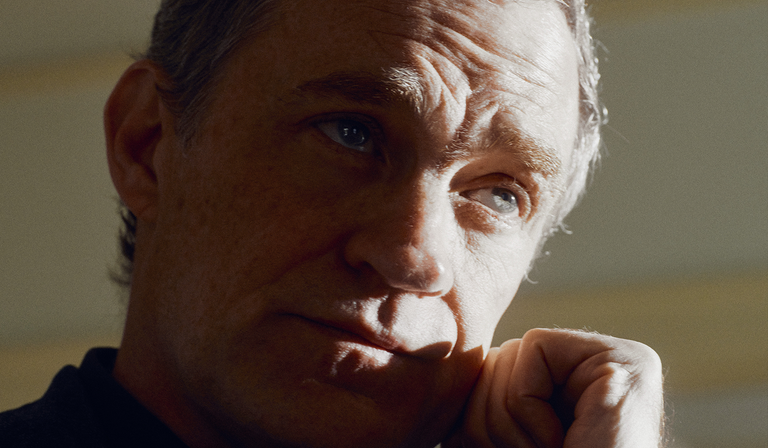
Even when Patrick Radden Keefe considers a question, he takes on the look of an interrogator working against the clock: brow furrowed, shoulders set—the focus of someone who lives off his knack for listening closely. Four acclaimed non-fiction works, covering everything from the Troubles in Northern Ireland to the crimes of Big Pharma, have established Keefe as a reporter in the mould of a Cold War intelligence man, a real-life George Smiley.
“I’m drawn to these galvanic characters,” Keefe says over video, dressed in a denim jacket that reads more workshop than newsroom. “I’ve always had the feeling there are individuals who through sheer force of will and brio could reorganise the world.” His latest book, London Falling, delves into the mystery surrounding Zac Brettler, a striving, status-hungry 19-year-old who hustled his way to a fake identity as an oligarch’s son, before falling from the balcony of a luxury apartment in 2019.
Keefe has profiled an unlikely cast of rogues over the years, including a Mexican drug lord and a vintage wine fraudster. “These people have moxie,” he says. “There’s an old axiom about dramatic writing: you need people who come into a scene wanting something.” Keefe writes about Zac’s adolescent ambition with a kind of recognition. “I remember being for many years a young aspiring writer and I had the feeling of wanting to shake your fists and say, ‘I’ll show you’.”
In an alternate reality, Keefe works as an attorney for an elite law firm in Manhattan—a job he came within a month of starting, only changing course because the New Yorker finally accepted a pitch for a story about human smuggling in Chinatown. “I don’t want to put too much weight on this anecdote,” Keefe warns, as I prepare to do just that, “but when I interned at a law firm, I remember a senior colleague telling me, ‘Oh, our clients are the bad guys’, and it hit me with the force of revelation.”
“Working in a big corporate law firm can be a subtle but I think quite grotesque moral compromise.”
As Keefe’s writing catalogues deception, explicit judgement is withheld, leaving intact his subjects’ moral opacity. “I think a lot of the time people tell lies that are like little bridges; they just want to get from here to there. We like to believe that there is moral clarity, that things will be better in your life if you tell the truth. But that’s just not true.”
His mother’s research into psychiatric conditions helped him develop a keen eye for the distance between appearance and reality. “A big part of who I am as a writer,” he says, is informed by her interest “in how people conceive of themselves”. Keefe describes his relationship with his parents as “unusually close”, but “not in a pathological way”. “They read everything I write before most other people; even this book has developed in dialogue with them.”
His formative reading experiences were mystery stories; “I read my way through Sherlock Holmes and went on to hard-boiled American crime fiction,” Keefe says.
An early love of crime fiction, though, was only part of it. At 13, he had already found his first galvanic character. “In 8th grade, our teacher asked us who our heroes were. The kids talked about their parents or the quarterback of the New England Patriots. I said Nelson Mandela.”
When that same year (1990) a family friend, the writer Rose Moss, travelled to South Africa to interview anti-apartheid activists, she took Keefe along.
“There was a lot of violence while I was there, and she was doing interviews where people were aware they were being bugged so we had to turn the radio up—the whole thing was wild.” I suggested this trip was a turning point. “Boy, that’s probably better than anything else; I watched journalism and history happening up close, there was intrigue, danger, and it had a big impact.” It’s precisely the kind of detail Keefe would seize upon—in somebody else’s story.