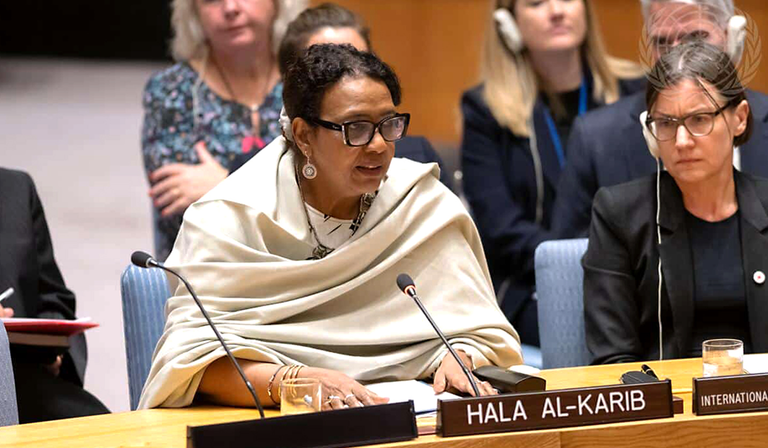
When I speak to the Sudanese women’s rights activist Hala Al-Karib, it is days after the third anniversary of the beginning of the war in Sudan.
Al-Karib has been demanding accountability throughout the war, as the regional director of the Strategic Initiative for Women in the Horn of Africa (SIHA) Network, a pan-African feminist coalition supporting survivors of conflict-related sexual violence.
There is a weary grief in our exchange of pleasantries, but her voice grows warm and nostalgic when I ask about her childhood. Born in Wad Madani, in a house by the Blue Nile which, “despite everything, is still standing”, Al-Karib hails from the lush and fertile Al-Gezira state and was raised in a bustling matriarchal household. Her highly literate grandmother owned the local mill and “most of the women in my family were working,” as schoolteachers or business owners, she says. By age nine, she was reading Russian literature alongside Islamic classics, then lining up to watch John Travolta at the local cinema on a Thursday.
Things changed drastically after 1978 with the implementation of the International Monetary Fund’s Structural Adjustment Programme, which involved currency devaluation, stringent austerity policies and privatisation. “It devastated the middle class completely,” Al-Karib recalls. “The impact was catastrophic. Public institutions lost the capacity to deliver.” She believes her generation is “probably the last” who were educated entirely via the public schooling system and were “still exposed to great teachers and facilities. The decline after that happened so fast.”
By the time Al-Karib began studying literature and psychology at Khartoum and Juba universities in the 1980s, everything was “dominated by politics”. Al-Karib remembers being ostracised by her chosen faction, the Democratic Front, for having friends from other parties. “[Politics] dictated your social life, your romantic life, everything. But I was a rebel… I couldn’t identify with this collective mindset.”
As a research assistant for an Oxford University project in the early 1990s, she investigated the plight of South Sudanese refugees violently displaced by civil war. Later, she worked with marginalised and Aboriginal communities in Canada, before returning to Sudan in the mid-2000s while a genocide was ongoing in Darfur.
Al-Karib stopped working for international organisations to join SIHA, which was then a small, indigenous African organisation. “We started from three staff and very little budget.”
During the 2019 Sudanese revolution that led to the overthrow of former president Omar Al-Bashir, Al-Karib was a leading voice, working closely with grassroots women’s groups, activists, and youth networks to call for democratic reforms and gender justice. Her organisation also provided water, food and transport to the demonstrations.
But Al-Karib is righteously angry about what followed. The 2021 coup by military leaders, which toppled the civilian-led transitional government, “revealed that the will of the people had been sold out”.
Today, SIHA works across nine countries and is dedicated to combating violence against women and girls, including by documenting crimes committed by armed forces. “Sexual violence is one of the worst forms of political violence.” It not only strips individuals of dignity, she says, but entire communities of their agency. “It is meant to crush the spirit.”
Al-Karib believes the international community must recognise its role in the current catastrophe. “The United Arab Emirates has destroyed my country,” she says, through funding the paramilitary Rapid Support Forces, while other states have stood by. Only months after the outbreak of the war, the UN Security Council voted to end a mission intended to support Sudan’s transition from dictatorship to civilian rule.
For Sudanese people, there are hardly any routes to safety. “We can only rely on each other for our survival,” Al-Karib says. As for justice, truth-telling tribunals are important, but more so is “economic reparation” from the UAE and other countries that have failed to prevent the flow of foreign arms into the region.
“We have been treated extremely brutally,” Al-Karib says. “I think Sudanese [people] will remember this for generations.”