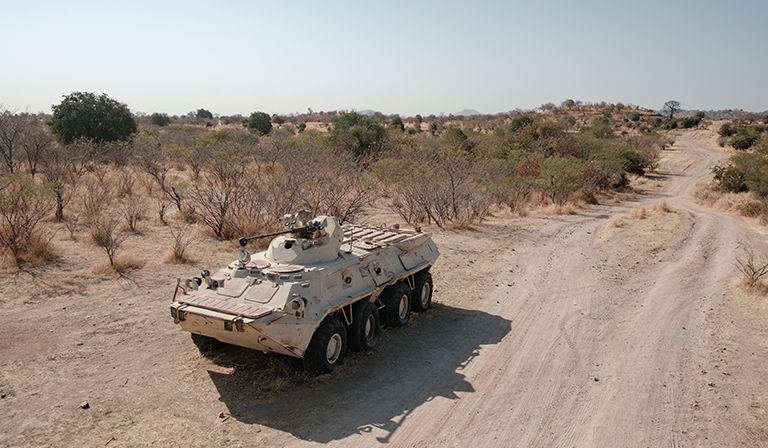
There is only one road into the Nuba Mountains: a thin ribbon of sand and rock leading towards shrubby foothills. The sky here is bleached white by heat; the air so thick with dust it smells of burning. There is no mobile signal, and news travels slowly. Neighbours gossip over shared food and cigarettes, piecing together what they can. It feels remote, cut off. But the outside world has now come to the Nuba Mountains.
What began in April 2023 as a power struggle between two generals in the Sudanese capital of Khartoum has cannibalised the country. On one side is Abdel Fattah al-Burhan, chief of the Sudanese Armed Forces (SAF), and the country’s de facto leader. On the other stands his former deputy, Mohamed Hamdan Dagalo Musa, commander of the Rapid Support Forces (RSF) and better known by the nom de guerre Hemedti, or “little Mohamed”.
When war first erupted in Sudan, the residents of the Nuba Mountains kept cattle and got on with their lives. Last year, however, the rebel movement that has long controlled these slopes announced an alliance with the RSF, drawing the region into the conflict. Hemedti’s forces now use the rugged mountains as a thoroughfare to take SAF territory in the east of the country, and ultimately to recapture the capital, Khartoum. The SAF tries to beat them back, while claiming more land for itself.
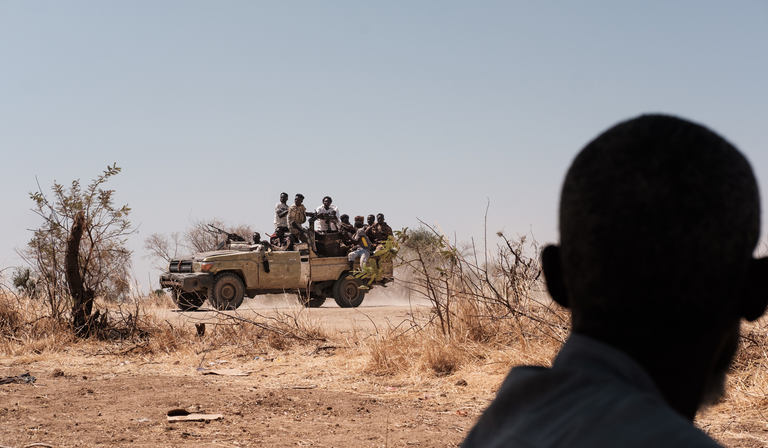
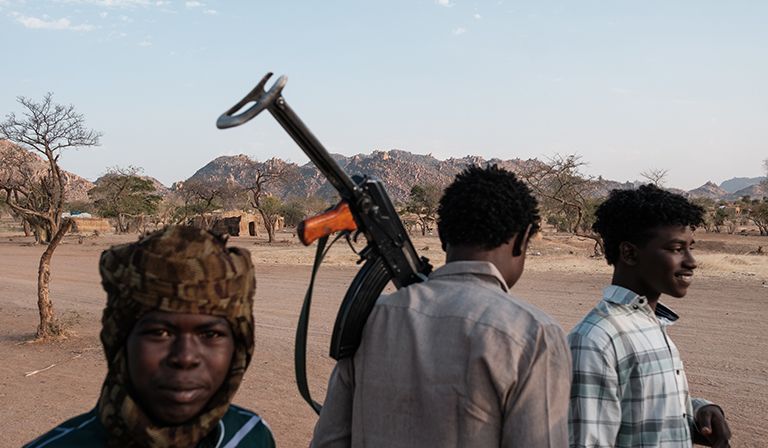
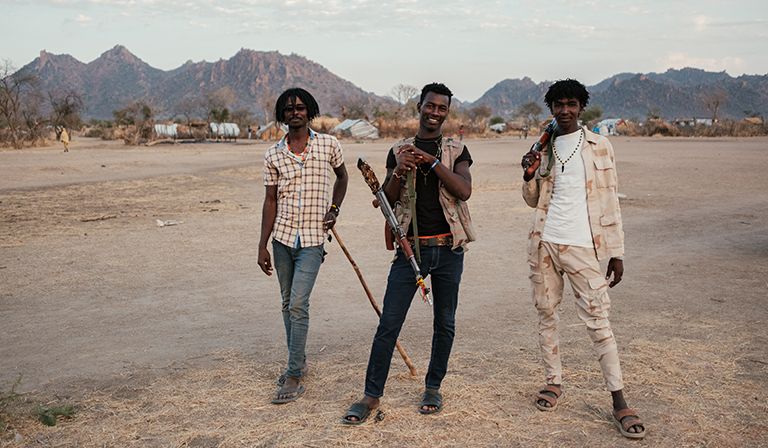
In the Nuba Mountains, RSF soldiers in tan uniforms now lounge in cafés, drinking spiced coffee with guns clasped between their thighs. As they wait to be called back to battle, the pop of gunfire and boom of artillery echo from distant hills. The periphery has become the centre, the Nuba Mountains a new frontline.
Meanwhile, in the vacuum opened by state collapse, other international powers have moved in. Egypt backs the SAF. The United Arab Emirates has been widely accused of supplying the RSF with weapons in exchange for gold. Turkey courts influence on the Red Sea. Civilians shelter in isolated displacement camps, fleeing drones provided by distant sponsors and fighters empowered by their support.
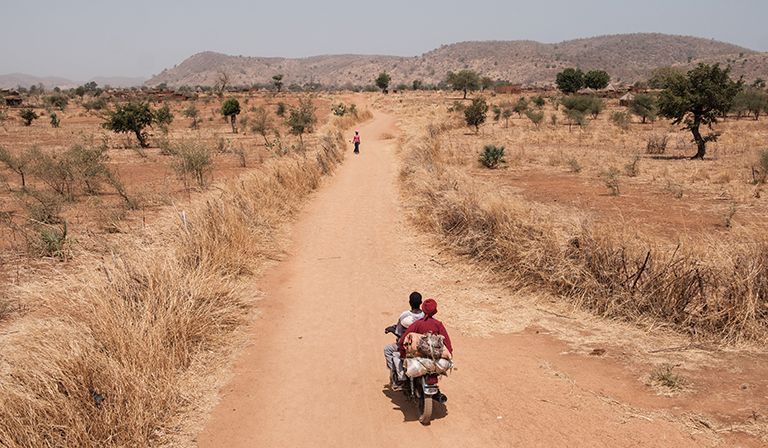
I travel to the mountains with photographer Guy Peterson. Our journey begins at a trading post in South Sudan, where refugees have massed. The border is a length of dusty rope; guards wave us over, not bothering to look at our passports. This is the territory of the Sudanese People’s Liberation Movement-North, better known by the abbreviation SPLM-N. The rebel group has governed the Nuba Mountains for decades, calling its fiefdom “New Sudan”. It has its own flag and a volunteer civil service. Representatives of this rebel government monitor our interviews as a condition of entering their territory.
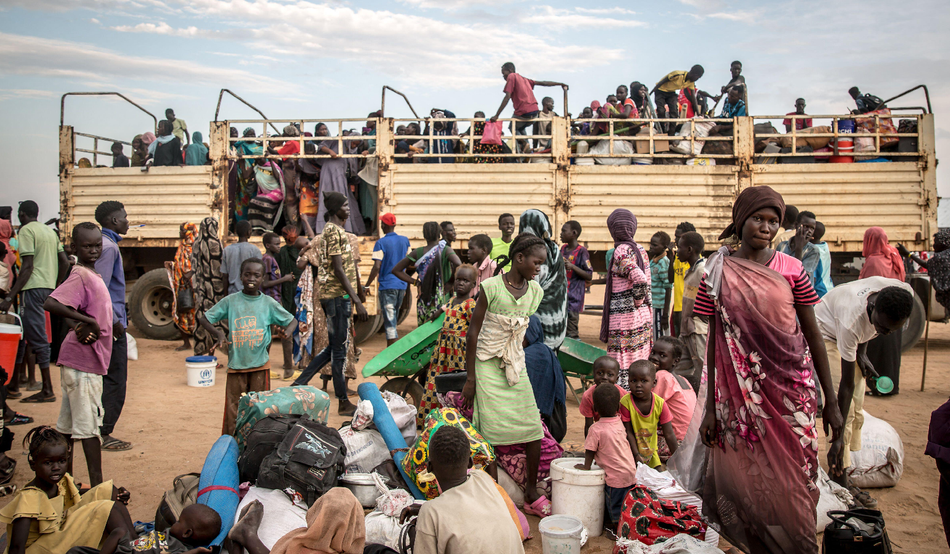
I begin my reporting in Tongoli town, Delami county, in the northern tip of the Nuba Mountains. Homeless people have strung up tarps between thorny trees to form makeshift tents. Across Sudan, some 8.8m have been internally displaced since the start of the conflict, while four million have fled to neighbouring countries. About half the population faces acute hunger.
Reminders of fighting are constant, even in moments of celebration. In one Delami displacement camp, RSF fighters join a crowd of dancers at a wedding, their weapons still slung over their backs. The alliance with SPLM-N means that this is their stomping ground.
Elsewhere in the camp, the mood is less jubilant and the memories of war fresher. In November 2025, a drone struck Afra Al Neil Hamed’s home in Ed Dubeibat. Hamed, who was four months pregnant at the time, had gone to fetch water for the family, but her husband and teenage son were still sleeping inside. She ran back at the sound of the explosion, only to find their mutilated bodies. Quickly, she took her five other children into the woods for shelter. They spent a week hiding there.
Fearing another attack from above, Hamed left Ed Dubeibat, walking out of the town with hundreds of other residents. She describes the trek in clinical terms. “I started bleeding on the road and walked for seven days,” she says. She bled from her womb. “Many women were bleeding on the journey,” she tells me. When the group reached a clinic, doctors treated Hamed to stop the bleeding and confirmed she had miscarried. Hamed blames the constant whir of drones and the fear and chaos they caused for the loss of her unborn child. She reports that more than 50 other women lost their babies in the same way as they walked towards safety.
Acute stress can increase the risk of miscarriage. The number in Gaza rose 300 per cent between October 2023 and May 2024, while the Sudan Family Planning Association also notes that rates have gone up among displaced women in Sudan since the war began. Malnutrition and lack of access to healthcare also contribute to miscarriage.
Hamed speaks softly, drinking from a cup of sugared tea. She is hungry, but there is little food. She adopted two children whose parents died in the war and must care for them alongside her own. She thinks al-Burhan’s SAF is responsible for the drone strike that killed her loved ones. But at the time her husband and son had perished, Ed Dubeibat was under government control, making the more likely culprit the same RSF soldiers now massing alongside refugees in the camp where she lives.
As the sun sets, a large group of men gathers outside Hamed’s thatched hut. Seeing my notebook, they shout angrily that Egypt must stop providing drones to the SAF. Give us “peace by any means”, a man with a scraggly beard calls out. In that instant, the interventions of foreign powers seem at once urgent and notional to residents of this remote encampment.
There was a moment of hope in April 2019, when Sudan’s long-ruling president Omar al-Bashir was toppled in a coup d’état after pro-democracy protests. The military announced a short state of emergency, to be followed by a transition to civilian rule. Residents of Khartoum took to the streets, dancing in jubilation.
Al-Burhan served as deputy head of state but refused to yield power to a waiting democratic government. In 2021, he arrested civilian leaders and consolidated control for himself, with Hemedti as his deputy. During the war in Darfur, which began in 2003, Hemedti was a commander in the Janjaweed, or “devils on horseback”, notorious for roving from village to village and slaughtering non-Arabs. They were later rebranded as the RSF, a paramilitary organisation loyal to the government. But the two generals jostled for influence after stifling the pro-democracy movement and all hope crumbled in April 2023, almost exactly four years after al-Bashir fell, when Hemedti’s RSF attacked positions belonging to al-Burhan’s SAF. War soon spread across the country.
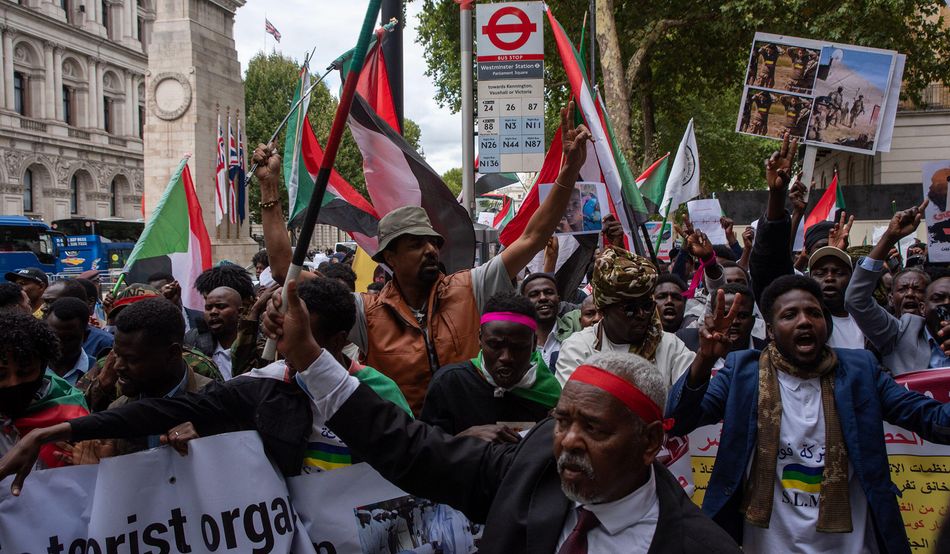
“I call it a counter-revolutionary war and I call it a war against civilians,” says Kholood Khair, a Sudanese analyst and founder of the Khartoum-based thinktank Confluence Advisory. The conflict, she explains, is happening on multiple levels. One is the competition for military control between Hemedti and al-Burhan; another is between middle powers looking to expand their own spheres of influence.
Egypt, for one, backs the SAF because it is eager to ensure friendly trade relations along the Nile River. The countries share a border, and a military government is easier for Cairo to control. It is in providing weaponry that foreign powers have the most direct impact. Some of the drones used in Sudan’s war originated from a desert military base in Egypt, according to a joint investigation by Reuters and the New York Times. Further afield, Iran and Turkey have supplied drones and other weapons to the SAF, looking for easy access to the Red Sea, which would connect them to vital commercial and military routes. Saudi Arabia supplies planes to the SAF for the same reason.
The United Arab Emirates, meanwhile, arms the RSF, while the gold that finances its fighters slips easily through UAE markets. The most dominant of the middle powers involved in Sudan’s fracas, the Emiratis are eager to project their influence across the Red Sea and East Africa. Abu Dhabi has also recruited Colombian mercenaries to fight alongside the RSF, with shadowy promises of lucrative jobs in the Gulf.
The latest phase of the war comes at a time when the United States has stepped back significantly from countries like Sudan, and international mediation is far less certain. “We are moving from a monopolar world largely defined by the US liberal order, to a multipolar order… with assertive interest by great powers, but also by middle powers,” says Ahmed Soliman, a research fellow at the Chatham House thinktank.
All these countries have denied backing armed groups in Sudan. But after three years, the war shows no sign of stopping. Grandstanding by middle powers “doesn’t just prolong the violence, but it also makes it very complicated for a political settlement to come in,” explains Emadeddin Badi, a senior fellow at the Global Initiative Against Transnational Organized Crime.
Sudan has long been treated as a prize by outsiders eager to extract gold from the soil and slave labour from the people. The territory was conquered by Egypt in the 1820s and seized by messianic rebels in the 1880s. The UK then invaded Sudan in 1896 on the pretext of restoring Egyptian authority, incorporating the land into its growing African empire.
The rugged terrain of the Nuba Mountains protected it from the reach of imperialists but left the area isolated. British political authority was concentrated some 350 miles away in Khartoum, stoking economic and ethnic tensions between the rural, black African Nuba people and a predominantly Arab and cosmopolitan north.
Sudan won its independence on the first day of 1956, but celebrations were short-lived. The country was already at war, as rebels from the south battled the north for greater political autonomy. Fighting went on for the next 17 years, in what is now known as the First Sudanese Civil War.
Conflict has continued, almost unabated, ever since. When South Sudan achieved independence in 2011, the Nuba Mountains were marooned in the north but sympathetic to the south. Khartoum rained barrel bombs on the hills, hoping to crush another rebellion. Residents hid in rocky caves, while the SPLM-N established a state-within-a-state that claimed to fight for secularism and democracy.
The current war is playing out on a granular level, Khair argues, as international tensions blend with regional concerns, like those in the Nuba Mountains. “Local interests, sometimes hyperlocal interests, are where this war is also being fought,” she says. In the sleepy town of Kauda, where low concrete buildings sit between sepia-toned hills and goats pick the leaves off spiny trees, I meet Daud Ishaya al-Ful, an SPLM-N leader and the acting governor of the Nuba Mountains. The alliance with the RSF is the first time his SPLM-N has engaged in national politics, its once-contained struggle becoming part of the broader civil war.
Why ally with the RSF? “We have now realised that these people are marginalised,” al-Ful replies. “That is why we also stand with them.” He is referring to the fact that Hemedti is a camel-herder from a nomadic tribe in Darfur, traditionally considered uncivilised in comparison to urban Arabs. Nuba people, meanwhile, have also been percevied as racially inferior by some of the Khartoum elite.
Despite that connection, why welcome such a dangerous group into SPLM-N territory?
A soft-spoken man, with a round face and grey stubble, he appears hesitant to engage with the topic of RSF violence. “The RSF, the SPLM-N and the government of Sudan all commit crimes,” al-Ful says, “but since RSF were established by SAF, they were trained on how to commit genocide by SAF.”
It was not a particularly conclusive answer. The RSF was accused by Human Rights Watch of massacring Nuba communities in 2024, and by the United Nations of committing genocide during the capture of the city of El-Fasher, both occurring after the RSF and SAF split. Al-Ful’s pet monkey watches as we speak, trying to unleash itself from a short length of frayed rope: an easy metaphor for a place bound by the impossible decisions of war.
So, what about the RSF crimes that took place after the split from the SAF? The acting governor adds that any party in the conflict, including his own, can face trial for its crimes once -fighting is over. The same should apply to -international powers interfering in the conflict. “Any country that supports drone strikes, or any other weapon that kills innocent people, has to be stopped,” he says.
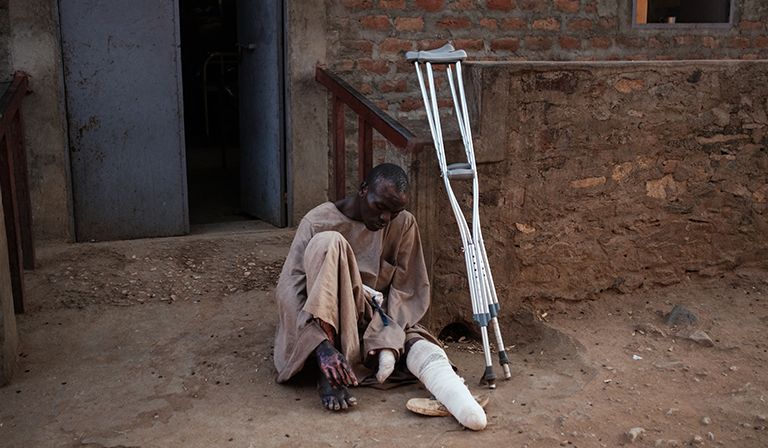
Combatants in the war seem more focused on the next battle. I travel to a hospital on the outskirts of Kauda to meet a young RSF soldier named Amin Isa. Shrapnel hit his leg during a firefight between SAF and RSF forces in January. He’s still recovering a month later, a metal rod protruding from his shin. Many hospital wards are full, so his bed is set up in a canvas tent outside. It is scorching hot. Other militants lounge on the beds next to his, smoking cigarettes and playing music from a Bluetooth speaker, their dreadlocks falling into their eyes.
In this hubbub, Isa quietly reflects on his decision to fight with the RSF. “Back home, we don’t have education, we don’t have healthcare and the government is controlling everything,” he says, echoing the governor’s diatribe about marginalisation. “All the resources are in Khartoum.”
Whatever ideals pushed Isa to join the RSF, all parties have been accused of attacking civilians indiscriminately. The toll of the war is overwhelming. Some 400,000 people have died both because of violence and the hunger and illness that follow in its wake, according to the former US envoy to Sudan, Tom Perriello.
How does Isa respond to accusations that his comrades have targeted civilians?
“It’s just a fabrication,” he tells me. As men chatter around us, Isa reaches under his pillow to show me the death certificates of five of his brothers who perished in battle together. Isa quietly repeats their names. As soon as his injured leg is better, he will return to the front.
It is currently dry season, when troop movements are easier. Battles are fought directly by men like Isa, and from afar with high-tech drones and missiles. Supplied to the SAF and RSF by their foreign backers, drones had not been widely used before 2023 but are now ubiquitous. “Sudan is clearly a theatre for burgeoning modern warfare. The contestation between the warring parties is being shaped by the skies,” says Soliman of Chatham House. The result, he added, is “thousands of civilian casualties reportedly resulting from drones and other air strikes since the start of the war”.
External forces may be shaping how the war is fought, but international mediation has faltered. The US is currently leading a dealmaking process called the Quad, working with Egypt, Turkey and the UAE to negotiate their grievances and promote a temporary ceasefire in Sudan. In early February, the Trump administration’s senior adviser for Arab and African affairs, Massad Boulos, announced that they’d nearly reached an agreement. Boulos is father-in-law to Tiffany Trump, the president’s fourth child, and has not previously held diplomatic office. Analysts told me that the accord failed to address the deep-seated differences between its participants, and even the root causes of Sudan’s war. Both the RSF and SAF had preliminary approval of the deal but have since refused to lay down weapons.
The Quad, reflects Soliman, “has not been a mediation platform to mediate differences between the SAF and RSF. It has been to mediate differences between the Gulf states that are involved.”
Sudan’s civilians, who once took to the streets to demand democracy, have been left out entirely. “If you want to call it a peace deal, and not just a deal, it will need to engage with civilians. That’s something which I haven’t seen happen,” says Badi of the Global Initiative.
Meanwhile, the UK government has sanctioned individuals and companies accused of fuelling the conflict, with the most recent round announced on 5th February. The goal, according to foreign secretary Yvette Cooper, is to “dismantle the war machine of those who perpetrate or profit from the brutal violence in Sudan”.
Neither news of fresh British sanctions nor a US-brokered ceasefire had reached the Nuba Mountains when I visited in the same month.
South of Kauda, the city of Kadugli has become a flashpoint in fighting. The capital of South Kordofan state, with a pre-war population of some 200,000, Kadugli was known in peacetime for the trade of leather and livestock. When war broke out in 2023, control of the city meant control of key supply routes and roads. After the RSF and SPLM-N announced their alliance, fighting intensified. The RSF rained drones and missiles on the city, while the SAF held a military base inside. The RSF also blocked food and medicine from reaching Kadugli. Unidentified combatants shot anyone who tried to escape. Both forced starvation and the blockage of essential aid are war crimes under international humanitarian law. Now, most of Kadugli’s residents have fled.
In one of the displacement camps circling Kadugli, I met a 17-year-old girl who grew up in the city and asked to be called by the pseudonym Susu. Her temporary new home is framed by jagged purple hills. Rubbish scattered on the ground is the main sign that people have tried to make a life here. The air is blisteringly hot and thick with the smell of dirt and sweat. Back in in Kadugli itself, Susu loved visiting art museums and “playing” in hotel swimming pools. In war, the city became “a place of hunger”, she says.
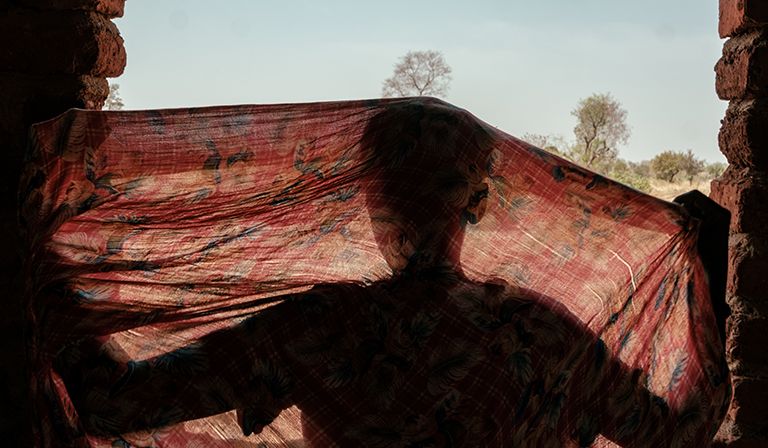
In August 2025, Susu and her older sister decided to escape. Their parents stayed behind, hoping that calm would return. In a riverbed some 20 minutes’ walk from Kadugli, the girls were met by eight men. Two took their money and spare clothes and ran off, but six stayed. In a conflict propelled by high-tech weapons, fighters still resort to old methods of cruelty too. Three of the men raped Susu, three others raped her sister. Susu was three months pregnant at the time. She recalls one of the men asking the others, “Why would you rape this girl? She is pregnant.” But the gang did not stop. “We were wrestling and fighting them in the river, but there were too many,” Susu said. As the men raped her, they threatened to kill her. Then, for some reason, they allowed Susu and her sister to go.
The group who attacked Susu wore no uniforms, making them hard to identify, but she believes they came from the SAF, given their proximity to the city. The RSF and SAF have both been accused of using rape as a weapon of war, while residents of Kadugli told me that bandits roamed the city and its outskirts, taking advantage of war’s chaos to rob and harass civilians. The UN has called the scale of sexual violence in Sudan “staggering”.
When their parents escaped from Kadugli and joined Susu and her sister in the displacement camp, Susu confided in her mother. “My mom said she should never have let me leave, as she never expected such a thing would ever happen,” Susu recalls quietly. The teenager’s husband is still in Kadugli. They have not spoken in months, for she has no phone and no money. “If he ever finds me here in this camp, I will tell him the truth. I cannot hide what happened to us,” she says, resolutely.
We sit silently for an instant, holding hands. I ask how she views the influence of outside powers in the war. “I hear that many different countries are helping both sides fight this war. I don’t know what the truth is,” Susu replies. “All I want is peace and stability.”
Her hopes are tangled in decisions made thousands of miles away. The UK considered multiple programmes to prevent atrocities in Sudan, but has been criticised in the Guardian for settling on the “least ambitious” option because of aid cuts. Just after announcing its latest sanctions, the UK also said in March that it would deny study visas to Sudanese scholars, with the Home Office declaring it has received an overwhelming number of asylum claims from students.
“If we’re looking at how to resolve this war, the next step is the political process. How does the UK position itself to support those efforts or to engage in those efforts? For me, that’s not clear yet,” says Chatham House’s Soliman.
In the Nuba Mountains, the prospect of international mediation feels distant; something to be only dreamt of or furtively discussed. During my travels in Sudan, I never sensed people thought that Britain or America would successfully negotiate a peace deal. Instead, they were trying to make it from sunrise to sunset, doing what they could to care for friends and neighbours in between.
The impact of foreign powers supporting the warring generals felt at once immediate and abstract. In displacement camps, people spoke of friends and family killed in drone strikes: a clear symbol of violence spurned by foreign intervention. But they were more worried about sending their children to school and getting medical care, than who paid for advanced weaponry.
The SAF broke the RSF and SPLM-N siege of Kadugli in February of this year, but food and aid are still slow to arrive in the city. Families are equally hesitant to return, while others continue to stream out of Kadugli, escaping ongoing drone strikes and looking for something to eat. The RSF and SAF’s chaotic skirmishes for territory continue, as does the fraught competition between middle powers. “There is a scramble, both in terms of trying to get hands on resources as much as possible, particularly in the decline of Pax Americana, but also not really being able to do that in any controlled, constrained, predictable way,” says Khair, the Confluence Advisory analyst.
When the time comes for Susu to deliver her baby, she will do it on the floor of her hut in the camp. She has no supplies and no way to prepare. Still, she wants the child to live a happy and healthy life, some day working to improve Sudan.
I left the Nuba Mountains on the same road I used to enter the remote territory. My car rattled past lorries of people travelling towards refugee camps in South Sudan; all fleeing a conflict with no end in sight.
Reporting for this story was supported by the Pulitzer Center