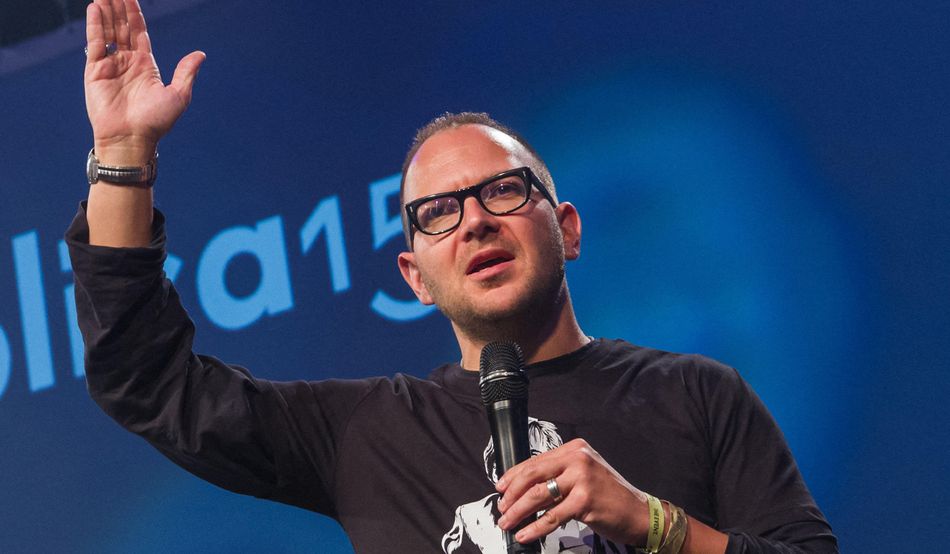
In 2022, Cory Doctorow coined a term to describe how the internet has decayed at the hands of tech giants, making the digital world a far worse place. His neologism, “enshittification”, was named the American Dialect Society’s word of the year in 2023 and Australia’s Macquarie Dictionary word of the year in 2024. It turns out that the key “to getting people to care about abstract, technical questions”, Doctorow says, “is to give them licence to be slightly rude.”
In his new book, Enshittification: Why Everything Suddenly Got Worse And What To Do About It, Doctorow describes four stages for the deterioration of online platforms: “First, platforms are good to their users. Then they abuse their users to make things better for their business customers. Next, they abuse those business customers to claw back all the value for themselves. Finally, they become a giant pile of shit.”
Jeff Bezos’s Amazon, for example, has fixed searches to prioritise either its own products or goods from vendors willing to pay the most for promotion. The company has killed off competition by blocking anyone who sells their goods cheaper elsewhere, while sellers are forced to give Amazon exorbitant amounts of their revenue.
Now based in the US, Doctorow was born and raised in a politically liberal household in Toronto. His father was a computer scientist, which explains his early interest in the interactions between technology and people.
As a journalist, sci-fi author and digital rights activist, Doctorow was, and remains, enthusiastic about the internet: “You have to be excited by the good that can come from networks, but at the same time be very afraid of what can happen if we get it wrong: the potential for control, surveillance and exploitation,” he says.
Over the last few decades (which Doctorow calls “the Age of the Enshittenment”), he has seen tech bosses (“a bunch of weak-chinned, ultra-rich idiots”) break promises and maximise their profits, at the expense of users and business customers. It’s all happened rapidly, ruthlessly and competently, with the notable exception of X, Elon Musk’s disastrous Twitter 2.0, which sent users and advertisers fleeing. “Musk’s a chancer,” says Doctorow, “He’s a bullshitter. I don’t think he knows what he’s doing.”
As the digital merges with the physical, the same unscrupulous tech companies are producing our TVs, cars and security systems. It’s a grim picture, particularly after some online platforms have been shown to be harvesting and selling user data (as in the Cambridge Analytica scandal), or being used to amplify misinformation and hate speech—such as Facebook failing to prevent its platform from being used to incite genocidal violence against Rohingya Muslims in Myanmar. “We’ve seen firms do bad things without any consequence,” says Doctorow.
His own tech safeguards include using a custom email address and doing his best to avoid shopping on Amazon. He is still on X—being unable to leave without abandoning his half a million followers and professional contacts—a sign of how platforms “lock” consumers in. But he draws the line at Facebook products: “I became a ‘Zucker Vegan’ long ago, so I don’t use any services associated with Mark Zuckerberg.”
Doctorow mainly uses Signal for messaging, regularly deletes his history, and is “diligent” about turning off location-tracking and data-gathering. But, he stresses, there’s ultimately “very little” that individuals can do—“shopping harder… isn’t going to make a gigantic difference. These are structural issues.”
The problem, as he sees it, is “concentrated corporate power”, once previous checks and balances on human greed are stripped away. “This has been a death by a thousand cuts”, he says.
Tech bosses can’t be relied on to be good, Doctorow argues, so they need to be forced to be make the right choices through government regulation, competition laws and the strengthening of worker unions. Getting platforms to work for everyone is vital.
This might seem like a losing battle. But Doctorow, who works for the Electronic Frontier Foundation and co-founded the UK’s Open Rights Group, sees promising signs in recent “muscular, uncompromising antitrust enforcement actions around the world,” from the UK to China: “cases brought, companies sued, companies broken up, companies regulated to promote competition.”
“It’s nothing short of a miracle. We have to build on these victories,” he says. “You go where the momentum is, and you push.”
‘Enshittification: Why Everything Suddenly Got Worse And What To Do About It’ is published by Verso.