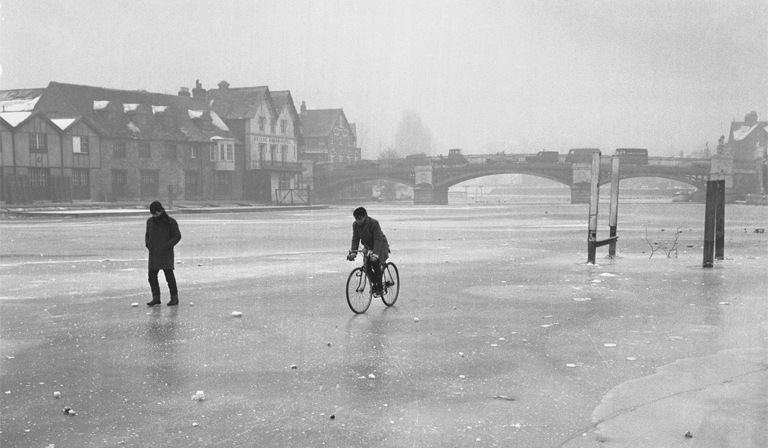
Just before Christmas, a bitter wind blew in. Ice and snow descended, first in Scotland and then, on Boxing Day, across the rest of the UK. Before it could melt or the new year arrive, a second blizzard left fresh snowdrifts six metres deep. They wouldn’t thaw until March. It was the winter of 1962 and 1963, and it was the bitterest in 200 years.
Films from the time capture something of an idyll: boys flying off toboggans, a man riding a bike on the Thames, milkmen on skis delivering their bottles. Two commuters in Leicestershire ice-skate to work wearing bowler hats, and on the Lake of Menteith in Scotland, almost 2,000 curlers skite about during the great curling bonspiel.
But the cold, as it settled across the country, was unforgiving. Two hundred main roads were soon impassable. In the Pennines, Cornwall and the Highlands, routes would remain shut for almost two months. “Now it’s Siberia!” the papers exclaimed. Villages and towns such as Weymouth and Tavistock were cut off. The sea froze: at Dover and Eastbourne, the ice stretched out towards France. “It looked like we were going to be joined with Europe, whether De Gaulle liked it or not,” said a BBC reporter.
In the span of human record, such winters are exceptionally rare, and anthropogenic climate change has made them ever less likely. In the years since the “Big Freeze” of 1963, average global temperatures have increased by more than a degree, rising from close to the pre-industrial baseline, an average against which increases are measured. As a result, winters in the UK tend to be warmer, wetter and wracked by more dramatic storms. Summers are hotter too: 2022, 2023 and 2025 were the warmest years on record.
When we think about a future shaped by climate change, many of us imagine more of the same: hot summers and warm, wet and stormy winters. In simple terms, those whose job it is to prepare us for the future have been planning for such a world. But that is not the whole story. Scientists are warning with increasing urgency that global heating could soon tip us into a very different future, one in which temperatures would rise around the world and the summers would be hotter than ever before. But the winters? In the UK, winters would be much worse than the Big Freeze.
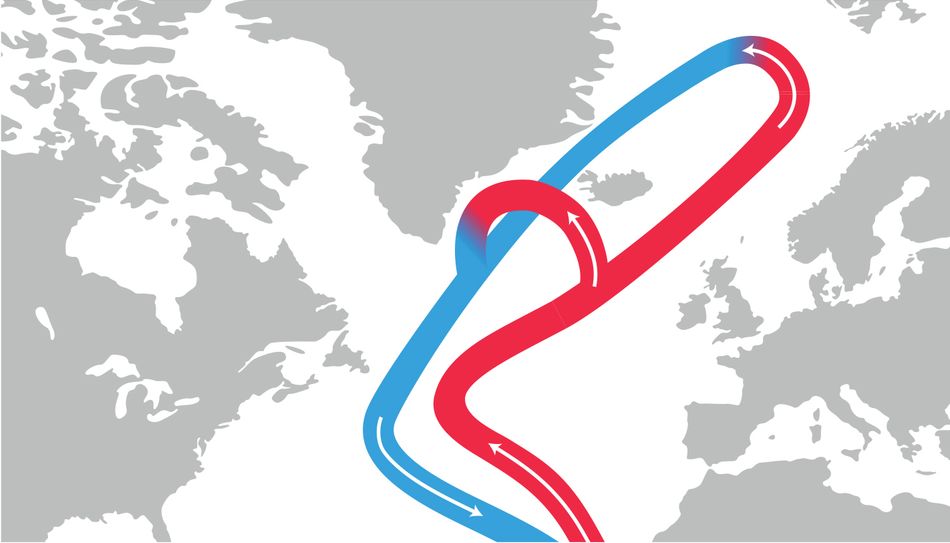
Out in the deep Atlantic, a great current drags warm water north from the tropics, through the Caribbean and along the coast of the United States, before swinging out into the middle of the ocean. Near Greenland and Iceland, the water in this current cools. Fresh water evaporates into the atmosphere, leaving energy behind as heat—the equivalent of around 50 times the total energy use of humanity. The water still borne along by the current is saltier and denser—and so it sinks thousands of metres into the depths. The current then turns back south, towards the tropics, where it will warm again.
This is the Atlantic Meridional Overturning Circulation, known as the AMOC. It is the primary reason why the northern hemisphere is on average 1.4°C warmer than the south, and why the Earth is hottest not at the equator, but 10° north of it. It is why the UK and northern Europe have relatively mild climates; why, although they share latitudes, Glasgow is warmer than Moscow, Paris milder than Vancouver and Reykjavík less frozen than Greenland’s capital, Nuuk.
Since 1961, scientists have known that the AMOC is one of the Earth’s climate “tipping points”, meaning it could swing from one state into another from which it is extremely difficult to return. Palaeoclimate data suggests that it has tipped before, during the last ice age, with dramatic effects on the global climate—and now scientists are warning that manmade climate change is the likely cause of it weakening over the past 100 years, and may cause it to tip again.
An AMOC shutdown happens in “quite a few of the standard global warming scenarios” captured in reports from the Intergovernmental Panel on Climate Change (IPCC), according to Stefan Rahmstorf, a physicist and oceanographer at the Potsdam Institute for Climate Impact Research who has studied the AMOC for 35 years. Together with other researchers, he calculated the approximate risk of AMOC collapse from a range of climate models. In a scenario of high global emissions, leading to warming of 3.6°C or more, the chance of the AMOC crossing a tipping point is 70 per cent, they found. If global temperatures rose 1.8°C by the end of this century—a level we are likely to exceed—there would still be a 25 per cent chance that the AMOC shuts down entirely by 2100, cooling the northern hemisphere.
According to analysis by the independent Climate Action Tracker, based on the current policies in place globally to tackle the climate crisis, the Earth will experience 2.6°C of warming—an intermediate emissions scenario. Projected warming of close to that—2.7°C—gives a 37 per cent chance of the AMOC crossing a tipping point: more than one-in-three.
Until five years ago, “we considered an AMOC shutdown a low-probability but high-impact risk,” Rahmstorf told a panel convened at last year’s UN climate conference in Brazil, COP30. Most thought there would be a “less than 10 per cent” probability of it happening. Even before then, it was “too big to ignore. But now the probabilities look much higher,” he said.
One key indicator that the AMOC is already weakening is the “cold blob”. While temperatures have been rising everywhere else on Earth since the 19th century, the cold blob, an area of the north Atlantic, is the one place on the planet that has for decades been cooling. This—as well as the fact that water is warming off the coast of the eastern United States—suggests that the AMOC is already bringing less heat into the area than it was before.
There is also a chance that the figures Rahmstorf cites are an underestimate, as scientific models he used to calculate these risks don’t take the melting of the Greenland ice sheet—which is releasing cold freshwater into the north Atlantic and disrupting the AMOC’s flow—sufficiently into account. He warns that the tipping point “is actually quite close in the future, in the next decade, or two or three”.
Not all scientists are comfortable with making predictions. Laura Jackson, a research scientist at the Met Office who specialises in global ocean circulations, is one who urges against “trying to put percentages on these things… I don’t think it’s a very useful thing to do because it’s so uncertain,” she tells me.
And yet, while Jackson thinks there is only a “small chance” of AMOC collapse, she also cites “a number of studies recently where they have shown that there’s a possibility that the AMOC could cross the tipping point before 2100”. And she wholeheartedly agrees with Rahmstorf on perhaps the most important point: “If it did happen, the impacts would be large… We don’t want to ignore the fact that it could happen,” she says. “Because if it did, we’d be in great trouble.”
AMOC collapse would create conditions “like nothing we’ve ever seen before”, Tim Lenton, founding director of the Global Systems Institute and chair in Climate Change and Earth System Science at the University of Exeter, said in a briefing in Westminster last November. The UK would be one of the nations to be hardest hit, but the consequences would be global.
According to Lenton, in one model based on a collapse happening at a global warming level of 2°C, the North Sea would be covered in ice by February each winter. London would be frozen for three months, with temperatures as low as -20°C. Edinburgh would endure five-and-a-half months of ice, with temperatures down to -30°C. Water would run short because too little would fall during the winter to last the most populated areas through the summer. Food production would be severely affected in the UK. Across the world, the area in which the staple crops of wheat and maize could be grown would be reduced roughly by half. Global rain patterns would move south, drying and killing the Amazon and changing where monsoons fall across Asia, South America and west Africa. Sea levels may rise, exacerbating coastal erosion and storm surges. “We’d have to expect the kind of extreme weather events that we’ve never known before,” says Rahmstorf.
The UK is not prepared for such a future. The country’s housing stock is already the worst in Europe, ill-equipped for extreme temperatures. Railways would grind to a halt, as they did in 1963 when trains disappeared into snowdrifts and lines were buried under avalanches for days. Power grids would struggle; there would be blackouts. Hospitals would feel the strain: the number of excess human deaths in England and Wales in 1963 was more than 80,000.
None of this would happen overnight; scientists estimate that the AMOC could take 50 to 100 years to wind down, though some effects would be felt sooner. “But that doesn’t mean we shouldn’t be concerned now,” says Jackson. “It doesn’t mean it’s not important to know if you’re crossing a tipping point and might not be able to get back.”
Because of this concern, the Met Office has been busily researching how changes to the AMOC might impact the UK. “And thinking not just what the temperature changes or the rain changes would be, but how that might affect droughts, energy—all that downstream impact,” says Jackson. “Obviously all these things have knock-on effects on ecosystems, on economies.”
Some of this work is government funded, as is an £81m project at the Advanced Research and Invention Agency (Aria) focused on developing an “early warning system” for climate tipping points and, specifically, for one section of the AMOC called the subpolar gyre. Numerous other international projects are doing related work.
Yet the AMOC hardly appears on the UK government’s radar. It does not feature on the latest official National Risk Register—where terrorism, cyberattacks and threats from states such as Russia are covered in detail—or in its chronic risks analysis, both released by the powerful Cabinet Office, at the heart of government. Responsibility for this existential threat is fragmented across departments of lower priority, which aren’t generally responsible for security concerns: the Department for Energy and Net Zero, which has responsibility for reducing emissions, the only way to avoid AMOC collapse; the Department for Environment, Food and Rural Affairs (Defra), tasked with protecting against the impacts of climate change. “If pandemic threat assessment and preparedness was as fragmented… we would be scandalised,” says Laurie Laybourn, director of the Strategic Climate Risks Initiative, a thinktank that focuses on dangerous climate risks.
It is Defra which publishes the government’s national adaptation programme every five years, following regular assessments from the independent Climate Change Committee (CCC) into the risks of climate change to the UK. There’s no mention of the AMOC there yet, either.
One reason for its absence may be that “the science is too new,” an expert at the National Audit Office says—scientific findings that demonstrated a higher risk of AMOC collapse were published just last year. Many people interviewed for this piece tell me they hope that the AMOC will be taken into account in the next iteration of the government’s climate change risk assessment, in 2027, and its national adaptation programme, in 2028.
But it is not just the risks of AMOC shutdown that are being overlooked—the climate crisis more generally is overshadowed in conversations about national security. This is rooted in what Laybourn calls the “original sin of how we assess climate change”.
For as long as states have existed, governments have been familiar with the dangers of war and disease, but the threat of climate change is much newer. As understanding grew through the end of the 20th and into the 21st century, governments “turned to the scientific community” to help make sense of the problem. This was “absolutely the right thing to do”, says Laybourn, but it led to a culture clash. Scientists “don’t want to say something is going to happen unless they’re totally sure”. That is the right approach within science—but governments need to think differently.
Scientists might be cautious in stating the severity of a danger, but policymakers should take the opposite approach, “because it doesn’t matter if you predict 9/11 or 7/7 or Pearl Harbor, and then it doesn’t come true. What matters is if you fail to predict it, fail to admit that it was a possibility, and then it did actually happen and no preparation was made,” says Laybourn.
Since the first COP in Berlin in 1995, and even since the UK’s Climate Change Act of 2008, we have learned that the ramifications of climate change will get worse, but not always in a linear fashion. We know about the threat of AMOC collapse and tipping points, and about the domino effects of climate change, such as how droughts or floods can harm health and the economy, for instance.
Governance may need to catch up with what we know—and with how other risks are assessed, too. When governments think about terror attacks or threats from hostile states, they prepare for the worst possible scenarios, Laybourn explains: “If you’re building a nuclear power plant, you build it not to withstand just the average conditions. You build it to withstand, in the UK, a one-in-every-10,000-year event, although the nuclear power plant probably lasts 30 years.” Why can’t the same thinking be applied to the AMOC?
During last year’s COP in Brazil, Iceland became the first nation to label the AMOC a national security issue. “For us the future of the Atlantic Meridional Overturning Circulation is not an abstract scientific question,” Jóhann Páll Jóhannsson, the country’s minister for environment, energy and climate, said at the time. “The ocean shapes our climate, our energy systems, our food security, our infrastructure and our way of life, and when that system shows signs of stress, it is our duty to pay attention… and act before it is too late.”
The move has enabled Iceland “to bring together all the relevant ministries and institutions, not only those responsible for environment or climate issues, but also civil protection, energy, transport, food security and foreign affairs,” Jóhannsson tells me. This will ensure the issue “is addressed with the seriousness it warrants”. This year Iceland will publish its first national adaptation plan, with a disaster preparedness policy to be completed in 2028. It seems likely that the AMOC will be included.
Other nations are taking notice, too, notably the Nordic states, after scientists wrote to the Nordic council of ministers. Ireland’s adaptation plan specifically notes the risks to the country from tipping points, including changes to the AMOC. Across Europe, including at the EU level and in France and Germany, AMOC-related risks are also increasingly under discussion. Meanwhile, the European Space Agency has signalled plans to monitor AMOC-related changes.
No such approach exists yet in Britain—though officials and experts from Iceland and the UK’s government-funded Aria programme on climate tipping points have “exchanged views on monitoring and early-warning approaches”, Jóhannsson says.
There are signs of growing awareness about the AMOC in Whitehall. Tim Lenton recalls how one civil servant he briefed about AMOC collapse “was quite upset… their point was basically these adaptation actions we’re taking will be worthless in this scenario”.
Nothing suggests that we could prepare fully for a world in which the AMOC does shut down
In any case, to date those actions have been “inadequate”, according to the CCC. Adaptation planning is “piecemeal and disjointed” and “progress is either too slow, has stalled, or is heading in the wrong direction,” the independent committee has found. A Defra spokesperson said the department recognises “how important it is to prepare the country to adapt to climate change”, stressing that the government is “now investing a record £10.5 billion to protect 900,000 properties [from flooding], as well as the largest investment in nature-friendly farming in this country’s history”. But if the UK is to be better prepared for the future—whether the AMOC tips or not—this work would have to accelerate.
There is some good news for that despairing civil servant, which is that many adaptation initiatives that would be useful in a world where the AMOC doesn’t tip “are even more functional with the AMOC tipping point,” says Lenton. Protections against rising seas, for instance, may be needed sooner if AMOC shutdown does occur. And “there are lots of things you can do around nature and resilience of ecosystems that work for either eventuality”. Reservoirs might be another of the “no regrets” options—water security will be tested whether the AMOC collapses or not.
Still, nothing suggests that we could prepare fully for a world in which the AMOC does shut down. There is a single path that leads away from the future warned of by Lenton, Rahmstorf and others, and it is the path away from fossil fuels. Global warming has already reached 1.4°C, and every rising fraction of a degree beyond that accelerates the threat of the AMOC tipping. Currently, just a third of the emissions reductions needed to hit the UK’s 2030 targets are covered by what the CCC calls “credible” plans. Meanwhile, progress towards these goals is being actively challenged: Reform’s Richard Tice has said he would, if elected, “get rid of the madness of… net stupid zero”.
What is madness, in fact, is any decision to ignore the risk of AMOC collapse. Despite the uncertainty about when exactly it could occur—sending the northern hemisphere into a future shaped by extreme heat, extreme cold and extreme weather—the science is clear about why it occurs, and how to stop it. “We’ve got to do everything in our power to limit the amount of time we spend over 1.5°C, and the amount of temperature we go over 1.5°C… that requires a radical acceleration of action towards zero emissions,” says Lenton.
For now, though, we must live in uncertainty about the future. We must live with the understanding that our lives as we know them depend on a great current continuing its journey through the deep ocean. And we must hope that its journey will not end. For if it does, Britain will face many a winter where the snow piles higher and the ice stretches further than was even imagined in the winter of 1963.