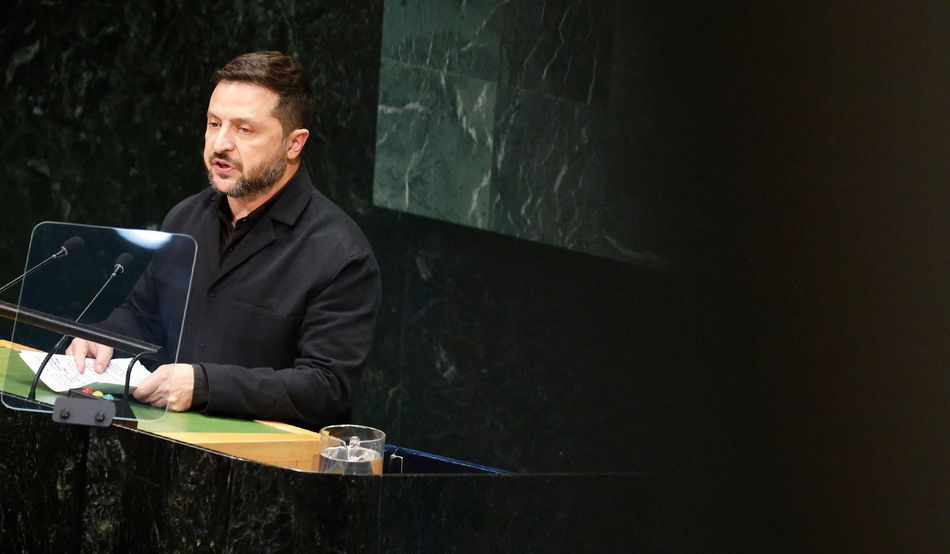
The apparent implosion of Donald Trump’s latest attempt to force Ukraine to cave in to Vladimir Putin highlights Volodymyr “Houdini” Zelensky’s astonishing success in getting out of one seemingly impossible situation after another, four years on from Russia’s invasion. And this despite the defection of his formerly principal ally.
When Trump’s diesel deal with Putin was first announced on Truth Social last Friday, it was met with genuine alarm, in Kyiv and across Europe. Here was the president of the United States not only dismantling American trade sanctions against Russia imposed after the 2022 invasion, but directly financing Putin’s war machine.
In terms of signalling and intent, Trump’s deal with Putin is dire. It substantially reverses the US policy of seeking to strangle the Russian economy until Putin stops his war. As soon as Zelensky pointed this out, the orange mask slipped entirely. Trump raged at Zelensky for not making a “deal” with Putin and said “he’d better damn well stop” bombing Russian oil refineries. “I think it’s time for Ukraine to get a new president,” he lashed out, as if the presidency of Ukraine was his to bestow.
Trump’s latest diatribe is worse even than his notorious Oval Office shouting match of February last year. Back then, he threatened Zelensky: “You've done enough talking. You're not winning this... You gotta be thankful. You don’t have the cards”. Trump told Zelensky that he had to negotiate with Russia. He didn’t, however, explicitly side with Putin or call for Zelensky to be eliminated, as he has done now.
In any case, Zelensky turns out to have quite a few cards after all. The combination of his resolute leadership, the decisive action of Europe’s leaders in substituting for American financial aid and Ukraine’s amazing successes against the Russian war machine—not least its new drones that are systematically disabling Russian oil refineries hundreds of miles away—have all prevented Putin from making any notable advance since the Oval Office debacle last year.
Zelensky’s cards came into play after Friday’s diesel deal. It rapidly became clear that, despite Trump bandying around large numbers, the proposed diesel sales to the US constituted only a tiny fraction of its requirements to get pump prices sharply down in face of the continuing Iran war. Worse for Trump, even these proposed Russian diesel exports were described by experts as probably unattainable because of the needs of Russia and the continuing Ukrainian bombardment of its refineries. Within 24 hours, he was reduced to inventing a supposed “energy ceasefire” which Putin has obviously not agreed to, and will therefore not be observed by Zelensky, whose drone production doesn’t depend on US permissions.
Oh, and Zelensky calmly informed Fox News that he wouldn’t be standing down, although he would happily call an election if Trump could persuade Putin to agree a 60-day truce for the purpose. Of course, the race that is going ahead within 60 days is the US mid-term elections, which will very likely weaken Trump, giving Zelensky another break.
So the Houdini of Kyiv survives to fight another day, literally. The constancy of Europe has been vital to his ability to outwit Trump and physically resist Putin. To date, changes of leadership in Europe have either made no difference to support for Ukraine (as in the various changes of UK prime minister since Boris Johnson) or have actually helped Ukraine (as in the defeat of Viktor Orbán of Hungary and the strengthening of Giorgia Meloni of Italy). Andy Burnham maintains this anti-Russian unity; indeed, this week he pointedly resurrected claims of Russian interference in the Brexit referendum, as domestic evidence of Russia’s general bad faith and malevolence.
Putin may be hoping that next May’s French presidential election will breach Europe’s implacability. In reality, I doubt that even a Le Pen/Bardella government in Paris would lead to such a result. The independence of Ukraine is now too bound up in Europe’s wider future as a strong bloc against a steadily more threatening US, Russia and China. French pretensions to global influence rest upon this. Significantly, after a recent crisis security meeting with Emmanuel Macron about direct threats to French security, Marine Le Pen and Jordan Bardella issued a statement denouncing Russian “hostile acts”.
As one remarkable Zelensky act of survival succeeds another, the battle lines in Ukraine become ever more clearly frozen. The most likely end to the war is that Putin or his successor ultimately accept this, and there is a ceasefire on roughly the present zones of occupation. Such an outcome would be a triumph for Ukraine, enabling four-fifths of the country invaded by Putin to continue as an integral, prosperous, independent European state. But to achieve this, the escape artist may need to pull off a few more acts yet.