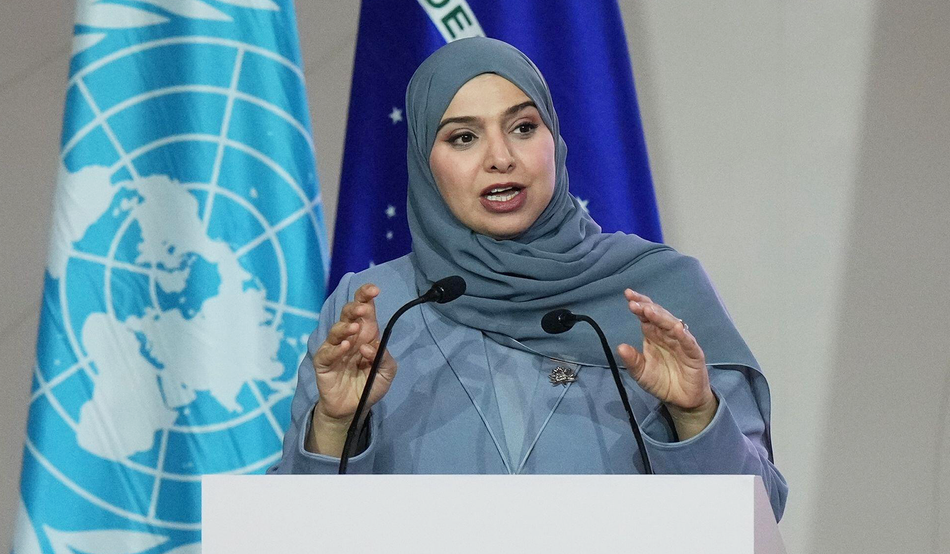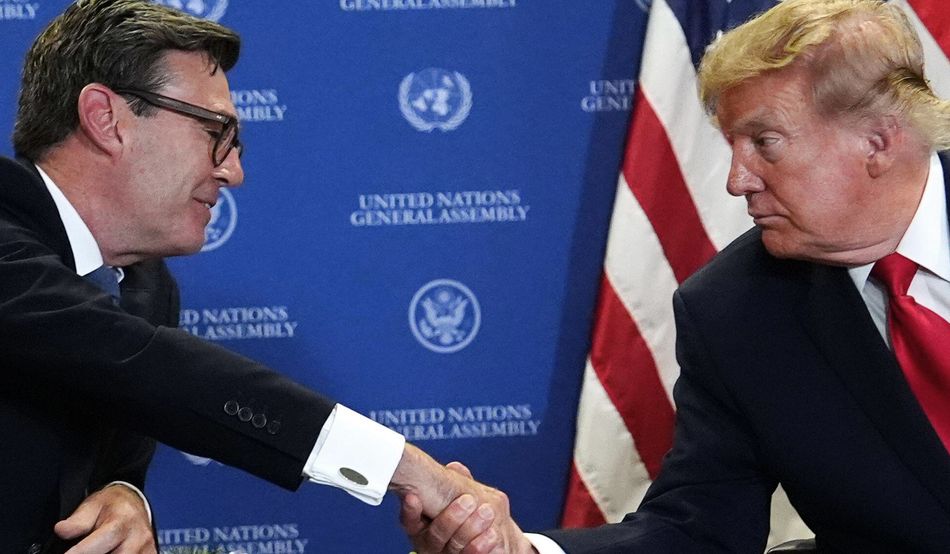
Just when you think the United Nations has become totally irrelevant, Andy Burnham gives it a new role. This week the UN became a safe, neutral space for a first meeting with the president of the United States, avoiding the theatrical gauntlet of the Oval Office. Tellingly, Donald Trump’s next two visitors, after his speech at the UN General Assembly in New York, were equally nervous “allies”: Volodymyr Zelensky and the prime minister of Japan, Sanae Takaichi. The acting president of Venezuela, Delcy Rodríguez, was also on Trump’s schedule.
It is a welcome relief that second-term Trump hasn’t boycotted, let alone withdrawn from, the UN. This month he even paid a large chunk ($725m for the UN’s regular budget and a further $102m for peacekeeping) of the arrears in US dues to the organisation so as not to lose US voting rights in the General Assembly.
A big issue in this autumn’s UN meetings is the selection of a new secretary general to succeed António Guterres, whose term expires at the end of the year. The pros and cons of the top candidates, who include senior diplomats from Central and South America, are less important than the fact that Trump is going along with the process.
For the US president is doing his best to cull UN activity across the board, including UN peacekeeping and humanitarian forces in areas where the US is asserting its power and that of its closest allies. UN peacekeepers have been located on the southern Lebanon-Israel border for nearly 50 years but are now due to leave under heavy pressure from Trump and Benjamin Netanyahu, who see them as an obstacle to Israel’s ability to confront Hezbollah and control Lebanon. This follows drastic curbs on the role of the UN in Gaza, and the creation of an entirely new US-led vehicle—the so-called “Board of Peace”—to redevelop the war-torn territory.
But even in the Middle East, UN withdrawal is only partial, and the organisation looks set to play a significant role. UN peacekeepers remain in Jerusalem and on the volatile Israel-Syria border in the Golan Heights. UN-supported humanitarian work remains utterly vital in Gaza, even with the Board of Peace and amidst ongoing Israeli military offensives.
In my native Cyprus, where UN peacekeepers have been present since the Turkish invasion and partial occupation of 1974, the blue helmets are also staying. Neither the Republic of Cyprus nor Turkey want tensions to explode. The UN continues to just about keep the peace, and remains the most likely vehicle for brokering any ultimate settlement.
In sub-Saharan Africa, where most UN peacekeeping and humanitarian forces are located, it is a similar picture of crisis and scale-back. But there are significant continuing missions and attempts to rebadge and refinance existing UN missions, including in Somalia, another of Trump’s bugbears.
In short, the UN is going to survive Trump, albeit battered and emaciated, and looks as if it will make it to the centenary of its foundation in the immediate aftermath of the Second World War. This matters not because the UN has ever, since 1945, played a decisive role in checking the determined imperialism of the superpowers. Today the UN’s most vocal critic is Trump’s US; during the Cold War it was the Soviet Union, which boycotted the UN for a period in 1950, at Stalin’s direction. China has been equally dismissive of UN criticism and attempted intervention over the decades.
However, much of the world isn’t run by the superpowers, and for those outside a direct imperial ambit, the UN plays a useful role in stabilising territorial conflicts, brokering settlements and promoting humanitarian aid. The UN has also provided a constructive international framework for debating and promoting international action on critical global threats, which the superpowers themselves accept can only be addressed collectively. Climate change and nuclear proliferation have been top of this list in recent decades, even if the superpowers themselves have blown hot and cold in their willingness to address these crises. AI could be the next big ticket item on the global docket.
In none of these respects is the UN a panacea. But as a standing committee of the world’s nation states, it is a ready-made forum for collective action where there is sufficient will to act. It would be a tragedy to lose even this minimal framework for constructive international engagement.
At its least, the UN is a talking shop. But as Burnham, Zelensky and others will surely have recognised this week in their UN sessions with Trump, talking shops can be very valuable diplomatic forums indeed.