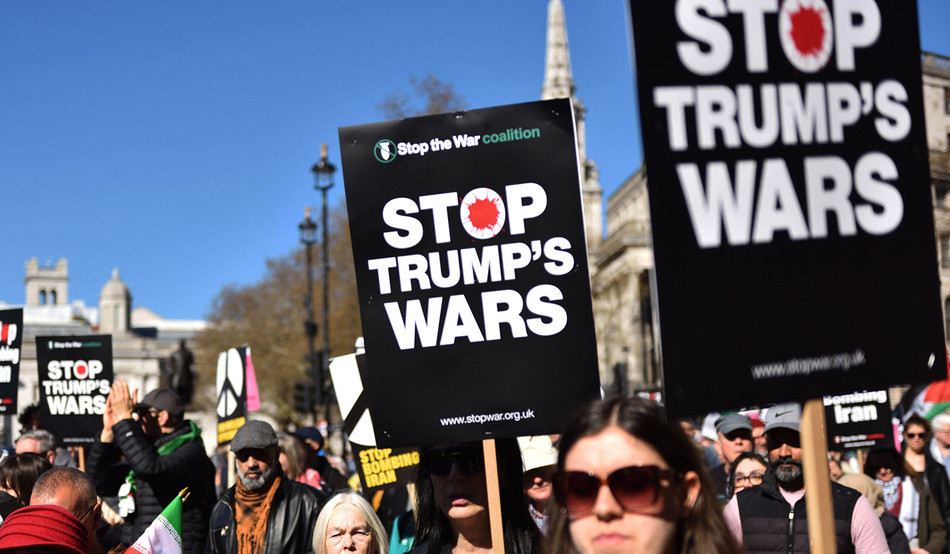
“This is not our war and we are not getting dragged into it,” says Keir Starmer. Not long after the US and Israeli bombing of Iran began, Starmer drove this point home by telling the House of Commons that the government remembers “the mistakes of Iraq”.
Alas for Starmer, this isn’t a rerun of the Iraq war. It is potentially far worse, and we are getting dragged into its consequences, regardless of whether we engage in the fighting or not.
In the case of Iraq, Tony Blair encountered huge domestic backlash when he joined George W Bush’s invasion in 2003. His relations with much of the left never recovered. But the economic consequences were minimal. In particular, there was next to no disruption to Britain’s oil and gas flows from the Middle East.
Even at the political level, the arguments about Iraq, while intense and bitter within the Labour party and the wider left, did not stop Blair from winning a third election victory—with a reduced but still significant majority—fully two years after the war began, and he continued as prime minister for a further two years.
In retrospect, the economy determined the politics to a far greater degree than most of us in government realised at the time. It was precisely because the economic consequences of the Iraq war were so limited—in that era of strong economic growth and far lower taxation that still allowed for better public services—that Blair was able to survive.
Most of the voters paid little, if any, attention to the arguments about the morality of the Iraq war because they weren’t affected personally. It was the banking crisis and economic downturn between 2007 and 2008 which really ruptured electoral politics and led to Labour’s defeat in 2010, followed by the populist surges which delivered Brexit and now the Reform party. The key fact is that economic growth—and real wage growth—never recovered from the financial crash and its aftermath.
It seems a fair prediction, then, that the impact of the Iran war depends not so much on how far Britain is involved militarily but on how far it is affected economically. In the case of Iraq we were deeply involved, but largely unaffected. In the case of Iran, Starmer might be resolutely uninvolved militarily, but he can’t stop the country from taking an economic hit. And the worse the economic consequences, the worse will be the ultimate political fallout for Starmer. Since he starts from an already weak position in the polls, this is a bleak prospect for the government as much as for the country.
The best hope is that Trump declares victory this week, stops the bombing and cajoles Netanyahu into doing likewise, in return for the Iranian regime stopping the strikes in the Gulf and reopening the Strait of Hormuz. In that event, oil and gas prices should drop immediately, and the geopolitics of the Middle East might draw back from endemic war.
However, if Trump intensifies and prolongs the war by invading Kharg Island or other Iranian territory, the energy crisis will immediately deepen. Maybe the upshot will be a complete and rapid Iranian military collapse, enabling the US to restore oil and gas flows within weeks. But, if that doesn’t happen, we could be in for a re-run of the 1970s oil shock and another massive economic rupture.
Meanwhile, the war of words between Trump and his erstwhile European allies escalates with each passing week of the war. So does the glee of Putin at this amazing stroke of luck for his embattled dictatorship. The future of Nato and Ukraine look very bleak if the war continues for months rather than weeks. And then there is Xi of China, waiting in the wings.
Whether we like it or not, we can’t ignore this war—we’ll feel the shocks no matter what the UK decides to do.