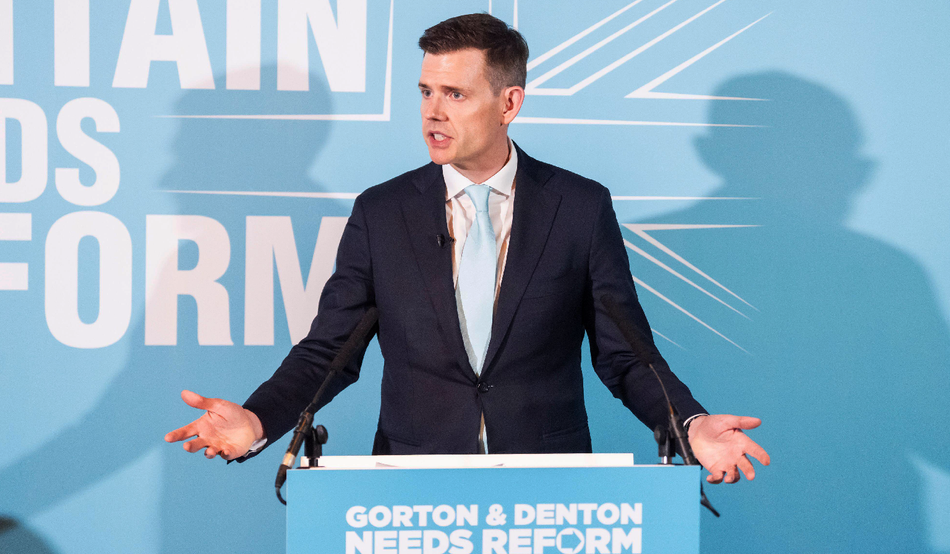
It became known as “Dinnergate”—the moment Matt Goodwin, populist professor, GB News frontman and now Reform candidate, realised there really was a powerful cabal running Britain.
This is what happened: David Aaronovitch, the erudite and pugnacious broadcaster and columnist, proposed a public debate with Goodwin. Think a battle-hardened veteran of the boxing ring challenging a brash, media-savvy, YouTube influencer to a fight. Only without the £150m purse.
Goodwin accepted, and the two men slugged it out—not in a Miami arena, but in the gently faded Conway Hall in London under the auspices of Prospect Magazine. It’s fair to say the two brawlers could barely conceal their contempt for the other, but no one was killed or even hurt.
A shake of hands at the end, and David and I went off for a bowl of pasta.
Was it rude not to have invited Goodwin too? Possibly so. Replaying it in my mind, I probably thought neither man would relish pretending to like each other as they picked at their rocket salad.
But, no, it was much worse than rude. Goodwin took to X the following morning to denounce us to his 287k followers. “They didn’t even bother to invite me….Classic New Elite!” he sneered.
For Goodwin, this was the final confirmation of his theory of Broken Britain. A once great country has fallen into the hands of a small, out-of-touch “radicalising minority”. They are ruining universities, towns, companies, media and culture. And they don’t invite him to dinner.
Who are these new elites? They are “Anywheres”, who feel more at home in Davos, Brussels or Berlin than in provincial Britain. They are highly educated professionals with an unwavering commitment to radical social liberalism, hyper-globalisation and woke ideology. They hold “luxury beliefs” and believe in authoritarian progressivism.
You want some examples? Let’s start with the civil service, aka “Wokehall”, a bureaucracy apparently ram-packed with left-wing activists. Then there’s the legacy media: in particular, the BBC, the Financial Times and the New York Times, which all prioritise dogma over truth.
Don’t get him going on universities and their “ideological monoculture”, even though Matt himself did rather well out of the system, gaining a professorship at an unusually young age. He has particular contempt for the John Lewis partnership (“completely and utterly captured” by DEI stuff), and he won’t be using Enterprise Rent-A-Car, which has also fallen.
Apart from David Aaronovitch, he has no time for the likes of Emily Maitlis (“completely misrepresents the evidence”), Gary Lineker, Rory Stewart or Jon Sopel. Then there’s the Davos Set (“Failed economically. Failed socially. Failed civilisationally.”)
And, talking of civilisation, we are on the verge of “demographic rupture.” He stood shoulder-to-shoulder with Donald Trump when the latter recently observed: “certain places in Europe are not even recognisable… Friends come back and say, ‘I don’t recognise it.’ And that’s not in a positive way.”
Trump’s right, says Goodwin.
In sum, he’s worried that there are too many Muslims in Britain. He’s alarmed by research that shows that around 17 per cent of the UK population could be Muslim by 2050. Muslims are, bluntly, outbreeding “native British people”, and in future we need to put British children and families at the very centre of our aspirations and priorities.
But who is British? Well, in Goodwin’s mind the new elites believe in a “thin” version of citizenship, whereas he himself prefers a “thicker” version based on an “ethno-traditional” idea of shared history and ancestry. “It takes more than a piece of paper to make somebody ‘British’,” he says defiantly.
Now, this stuff has been around in one form or another for years. The Conservative MP Enoch Powell had a similar preoccupation with immigration and identity and is best remembered for his 1968 “Rivers of Blood” speech in which, like Goodwin nearly 60 years later, he warned that mass immigration would lead to social conflict.
The difference is that Powell’s most incendiary speech cost him his job—sacked from the shadow cabinet by Edward Heath. Whereas Goodwin has just been selected by the Reform Party to contest the forthcoming by-election in Gorton and Denton.
This is what Sir Humphrey Appleby—that fictional Mandarin before Whitehall went all woke—might call a brave choice. And one has to wonder what kind of research Nigel Farage’s top team did before deciding to parachute Goodwin into this particular battleground.
There are constituencies with a higher proportion of Muslim voters than Gorton and Denton, but not many. The Henry Jackson Society website has a handy interactive calculator which shows that it ranks 23rd out of 600-odd voting areas for concentration of Muslims—around 30 per cent, in the 2021 census, compared with a 6 per cent average for the UK as a whole. Around a third of residents were born outside the UK (the UK average is 17 per cent). Nine per cent are black.
It will be entertaining to see Goodwin engaging with the people he seeks to represent. Will he tell them he’s worried about civilisational collapse in areas like Gorton and Denton because there are, tbh, too many Muslims? Will he speculate on how many of his would-be voters are “really” British, no matter what it says on a spreadsheet? Will he delicately ask them to slow down on the breeding front to allow native Brits to catch up?
If the voters haven’t watched it already, I can recommend an Al-Jazeera programme from last year in which Goodwin goes head-to-head with the presenter Mehdi Hasan over some of his more inflammatory language. He tells Hasan that the killing of the children in Southport in 2024 was “obviously about immigration”, even though the killer, Axel Muganwa Rudakubana, was born in the UK. “He is a product of immigration,” says Goodwin. QED.
As the interview progresses, we find a certain slipperiness about statistics from the professor who so despises, say, Emily Maitlis for “completely misrepresenting the evidence”. Hasan repeatedly pins him down on figures he’s used but can’t defend under questioning. After a while the audience starts laughing.
I’m guessing the voters of Gorton and Denton have the same basket of concerns as anyone else. They’ll have worries about the cost of living. Then there will be the NHS and healthcare, followed by the economy and job security. There will be anxieties about the cost of childcare, about crime, about policing, about potholes.
What will the Reform candidate tell them about these everyday issues? “To a man with a hammer,” Mark Twain is reputed to have said, “everything looks like nail.” To Goodwin, every problem in Broken Britain is down to immigration, civilisational collapse and out-of-touch elites. It’s something like an obsession—but I’m not sure it’s an obsession that’s going to sing on the by-election doorstep.
If he sails home as the next MP for Gorton and Denton it will just prove how out of touch I am. And, Matt, dinner will be on me.