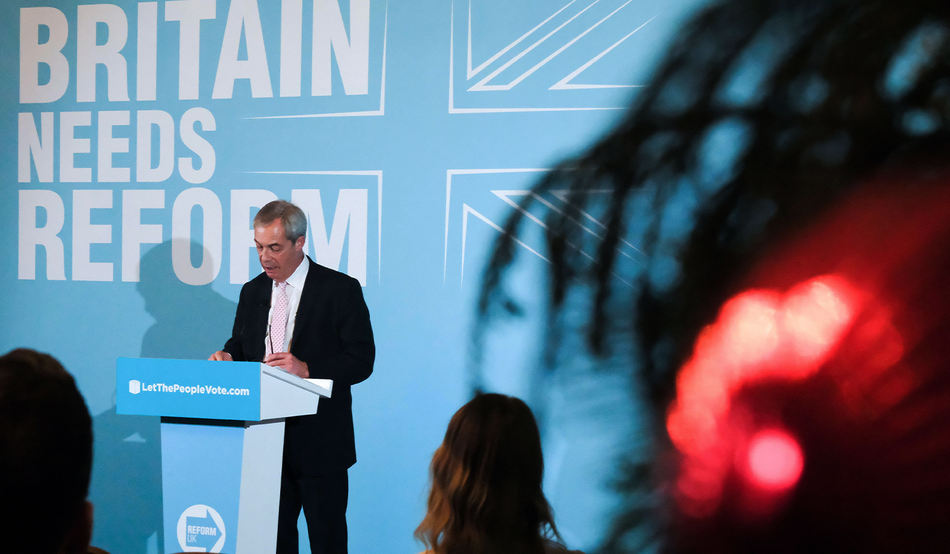
“BERNARD MANNING!” Nigel Farage shouted at a hapless ITV reporter yesterday. “BERNARD MANNING, BERNARD MANNING!” He raged at the BBC’s Emma Barnett, calling her a “lower grade presenter” and accusing her of asking “despicable, disgusting questions” about him to the Reform deputy leader Richard Tice. He summoned up the ghost of a long-forgotten fictional TV character, Alf Garnett, and demanded an apology from the BBC for some of its comedy shows from the mid-to-late 1970s.
It was not easy to follow his line of argument, but let’s try.
Farage stands accused by multiple of his school contemporaries of behaving in a racist and bullying way nearly 50 years ago. Richard Tice says his accusers are liars. But Farage seems to be trying a different defence.
“If I did it—and I'm not admitting I did,” he seems to be saying, “it was banter. You’re judging me by the standards of 2025, but look at the BBC and ITV: they broadcast lots of material that was considered funny back then, but which isn’t now. So you’re all hypocrites for asking, and is it any wonder half a million people won't pay their licence fee?”
I’m trying to work out how the “Je suis Bernard Manning” defence actually works. For those too young to remember, Manning was a corpulent northern club comedian who revelled in shocking his audiences by saying the unsayable. Typical “risqué” joke: “We’ll have no more Jewish stories tonight. I’ve just discovered that I lost my grandfather at Auschwitz.” Pause. “He fell out of the machine-gun tower.”
One obituarist wrote of him: “It has been said that Manning was banned from television because of his material, but this is not strictly true. He went on to appear on various BBC and ITV shows, but it became evident that he was engaged in a process of self-marginalisation by refusing to compromise, so in effect, he banned himself from television.”
In other words, both the BBC and ITV—even back then—considered much of his material unbroadcastable. Rather than compromise, Manning stuck to the club scene and to his comfort zone of racist gags. In 1995, an enterprising ITV World reporter clandestinely recorded him entertaining an all-male audience of off-duty Greater Manchester police officers with a series of vile jokes which were warmly received.
“Manning’s repartee is notorious,” wrote an Independent editorial, “but that night he outdid himself. Jokes about beating up “n**gers” and “c**ns” were followed by references to the Asian population of Bradford that might have graced the pages of a British National Party freesheet.”
The editorial continued: “His humour is cold and antagonistic—aimed exclusively at easy targets. There is an absence of empathy, warmth or understanding. No black person or Asian could feel comfortable in the presence of such palpable hostility.”
There is a comparison to be made between Manning and Farage, but it’s not necessarily the one he has in mind. The Reform leader is accused by Jewish contemporaries at Dulwich College of sidling up to them and saying things like “Hitler was right” and “gas ‘em,” while making hissing sounds.
More than one school contemporary remembered Farage’s variant of a George Formby song, “Bless ‘em all,” which reportedly ran as follows: “Gas ‘em all, gas ‘em all, into the chambers they crawl. We'll gas all the Paks, and we’ll gas all the Yids, and we’ll gas all the c**ns and all their fucking kids.'"
Manning, according to an obituary, pronounced himself an “admirer” of Hitler. “Not everything about him, of course,” he’s reported to have told the Sunday People. “I deplore his gas chambers and Gestapo as much as anyone, but I admire him for the things he got right, which I reckon was about 50 per cent.”
So, let’s accept Farage has a point: there are, indeed, similarities between the kind of things he and Bernard Manning found funny nearly 50 years ago. But even in those far-off politically incorrect days there is no way that either the BBC or ITV would have dreamed up running the kind of “jokes” that Farage is alleged to have hissed at his Jewish school contemporaries. And which, at times, he has denied.
Second, there is the issue of intent. Farage thought it was hypocritical of a BBC reporter to challenge him on his Dulwich schooldays because the BBC itself ran a comedy called Till Death us Do Part, featuring a hideously bigoted character played by Warren Mitchell called Alf Garnett.
The writer, Johnny Speight, created in Garnett what the writer Dave Hill called “a loud-mouthed bigot and an impotent tyrant, including within his own four walls, although, as Canning Town-born Speight would regretfully acknowledge, some, perhaps many, viewers embraced Alf as hilariously forgivable or even a heroic reactionary.”
In other words, the intent was satirical. Speight was lampooning the people who revered Enoch Powell and laughed at Bernard Manning’s jokes. It’s a mystery why then, even in the muddled head of Nigel Farage, the BBC should be required to apologise for a piece of 50-year-old satire; or what on earth any of this has to do with a reporter doing their job in questioning a man who sees himself as the next prime minister.
It's all a bit Trumpian. Farage's savage attack on Emma Barnett and the BBC is a tawdry echo of the tactics his friend in the White House deploys against any reporter—particularly, but not only, female reporters—who dare to ask robust questions. The way reporters are supposed to do.
The White House has taken to advising the world to watch GB News rather than the “100 per cent fake” and apparently dying BBC. Which suits Farage nicely. He's trousered more than £400k in the past 12 months for his GB News show and his personal company, Thorn in the Side, owns nearly half a million shares in the company. GB News’s Martin Daubney recently quizzed Farage on the allegations of antisemitism as follows: “Isn’t it fair to point out you’ve been a very vocal supporter of Israel and the Jewish community since October 7th 2023?”
That’s more like it! We should have more journalists like Daubney, who are not afraid of tickling their interviewees’ tummies with a feather duster. Mr Daubney’s career has included spells as editor of the Sun’s page3.com, and with the men’s lifestyle magazines FHM, Loaded and Nuts. He was elected as an MEP for the Brexit Party in 2019 and, in 2021, was “mightily chuffed” to be appointed deputy leader of Laurence Fox’s Reclaim Party. In Farage’s through-the-looking-glass world Daubney is a proper journalist, while Emma Barnett is a poisonous troll and the reason why, if he ever gets into Downing Street, he will do his best to emasculate the BBC.
Je suis Bernard Manning. Bit by bit, Farage is showing us who he really is. As Maya Angelou would say, we should believe him.