Like stragglers from a different age, the old Brexit crew is trying to get the band together for one last show. They are dusting off the fading playbook, strumming the strings to see if they can recall the chords. Trying to remember why they fell out with the drummer. Arguing about who gets to sing lead vocals. Mistaking the echo from the amplifiers for the roar of the crowd.
They remember the packed stadiums of a decade ago rather more vividly than the half-empty halls of recent years. They’ve persuaded themselves that they were not so much overtaken by events as ahead of their time. And that their moment has finally come.
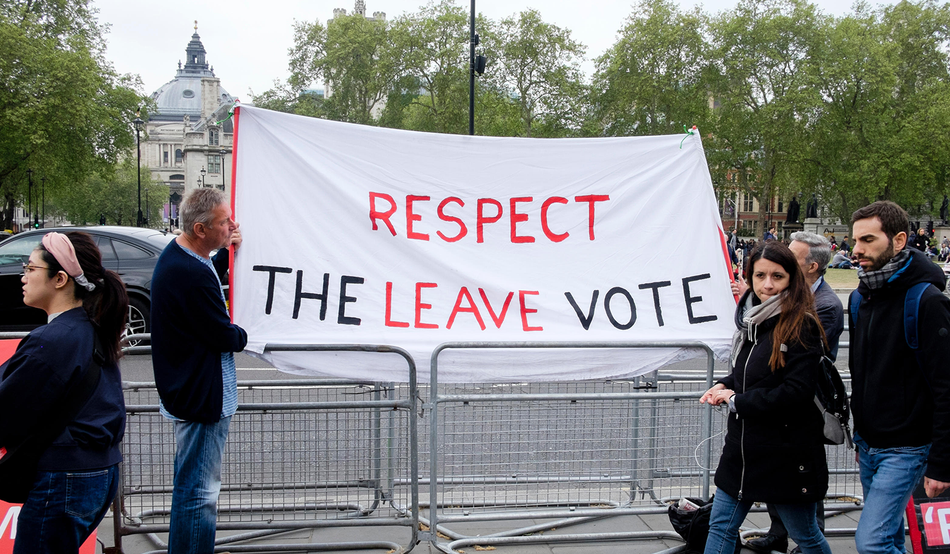
Well good luck to them. There will always be the diehards who never stopped wearing the T-shirts. A few nostalgic souls hoping to recapture the excitement of their late-middling years. But the context today is entirely different from the summer of 2016. Back then, the band could chant songs of hope. Forget Project Fear, they offered a revolutionary path to sovereignty, growth, unlimited trade and lower immigration. Ten years later, we know better.
The unforgivable thing is that it looks very much as if their cheerleaders in Fleet Street are ready to join in. They applaud the opening bars of every familiar number. They greet the old routines as if hearing them for the first time. The band and the press sustain each other in the agreeable illusion that nothing much of consequence has happened in the intervening 10 years.
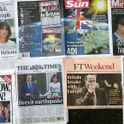
Rightly or wrongly, the prime minister is trying to start a faltering conversation about our future relationship with Europe. But to the band of faithful headline writers there’s only one word that counts: BETRAYAL! Alternatively: SURRENDER! Or, if you want three words: EU SELL-OUT! Brace yourself for a flood of new migrants, bellows the Express. Its Sunday counterpart clears its front page for a “bombshell shock analysis” which would leave every household £6,500 POORER”. Remind you of 2016? It’s meant to.
Let’s consider the origin of this bombshell report. It comes from an outfit called the Growth Commission, sometimes known as “Truss’s Taskforce” since it was convened by the most catastrophic prime minister in Britain’s history in July 2023. It was widely understood at the time as an attempt to resurrect the economic agenda which led to her calamitous, career-ending mini-budget of 2022.
Truss continues to think that she was right in her analysis of what Britain needs, and that everyone else was wrong. The Conservative peer Simon Heffer recently reviewed her self-exculpatory treatise and concluded that, of all the books he had ever reviewed: “this is without question the most deranged.”
Truss did not personally write the 176-page text relied on by the Sunday Express for its BOMBSHELL report, though she certainly promoted it. The main author appears to be someone called Shanker Singham. A trainee journalist would ask two obvious questions: who funds the Growth Commission, and what are Singham’s credentials?
The answer to the first question is: they won’t say. The investigative journalist Peter Geoghegan took a look in July 2023 and pronounced it “yet another dark money outfit in British politics—led by senior figures from US and UK free-market thinktanks who have been funded by fossil fuels, the Koch Brothers, climate change deniers, the tobacco industry and much more.”
As for Singham, he acquired the nickname the Brexiteers’ Brain back in the glory days of 2016. Some say he is a brilliant visionary. Others describe him as a Walter Mitty figure and a “total clown”. The Guardian reported in November 2018 that he does not hold a formal degree in economics. A Facebook profile claimed he studied law and economics at Oxford: in fact he studied chemistry. (Singham said he did create the profile but had not used it for many years). He “reluctantly” voted Remain because he thought the disruption caused by departure would be too great.
Now let us consider the role of journalism in society. Is it to unquestioningly amplify the provocations of highly controversial figures with funding from shadowy sources? Or do you owe it to your readers to help them form some kind of informed and independent assessment about apparently shocking claims?
The question is existential. Journalism is fighting for life in a crowded and chaotic information environment in which people increasingly say they no longer know who to believe or trust. Its only hope of being taken seriously is if it can demonstrate that it is—in the words of veteran US writer Tom Rosenstiel—a craft of “open-minded inquiry grounded in the discipline of verification”.
There is a centuries-old tradition of British journalism that doesn’t believe in that high-minded mission. There is a different mindset: We know which side we’re on. We think we know what our readers want to hear. We will give them what they want to hear.
To such people, the past ten years of evidence about Brexit is wholly irrelevant. They will dismiss the legions of economists who consider it a failed and doomed project. For them, we’re back in the summer of 2016 and there’s a fight on their hands. They know what to do.
So when a new Brexity campaign group, Stay Out, is launched, as it was last week, it can be assured of a warm bath of uncritical coverage. Tim Shipman, in the Spectator, got the scoop about the group with an article whose headline boldly asserted “Rejoining the EU would cost £750m a week.”
Who says? Well, according to Shipman the group is run by a Dominic Cummings acolyte, Oliver Lewis, who came up with the controversial £350m figure that adorned the 2016 battle bus. Shipman’s piece included an embedded link to a Stay Out video and a supportive quote from Michael Gove, who happens to be Shipman’s editor. The YouTube video is credited to OldQueenTV. The Spectator’s headquarters are at 22 Old Queen Street, Westminster.
Is this journalism, or is it an unsceptical plug for a campaign that Mr Gove wishes well? Try this exercise: use the following prompt into an AI agent: “rejoining the EU would cost £750m a week” true? Within seconds Grok will answer : “No, it is not a straightforward true figure—it is a selective campaign estimate of a gross contribution under specific (and contested) assumptions.” ChatGPT will tell you that it’s a “highly questionable figure—misleading on four counts”. Claude will also tell you that the figure is misleading—and also lists four grounds for why the figure should be taken with a pinch of salt.
Try the same exercise with the bombshell Sunday Express figure. Claude provides admirable context and critiques the methodology, the sources and contrasts it with the views of mainstream economists. Grok is damning: It “presents a contested think-tank projection as if it were a settled household-level cost”. Grok also explains why most economists take a different view. ChatGPT considers it “highly misleading”, listing four principal objections to the figure.
Is this what journalism has come to? That people occupying elevated editorial positions simply parrot the eye-catching claims of biased campaign groups while leaving the job of proper inquiry, context and verification to chatbots?
If laundering lobbyists’ talking points is truly the future, then journalism doesn’t deserve to survive—and it won’t. By all means let the old Brexit band get back together, but this time round journalism needs to be a critic, not a fangirl.