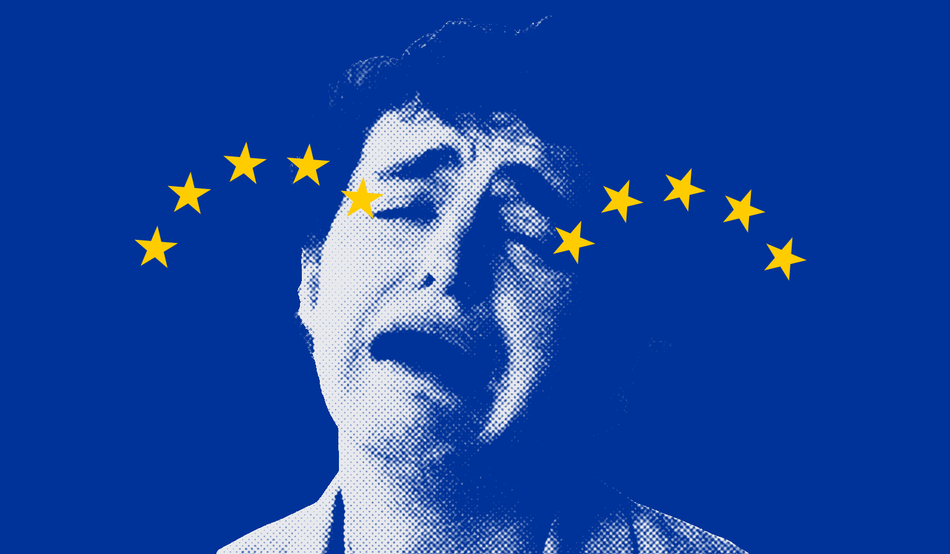
Ten years ago, Britain’s vote to exit the European Union sent shockwaves across Europe. The departure of one of the club’s largest economies cast doubts on the dynamism of the European project, and there was a fear that the result would spark a chain reaction. Eurosceptic political entrepreneurs, like Marine Le Pen in France or Geert Wilders in the Netherlands, hailed the vote as the dawn of a new patriotic spring. Commentators warned of “Brexit fever” spreading across the Channel; Frexit, Nexit and Italexit entered the lexicon of European politics.
A decade later, not one of these fears has materialised. Public support for the EU is high: nearly three quarters of Europeans say their country has benefitted from membership, according to the EU’s own Eurobarometer survey. Much of Europe’s radical right has moved from hard Euroscepticism—the politics of exit—to a softer Euroscepticism focused on changing the EU from within. Le Pen quietly dropped her referendum pledge and recast her party as defending French interests within Europe. Wilders similarly shifted away from advocating Dutch exit. And Italy’s prime minister, Giorgia Meloni, once a fiery EU opponent, increasingly presents Italian and European interests as intertwined. Ambitions to leave the EU have all but disappeared.
The Eurosceptic case rested on a particular picture of what the EU is: a one-way conveyor towards a European superstate. This was the federalists’ own story, and Eurosceptics simply inverted it. When David Cameron went to Brussels in 2016 to renegotiate Britain’s membership, his headline demand was an exemption from “ever closer union”. “Not now. Not ever,” he told the Commons. When that proved insufficient to settle the argument, the Leave campaign took it to its logical conclusion. If the conveyor couldn’t be stopped, the only remaining option was to jump off.
The truth is that the EU has never moved in one direction. It stalls, backtracks and lets members opt out. In fact, Britain, with its budget rebate and various opt-outs, was the chief beneficiary of that flexibility for decades. What the EU does instead is accumulate capacity in response to real and common policy challenges. This is why the features that British Eurosceptics found most objectionable—the EU’s slowness, endless negotiation and muddling-through—now deserve a second look. Slowness rechannels urgency into wide-ranging agreement on a direction of travel that tends to outlast a single electoral cycle. The multiple veto points that make Brussels so frustrating also make it hard to capture. In the US, a narrow majority in a handful of states can hand one person the power to rewrite foreign policy in a matter of weeks. That would be impossible in Europe.
The deeper misunderstanding of the EU concerns sovereignty. The slogan of “taking back control” depicted political authority as something that lives cleanly inside borders and can be exercised in full autonomy. Yet sovereignty doesn’t work that way. The British historian Alan Milward made this point decades ago, in The European Rescue of the Nation State (1993). Post-war integration in Europe was designed to “rescue the nation-state” by giving governments new tools to deliver prosperity and security after their catastrophic failures in the first half of the 20th century. This idea of strength through cooperation is just as relevant today. In a world of deep interdependence, sovereignty is more about the ability to shape events than the imaginary freedom to decide alone.
This is what we call effective sovereignty, and it is what EU membership is really about. The term refers to the collective ability of Europeans, acting through common institutions, to shape outcomes their states cannot control alone. Even the largest European countries cannot on their own set the terms of trade with Washington or Beijing, the standards for artificial intelligence or geopolitics. When the EU negotiates a trade agreement or writes a digital rulebook, it widens the menu of options available to national governments and prevents member states from simply becoming takers of rules made elsewhere. This is not a claim about projecting might. Europe’s history of projecting power abroad is one of domination and conquest, and nobody should wish for its return. Effective sovereignty is more modest, and therefore a more useful instrument for governments.
After Brexit, formal autonomy was recovered in full—but practical control was not
Britain since 2020 has been a controlled experiment in the alternative. Formal autonomy was recovered in full, but practical control was not. British exporters follow European standards they no longer help to set. The “reset” begun by Keir Starmer and now inherited by Andy Burnham is an attempt to settle matters such as food standards, educational exchange and access to European defence initiatives on terms that reflect the bargaining weight of a single market of 450m people. These are questions Britain once settled within Brussels. It now settles them, slowly and expensively, in negotiations with Brussels. Taking back control often meant less effective sovereignty.
The change in Britain’s political debate is telling. Former Conservative prime minister John Major has called for Britain to rejoin the single market within five years, while George Osborne, Cameron’s chancellor, now argues for rejoining a customs union with the EU. Public opinion has shifted too. According to YouGov, half of Britons support rejoining the single market and customs union, while 59 per cent favour a closer relationship with the EU. Strikingly, this includes 54 per cent of Leave voters. Even Burnham, though still bound by Labour’s 2024 manifesto pledge to stay out of both, has now floated a return to the single market and customs union—or, as he put it, going “all the way”. The terms of the debate have shifted.
The world around Britain has changed too. The Brexit referendum took place only months before Donald Trump first entered the White House. Since then, the assumption that the US would indefinitely underwrite British and European security has become much harder to sustain. Trump’s return to power has made the US pivot away from Europe more explicit, while Russia’s war against Ukraine has made the costs of acting alone hard to ignore. Britain may have left the EU, but it cannot escape this geography.
Brexit thus leaves us with two ironies. First, it helped discredit exit just as Eurosceptics on the continent turned to changing the EU from within. Second, it came just before political and geopolitical change made European cooperation more consequential. Brexit was conceived in the world of 2016, but that world no longer exists.
None of this amounts to uncritical Europhilia. To be sure, the EU leaves a great deal to be desired. But the world in which going it alone seemed plausible is long gone. The US and China are locked in a strategic competition that treats trade, technology and finance as instruments of statecraft, and each expects smaller powers to pick a side. In such a world, states acting on their own simply inherit decisions made elsewhere. In the words of the arch-Eurosceptic Jacob Rees-Mogg, they risk becoming “vassal states”.