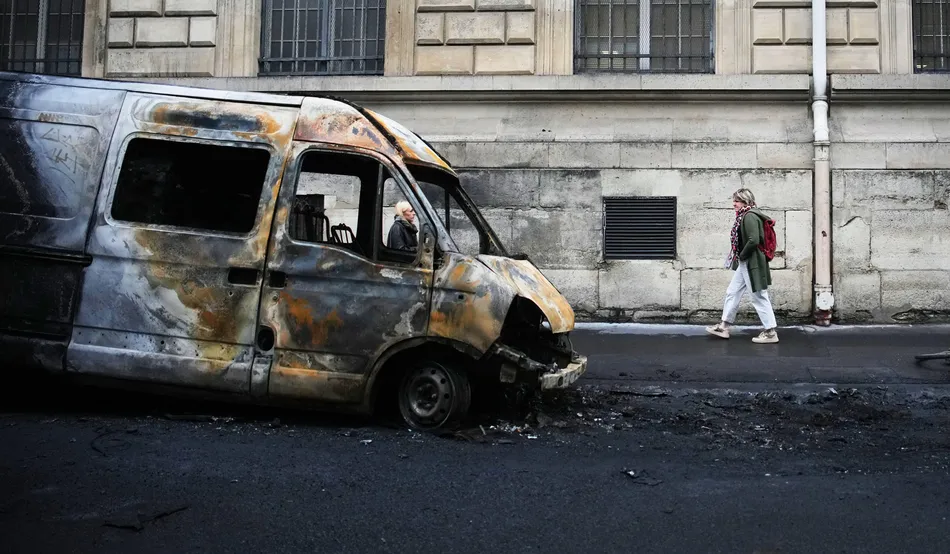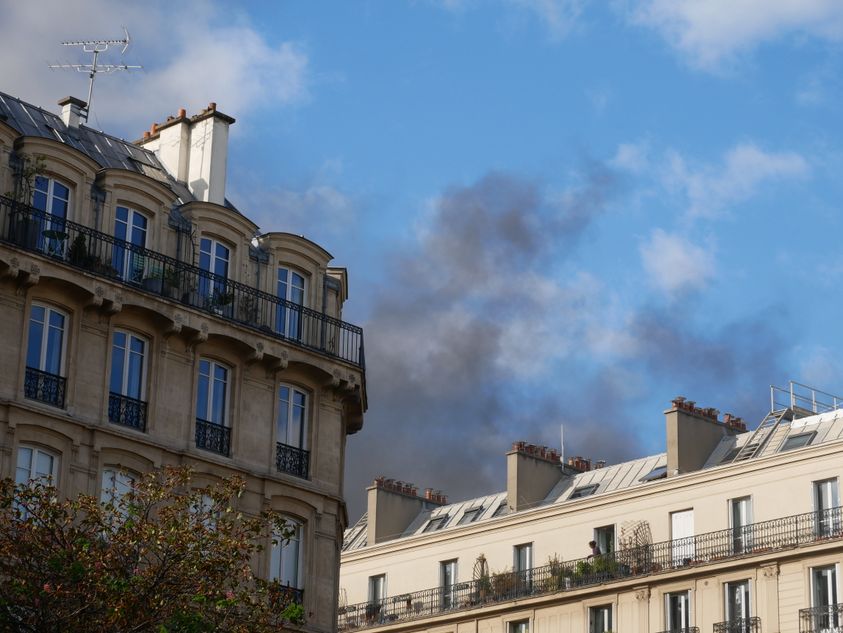
As she looked at a burning barricade made up of electric bikes, Selma worried the protest was slipping away from French students. None of this, said the 16-year-old schoolgirl, pointing to the broken shop windows and the tear gas drifting above her head, had anything to do with their demands for a better, fairer education.
“Cockroaches have been running around my history classroom for weeks,” she told Prospect near the Place de la République in Paris on Saturday. In her hand was a sign that read: “Sorry for the bother, I’m fighting for my future.”
Almost two months after la rentrée—back to school—she had yet to meet her maths teacher. “Students took to the streets because we feel ignored,” Selma said, “but I can already tell it’ll be even worse tomorrow.”
In the charred aftermath of a historic student-led protest, she predicted, adults would inevitably focus on the political fallout of the violence that had taken place at its margins, not on the students’ demands at its heart.
She was right. By Sunday, the headlines belonged to the burning town hall in Limoges, the masked mobs and the looted shops. Emmanuel Macron went on television vowing to make the “insurrectionists” pay. As for the students, whose meteoric movement had brought more than half a million people to the streets in solidarity the previous day, the French president invited them to file their complaints on a government platform. “This,” he concluded, “will enable us to work with our youth to develop appropriate solutions.”
France’s students, it turns out, have been working on solutions of their own for some time. The measures they laid out as early as 4th October are much more specific than their critics let on.
The first is an emergency plan to renovate dilapidated and unsanitary school and university buildings.
In the overseas French territory of Mayotte—where the student protests first began in late August–demonstrators took to the streets to denounce conditions at a school built for 900 that now crams in 2,300 pupils. There was little media coverage of their demands for an end to overflowing toilets and boiling classrooms in the Indian Ocean archipelago.
But the world began to pay attention by mid-September, as high schoolers across mainland France began protesting too. Students reported similar dereliction: crumbling ceilings, cockroach infestations, contaminated water, mice droppings in cafeteria microwaves. When pupils returned to school after holidays just weeks earlier, classrooms had not yet cooled from the summer’s successive heatwaves, and they now demanded buildings fit for a changing climate.
Another demand lost in Saturday’s smoke concerns not just material conditions, but the very thing that brings pupils to school—learning—and in this they have joined arms with their teachers. In Créteil, a working-class suburb of Paris, students stood beside their educators in protesting against teaching vacancies. The shortage of teachers is a nationwide epidemic, and their grievances travelled fast. In 2025 alone, students nationwide lost some 20 million hours worth of lessons by teachers who were never replaced by an education ministry gutted by a decade of budget cuts. The government has cut a further 3,256 teaching posts so far this year. Nurses, career counsellors and janitorial staff are in short supply too.
The students also demanded a better work-life balance, and a break from the gruelling 8-to-6 school day imposed by successive education reforms. Somewhat Frenchly, they demanded a “proper lunch break, of at least an hour-and-a-half”. Their plea for better-organised schedules soon saw the protest spread far beyond disadvantaged schools. By 1st October, the interior minister reported that more than 1,000 of France’s 3,700 high schools had been affected, with over 200 of them blocked by students.
Protesters also asked for the repeal of Parcoursup, France’s controversial admissions platform for higher learning institutions. This computer program, often described as a “black box” by anxious students, was created during Macron’s first term. Students say they have been forced to bet their future education on an algorithm no one will explain to them, describing it as elitist, discriminatory and a “social selection machine”.
Other protest demands include guaranteed access to €1 subsidised meals for all students, the repeal of the Macron-era differentiated tuition fees for non-European students, a freeze in subsidised student rent and improved student housing.
These are not luxuries. The demands explain why so many parents, workers and unions marched alongside teenagers on Saturday: for many families, empty fridges and empty classrooms tell the same story of gutted public spending and disregarded citizens.
The state’s sharpest response, beyond a draft 2027 budget that raises education spending by just 1.7 per cent (below inflation), has been policing. The government, which chose to label the movement not as a “school protest” but as “urban violence”, sent police riot squads to school gates and into classrooms. By 9th October the justice ministry had counted 6,877 arrests, 86 per cent of them minors. A 14-year-old had his jaw fractured and most of his teeth knocked out after being struck in the face by a tear-gas grenade. A 15-year-old in the north had his hand torn off by a so-called anti-encirclement grenade. On Saturday, in the eastern town of Mulhouse, 17-year-old Maïssa was struck by a tear-gas canister and lost her left eye.
These are the children the government’s platform was meant to hear.
In conversation with French writer Emmanuel Carrère for a 2025 Guardian profile, Macron made a confession that now reads like a verdict: “I was never a teenager. I don’t like teenagers. I don’t understand them.”
A president need not like teenagers. But when they spell out what they need, down to the length of the lunch break, “I don’t understand” starts to sound less like a confession, and more like a choice.