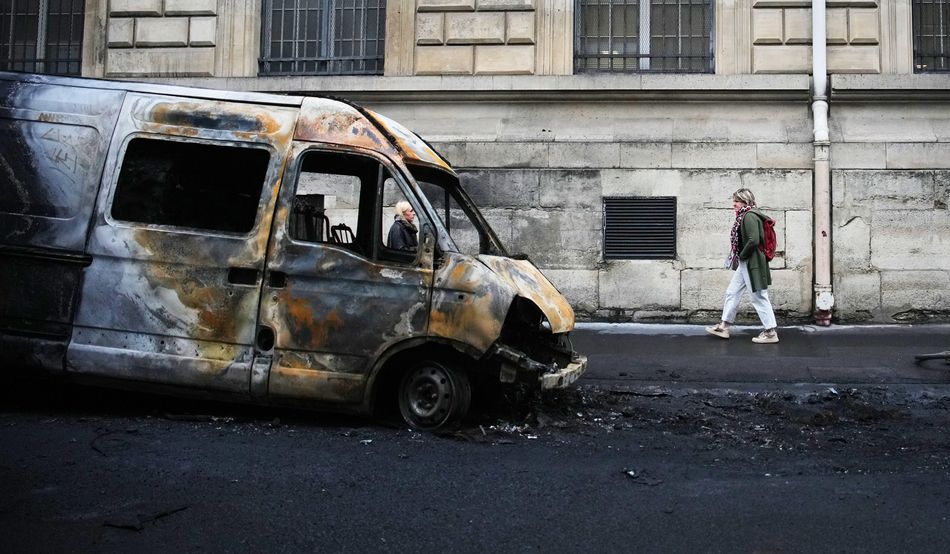
Serious rioting in the capital and several other cities, sparked by protests against the government. Public buildings set alight and shops ransacked. Then a massive police crackdown. Some 4,000 arrested, mostly young people with existing criminal records who were doing the looting and the violent disorder.
No, not France or Italy last weekend but England in August 2011, when protests against the police shooting of Mark Duggan in Tottenham, north London triggered days of riots—the worst in England in living memory. A big debate followed about the causes and consequences, with economic stagnation, youth unemployment and radicalisation all included as potential factors. Ultimately the riots rapidly fizzled out; there was no escalation of disorder.
It looks as if the violent outbreaks in Paris, Milan and a few other European cities are on the model of England 2011—not France 1968, let alone 1789. In other words they were spontaneous demonstrations of discontent followed by rioting and looting, much of it probably copycat, but not militant attempts at regime change, let alone the beginning of a revolution.
In particular, contra Donald Trump and far-right shills, none of the recent disturbances appear to have been race riots or race-inspired. The initial demos in Paris, in impeccably middle-class arrondissements, were about the dilapidated state of France’s schools. In Italy, the spark was cost-of-living protests, protests in northern cities, while truckers and farmers blockading the port of Naples and other choke points across the south. The disruption all of this has caused is serious, but it is far from unprecedented in postwar Europe. It is certainly not an indication of true civilisational conflict.
As for concern about the rise of populist extremism in Europe, this isn’t misplaced. But in the context of these protests and riots it needs to be calibrated.
Despite loose references by journalists to “extremist militants” amid the rioters in France and Italy, the populist right and left in neither of those countries—nor in Germany, nor virtually anywhere in Europe today—do the populists of right or left command armed vigilantes as they did in the 1930s. Marine Le Pen and Jean-Luc Mélenchon may be rabble rousers, but they aren’t violent revolutionaries; this isn’t fascism vs. communism. Le Pen’s speech after the riots—delivered presidentially behind a desk in a book-lined study—was pretty much the same appeal for order and support for the police as Emmanuel Macron’s address from the Elysée palace (albeit blaming the incumbent president for weakness and exhaustion).
As for Italy, it already has a populist right-wing head of government in Giorgia Meloni, and no she isn’t a prancing Mussolini. She won an election not a coup. She is tough on illegal immigration and trumpets law and order, but within conventional conservative democratic norms. Last week she made a major speech supporting Volodymyr Zelensky and a free European Union. In this, she not only took a stand against Donald Trump and Vladimir Putin but, in effect, also the oppositional far-right of France and Germany and their glib claims that stopping aid to Ukraine would be a quick fix for European prosperity.
The problem for Meloni and Macron—and Friedrich Merz, Andy Burnham and everyone else in power in Europe—is that they haven’t got much of a prosperity agenda to offer, either. And with AI coming fast down the track, even today’s levels of prosperity are under threat, particularly for the young and the poor. The closest that leaders have to a quick fix is to close Europe’s borders to immigrants, which is happening country by country. But when the borders close to outsiders and growth doesn’t follow, what then?
Revolutions and revolutionary ideologies flourish when societies collapse, either from war or economic disaster. Today’s problems, and protests, are located in a categorically more benign world of stagnation. To put this in perspective: between 1929 and 1932, German industrial production more than halved, on top of the catastrophes of the First World War. By contrast, since 2018 Germany’s industrial production has fallen by about nine per cent, after decades of peace and almost uninterrupted growth. This is the difference between stagnation and catastrophic meltdown.
So the riots are a stark warning, but they are a call to action rather than cause for alarm. Preventing Russia from inflicting more war on Europe is one priority. Civilising AI is another. Boosting European services and industry, and education and training, are all vital too. This is all doable, just don’t panic.