In the first weeks of the Iran war, Donald Trump faced a serious mutiny in the ranks of the Maga coalition. This particular rebellion was led not by Republican lawmakers, a faction within his administration or right-wing columnists (though many of them were unhappy about the conflict). It was led by standup comedians.
All these mutineers had played an important part in Trump’s 2024 presidential campaign, hosting him on their hugely successful podcasts and amplifying his message to their young, predominantly male, audiences. They had believed his promises that, if re-elected, he would end, once and for all, US engagement in “forever wars” and put “America First”.
So what was the president, not yet 18 months into his second term, up to in the Gulf? In the episode of his show Flagrant posted on 4th March, New York comic Andrew Schulz bristled at the betrayal of Trump’s electoral base. “Americans don’t give a fuck,” he said. “Americans can’t fucking afford healthcare. Like, why do they care about what’s happening in Iran?”
Theo Von, the Louisiana-born host of This Past Weekend and a guest at Trump’s inauguration in January 2025, was even angrier. “I’m sick of rich people not putting their fucking kids over in these wars,” he said. “Put your fucking honky-ass kids up there!”
Worst of all for Trump was Joe Rogan, a standup for almost 40 years, owner of the Comedy Mothership club in Austin, Texas, and host of the most successful podcast in the world. The three-hour episode of The Joe Rogan Experience on which the GOP nominee appeared in October 2024, posted 12 days before the United States went to the polls, racked up more than 60m views on YouTube alone.
In his acceptance speech, Trump personally thanked “the mighty and powerful Joe Rogan”. And in her revealing Vanity Fair interview in December, White House chief of staff Susie Wiles referred to “the new members of the Trump coalition, the people that I think about all the time… It’s the Joe Rogan listeners.”
No surprise, then, that when Rogan declared the attack on Iran “so insane” on 10th March, the news made the homepage of the New York Times. “He ran on ‘no more wars’,” the comedian said. “End these stupid, senseless wars. And then we have one that we can’t even really clearly define why we did it.”
Though the sheer scale of Rogan’s reach makes him an outlier, he is not an anomaly. The influence of standups in the public sphere is one of the most striking and unexpected features of the information ecosphere in 2026. But it has not happened overnight.
The influence of standups is one of the most striking features of the information ecosphere in 2026
Scroll back to 2014, when the caustic Australian comic Jim Jefferies surprised everyone, including himself, when a gutsy bit on US gun control in his Netflix special Bare not only went viral but was heeded by politicians and adopted as a teaching tool by university faculties.
Jefferies, who had made his name telling jokes about dysfunctional families, booze and sex, decided, as if on a whim, to dip a toe into seriously controversial waters—and found himself very much at home. On the National Rifle Association’s response to school shootings, he said: “They go, ‘We’ll put an armed security guard at every school across America.’ Yeah, that’ll work out. The average security guard in America earns $16 an hour. Not a lot of wiggle room to be a fucking hero! Someone comes onto the school and… [mimics a machine gun] and you’ve got Kevin. Now, I’m sure Kevin’s shit-hot at Call of Duty—but it might not fucking cut it, ladies and gentlemen.”
Almost overnight, a lager-swilling shock comic was being hailed in the media as a political commentator of substance. To this day, the Jefferies clip surges on YouTube whenever there is a mass shooting in the US. What started as just another joke—at the expense of sanctimonious Second Amendment defenders—has become a polemical text.
This shift in comedians’ social function has not been confined to America and Australia. In this country, TRIGGERnometry, launched in 2018 by friends and fellow standups Konstantin Kisin and Francis Foster, has become one of the most popular independent news and political podcasts, with secondary markets in the US and Canada. Though opposed to wokery and strongly supportive of free speech, the presenters consider themselves non-partisan and have hosted many left-wing and liberal guests, including Mehdi Hasan, Hasan Piker, Deborah Frances-White and Aaron Bastani.
More significant than the precise ideological profile of their interviewees, however, is the escalating seniority of the figures who have appeared on the show—from US presidential contenders such as Ted Cruz and Vivek Ramaswamy to Benjamin Netanyahu, who is generally wary of UK media but appeared on TRIGGERnometry in August. Whatever you think of the Israeli prime minister, it was quite a scoop for two club-circuit comedians.
To understand this cultural and political phenomenon, it’s important not to conflate standup with comedy in general. It is not the same as the sketch format of Saturday Night Live (SNL), recently exported with provisional success to the UK. It is different to panel and satirical shows. It has little in common with sitcoms—the conspicuous exception being Seinfeld, which was inspired by the respective experiences of Jerry Seinfeld and Larry David as club performers.
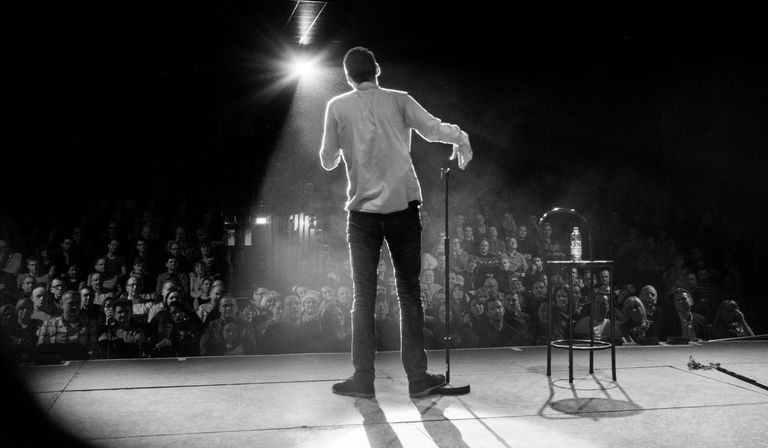
What distinguishes and defines standup is its brutal, Darwinian simplicity: a lone comedian with a mic, frequently against the bleak backdrop of a brick wall (a tradition that stretches back to the legendary hungry i club in San Francisco, where Mort Sahl, Lenny Bruce, Woody Allen, Phyllis Diller and Dick Cavett all performed in the 1950s and early 1960s).
It is no accident that comedians frame their own performances in terms of life and death: “killing”, “murdering”, “destroying”, “bombing”, “dying out there”. And, cruelly, the iterative failure that enables the comic to sharpen their material is the only route to success. As Chris Rock has said, “At the core of this ability is an understanding that you can learn more from bombing than killing.”
The rise of standup to its present hegemony has been long and far from linear. Its high style can be traced back to America’s greatest humourist, Mark Twain, whose stage performances drew thousands to venues all over the world. No less than his distant successors in cellar clubs a century later, Twain aimed “to vanquish an audience”.
But standup as we know it today has earthier, more demotic roots in early 20th-century vaudeville and burlesque. The emerging genre was given its name by the mob bosses who ran the dinner joints and clubs from the 1940s—a dependable boxer was a “standup fighter”, and the label was soon applied to the comics who could keep a room happy and the bar bills open.
Until the mid-1950s, the epicentre of standup was the so-called “Borscht Belt” of the Catskill mountains in south-eastern New York State, featuring mostly Jewish performers such as Milton Berle, Myron Cohen, Henny Youngman, Jack Carter and Joey Adams. Their stock-in-trade was the all-purpose, non-political joke that would put an audience of vacationing Americans at its ease.
The first revolution, seeded in San Francisco and Chicago, turned the art form on its head. As Gerald Nachman writes in 2003’s Seriously Funny: The Rebel Comedians of the 1950s and 1960s, “This new post-Korean War comedy poked and prodded and observed, demolishing fond shibboleths left and right; it didn’t just pulverise us with a volley of joke-book gags.”
Sahl, introduced at the hungry i as “the next president of the United States”, dared to mock Joe McCarthy in his prime and would ask an audience, “Are there any groups I haven’t offended?” Bruce’s repeated arrests for obscenity and constant legal battles both destroyed and immortalised him. Dick Gregory was the first breakout comedian of the civil rights era and a trenchant critic of Jim Crow racism (“Segregation is not all bad. Have you ever heard of a collision where the people in the back of the bus got hurt?”).
In the same period, open-mic nights—a sink-or-swim, no-fee, five-minute opportunity for novices—became a fixture in American clubs and have spread all over the free world. It is how the teenage Dave Chappelle got his start in Washington DC and New York, as did Rock, Ali Wong and Kevin Hart. This cut-throat rite of passage was recently celebrated in Bradley Cooper’s movie Is This Thing On?.
By the mid-1960s, the foundations of modern standup were secure and a talent pipeline established to nurture superstars such as George Carlin, Richard Pryor and Robin Williams in the 1970s; Eddie Murphy, Sam Kinison, Seinfeld and Roseanne Barr in the 1980s; Chappelle, Rock, Bill Hicks, Norm Macdonald, Mitch Hedberg and Janeane Garofalo in the 1990s, which was also the decade of Def Comedy Jam on HBO, an all-important showcase for the surge of black standup comedians; and then the giants of the new century, such as Hart, Bill Burr, Louis CK, Sarah Silverman and Maria Bamford.
But the question remains: how did a well-established genre of global popular entertainment mutate into a force that could alarm the White House and shift the dial of political media? There are, I think, three main reasons.
First, the digital revolution has transformed standup (as it has everything else). Technological shifts had always played a key role in the evolution of the art form. The arrival of long-playing records in 1948 enabled comics to release their own albums, making stars of Shelley Berman, Bob Newhart, Mel Brooks, Allan Sherman and many more. Carlin and Pryor each won five Grammy awards.
In the 1980s, the advent of cable networks such as HBO turbocharged the standup comedy special—notably, Murphy’s Delirious (1983) and Williams’s An Evening at the Met (1986). Even more important was the global spread of VHS cassettes and then DVDs, enabling customers to record, rent or buy performances and watch them whenever and as often as they liked.
Chappelle’s superstardom began with the cult success of his show on Comedy Central but was sealed by the sale of more than 4m DVDs. In the 1990s, standups began to host current affairs slots: Bill Maher’s Politically Incorrect on ABC and Comedy Central, and Jon Stewart on The Daily Show, also on Comedy Central. In 2004, one in five 18- to 29-year-olds were getting their presidential campaign news from comedy shows.
But the technological accelerant of digital media is without precedent. The internet is not simply the most advanced vector of distribution in history. It also disempowered the old gatekeepers who had, to a great extent, determined which comedians did get a shot—and which didn’t.
A five-minute set on Johnny Carson’s Tonight Show could make a career; even better, an invitation to sit down and talk with the host if he liked your style. One of the tragedies of Hicks’s life was the censoring by CBS in October 1993 (five months before his death of cancer, aged only 32) of a routine on Late Show with David Letterman about the folly of the pro-life position. Letterman did not broadcast the bit and apologise until 2009.
Now, a comedian only needs $100,000—perhaps less—to record a one-hour special and upload it to YouTube, where it generates ad revenues and promotes tour ticket sales. When Shane Gillis was hired and fired in the space of four days by SNL in September 2019, after podcast clips surfaced of him using language that the show deemed racist and homophobic, it was assumed—according to the old rules of showbusiness—that he was finished. Instead, he recorded his own special for YouTube, Live in Austin (2021), which has notched up 53m views to date, established him as the best Trump impersonator on the planet and relaunched his career as a stadium-filling comic—a career over which he has total control.
The digital age has also given standups the greatest arena they have ever had, thanks to the rise of streaming services. Netflix leads the field, dropping about 50 comedy specials a year. In 2016, Chappelle signed a $60m deal with the platform, which has so far yielded eight specials (in 2019, Sticks and Stones reached more than 20m viewers in its first month).
Comedians were also quick to spot the potential of podcasts: Ricky Gervais and Stephen Merchant in this country in 2005, and Rogan and the more liberal Marc Maron in the US four years later. Unfiltered, lo-fi and personality-driven, these shows are easy to consume on the go, framed in the language of normal conversation rather than the straightlaced idiom of the mainstream media—and (obviously) funny. They have left most journalist-podcasters with a traditional background in the dust—another reason why they were so important in the 2024 presidential contest.
Second: the cultural context in which these new technological vectors became available was perfectly primed for standup. Part of the comedian’s job description is—or should be—to oppose authoritarianism, speech codes and censorship in whatever form they arise. In the past, this has usually pitted comics—Bruce, Carlin, Pryor, Hicks—against the conservative right and the moral majority.
More recently, however, the threat to irony and what Chappelle calls “reckless talk” has come from the left, or, more specifically, the woke left. As Jefferies has pointed out, the dead hand of literalism is often the problem: “You can joke about anything. A joke doesn’t mean intent… Not my opinion. It was a joke I said, not my opinion. Not something I think, something that I think is funny.”
In the high season of woke censoriousness, standup comedians were the spear’s tip of the defence
In the high season of woke censoriousness, as governments and cultural institutions fumbled and faltered, standup comedians—no longer dependent upon the goodwill of television networks or big brand advertisers—were the spear’s tip of the defence of this most basic democratic freedom. Under a shadow of dreary earnestness, they hosted speakeasies where the bill of fare wasn’t prohibited booze but fearless speech and independent thinking.
In this sense, they were also way ahead of the curve: spotting the cultural recoil from wokery, campus mobs and speech policing that would play such a significant role in the battle between Trump and Kamala Harris. When others—in media, publishing and politics—kept their heads below the parapet, the comedians were on the front line. The speed of their response was rewarded by a surge in public credibility: on comedy specials, in clubs and on podcasts, their audiences felt seen.
Third, and most profoundly, standups have been the unexpected beneficiaries of the catastrophic collapse of trust in traditional institutions: the political class, the mainstream media, the courts, the police, even, worst of all, academic science. But our bond with comedians has not been ruptured. Improbably, the court jesters, the lords of misrule, have assumed a role that ranges from polemical to shamanic.
In his mesmerising response to the murder of George Floyd, 8:46, recorded in Yellow Springs, Ohio, on 6th June 2020, Chappelle identified precisely what was happening: “It’s serious. The only reason that people want to hear from people like me is because you trust me. You don’t expect me to be perfect. But I don’t lie to you. I’m just the guy. And I don’t lie to you. And every institution, every institution that we trust… lies to us.”
On his podcast Club Random last May, Maher, who still describes himself as a liberal, told right-wing commentator Tim Pool much the same thing: that honesty was the non-negotiable basis of his trade—even if it meant, for example, upsetting progressives by refusing to say that he had hated Trump after they had dinner in March. “I am not a liar,” is how he put it. “That’s my main bond with the audience. So even if I offended some people by telling the truth, in the long run, that’s what I do.”
Indeed, no critique of the Democrats’ failure in 2024 has struck such a nerve as the viral clip of the impeccably left-wing Maron in his HBO special Panicked last August: “Progressives have really got to figure out how to deal with this buzzkill problem. You do realise we annoyed the average American into fascism?” He pauses. “No one can ruin a barbecue quicker than a liberal: ‘So, you want something from the grill?’ ‘What about the genocide?’”
The risks inherent in this transference of trust ought to be obvious. When Rogan repeatedly expressed deep scepticism about the Covid vaccine and (against all official medical guidance) championed ivermectin as treatment for the virus, he provided a real-time lesson in the perils of over-mighty amateurism—during a global health crisis.
But as his friend and fellow standup Whitney Cummings tweeted in February 2022, “Don’t look to why so many people trust Joe Rogan, look to why so few people trust the mainstream media.” Warming to her theme, she added: “Comedians did not sign up to be your hero. It’s our job to be irreverent and dangerous, to question authority and take you through a spooky mental haunted house so you can arrive at your own conclusions. Stay focused on the people we pay taxes to to be moral leaders.”
Which was, and is, the point. Comics revel in absurdity—and there are few things more absurd than people seeking medical advice or political guidance from people whose job is to make them laugh, discard their inhibitions and have a good night out.
The ascendancy of the standups is a reproach to every other part of the polity; to those who have failed in their roles as civic leaders, political representatives and custodians of the public trust. If the mic is left open and the audience is restless, someone will seize it and crank up the shtick. Which is precisely what the standups did.
Now that’s what I call a punchline.