The event is invitation-only. After some asking around, a flyer arrives via WhatsApp. To secure my ticket, I fill out a form and wait to be sent the secret location the night before. No, I’m not heading to an underground rave; I’m attending a Reform press conference.
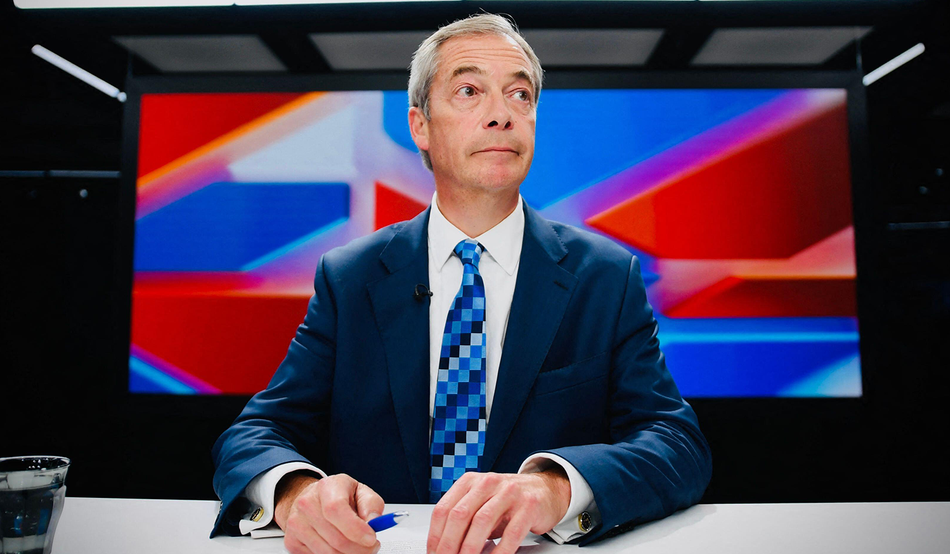
It’s the Monday after the Gorton and Denton byelection. The secret location turns out to be Church House, a venue next to Westminster Abbey, right by Reform UK’s HQ on Millbank. Onstage in the high-ceilinged, wood-panelled room are a giant sky-blue banner adorned with a faint Union Jack, a desk, and a lectern flanked by two glass teleprompters. Behind the rows of seating is a bank of television cameras. Studio lighting beams onto the stage. The room is half full of journalists from all the UK’s major outlets and there are teas and coffees at the back. For those who arrived early (not me), there were pastries too. I take my seat and wait.
Right on schedule the doors swing open and a procession of Reform politicians files in, flanked by four security guards. Zia Yusuf (former head of policy and now spokesperson for home affairs) and Richard Tice (deputy leader and business, trade and energy spokesperson) take their seats in the front, followed by Nigel Farage and new(ish) recruit Robert Jenrick, who both head to the stage. The photographers are on their feet, snapping dozens of pictures of the politicians, all in matching sharp navy suits with crisp white shirts and ties in various shades of blue. Jenrick uses his speech to brief against Rachel Reeves ahead of the Spring Statement, “exposing” her ties to the chairman of a mosque in Leeds who allegedly has “abhorrent” views.
Slick is the word that springs to mind as Farage and his entourage exit the room
Slick is the word that springs to mind as Farage and his entourage exit the room. From invitations to format to production, it’s glossier and more professional than your average political presser. Reform tends to host at least one such event a week, often laying on coaches to take journalists to locations outside London. If you’re curious, you can see for yourself: every press conference is livestreamed on TikTok, YouTube and X.
For decades, the UK’s politics have largely been defined by two parties, but two challengers to Labour and the Conservatives emerged during the 2024 general election. Reform and the Greens sit clearly to the right and left of the establishment parties, seeking to overturn the old adage that elections are won from the centre ground. I spent just over 10 years working and volunteering as a communications adviser and field organiser for various Labour campaigns and candidates. Following Reform and the Greens in the runup to and aftermath of the Gorton and Denton byelection, I found two powerful political forces more than ready to further disrupt the status quo.
An interview with Green leader Zack Polanski ahead of the byelection is a completely different experience to Reform’s press conference: no secret invitation, no free coach. Instead, I catch the train to Levenshulme in south Manchester and meet the party’s head of elections, Chris Williams, for lunch. Williams is warm, softly spoken, dressed in a neatly patterned navy jumper and jeans and unaccompanied by a press officer. After talking over Lebanese food about MRP polling (a novel technique) and betting markets, we drive to campaign HQ, situated in a former estate agent’s office. As we arrive, some young activists are spraypainting the front of the building from gold to green. There hasn’t been time to paint the inside, which is covered in a garish black and gold wallpaper (in the bathroom, the old estate agent sign is wedged in a not very clean-looking bathtub). Slick is not the word that springs to mind here and, until Polanski arrives, there is not a single suit in sight.
Still, the whole building hums with activity. As we enter, careful not to touch the wet paint, a dozen people of various ages stand around two large foldable tables, stuffing and bundling letters to be hand delivered locally by volunteers. A slightly stern woman with grey hair and a pink, purple and yellow cardigan is directing proceedings, while some of Williams’s team lurk on the edges, tapping away on laptops. I’ve spent enough time in campaign offices to know a well-run field operation when I see one. A pile of stickers with Green candidate Hannah Spencer’s name above a Palestinian flag sits next to a stack of Labour-red leaflets with Peter Mandelson’s face on the front. The latter must have been produced and printed within days of the latest Epstein scandal breaking.
By the time I come back downstairs after interviewing Polanski, the tables have been replaced by canvassing teams ready to knock on doors. Journalists are free to talk to the activists, who are a mix of local party members and people who have never been involved in a campaign before. Claudia, who lives in Denton, the part of the constituency that leans Reform, came straight from a cleaning shift. New to politics, she hovers nervously near the door. “I’m hoping to meet Zack and Hannah,” she says. After taking her selfie with Polanski, and despite making noises about going home, she’s persuaded to go out canvassing for the first time in her life.
The Green party’s first parliamentary byelection win shocked Westminster: Gorton and Denton was a bruising defeat for Labour, which lost its 13,000 majority in the space of two years, while the Conservatives got only 1.9 per cent of the vote and lost their deposit. It was also a harbinger of doom for two-party politics; 68 per cent of voters opted for the Greens or Reform, leaving Labour a distant third.
Polanski is six months into leading the Greens; by any measure, he’s passed his probation. The party has more than doubled its polling numbers and more than tripled its membership, from 68,000 to 215,000 members and counting, according to the Greens’ figures. The party had already won a record four MPs in the 2024 election (up from one), but Polanski’s leadership has turbocharged that progress, creating a “liftoff moment”, says Williams. Polanski is already the most visible leader in the Green party’s history, with a distinctive communication style.
Polanski says becoming prime minister is ‘not where my ambition is set’
To understand the impact Polanski has had, scroll back a year on the Green party’s YouTube channel. In an old party political broadcast, former leaders Carla Denyer and Adrian Ramsay stand in front of parliament talking about how disappointing the Labour party has been. To paraphrase the first YouTube commenter, the script is dry and the production dull. Polanski’s videos are nothing like this. In one, viewed more than a million times on TikTok alone, he stands on the cliffs of Dover talking about meeting a man who wanted to shoot migrants arriving on small boats. A natural storyteller, he sounds nothing like most of his peers in politics.
When we meet, the 43-year-old is earnest and unguarded. He encourages me to interrupt him if he talks for too long, and occasionally factchecks himself during our conversation. When I ask about his rapidly ballooning profile and ability to connect with people, he says it was initially daunting but “very quickly we decided the strategy was up and out”. Polanski seems keen to stress the “massive team effort” that goes into party comms. There are new people involved in production: Jeremy Clancy, chief filmmaker for Corbyn’s Labour party, makes many of the new videos; Ross Buchanan, formerly a producer at hit podcast studio Goalhanger, makes Polanski’s Bold Politics podcast. But every party staffer I speak to agrees that the creative direction and most of the ideas come from their boss. When I push him on becoming prime minister he says he is “almost ambivalent… that’s not where my ambition is set”.
One man who has been very clear about his ambitions is Farage. “Are you talking to the next prime minister? I think so, yes,” he told a summit for crypto investors in London last October. Watching him at the Reform press conference, it’s easy to imagine Farage in the role. The 61-year-old is a commanding presence, a confident speaker, with a deep voice and polished style. I’m struck by his ability with facts and figures, though he has been known to get things wrong. One moment he is talking about British naval capacity, the next he’s citing 20-year-old voting legislation (PPERA—the Political Parties, Elections and Referendums Act [2000], which established the electoral commission). His aides boast that he has a near photographic memory.
Unlike Polanski, Farage has been part of British politics for 20 years, having become leader of Ukip in 2006. Gawain Towler, a former Ukip and Reform press officer who is on Reform’s board, compares Farage to a comedian who has spent years “doing the working men’s club circuit” before getting a shot on Opportunity Knocks (think Live at the Apollo, if you’re a millennial or gen Z). People might think “they are an overnight success. But they’re not, they spent 20 years getting there… Nigel has spent 30 years”.
Farage is ready for the main stage because he’s been honing his style for years, practising in back rooms and small venues around the UK. He is king of the soundbite, not afraid to give a straight answer, and takes heckles in his stride like the most battle-hardened standup. In March, as people yelled “Tory” at him during a speech at Reform’s local election campaign launch on the Isle of Wight, he came across as reasonable, making the heckler seem like a slightly overwrought toddler in comparison.
The rise of Reform since Farage rejoined as leader will be familiar. The party netted five seats in the 2024 election and now has eight MPs thanks to a byelection win and multiple Conservative defections. Reform won 14 per cent of the vote in 2024 but has topped most opinion polls for nearly a year, with between 25 and 30 per cent of the vote. In December, Reform announced it had 270,000 members, making it the largest political party in the UK.
Farage is a natural showman. At the Isle of Wight launch he walks onstage to pumping music and finishes his speech with confetti guns firing and giant sparklers flaring. The whole event, attended by more than 1,000 people (not all of them party members), feels like a cross between WWE and a Butlin’s holiday camp. Darren Grimes, 32, warms up the audience. Each speaker is introduced via a well-edited video. At the end, as the audience applauds, the confetti falls and the indoor fireworks go off, Farage beams with joy.
The longer I spend following Reform and the Greens, the clearer it becomes that, despite their opposing policy agendas, the two parties have much in common. Both say they are offering radical solutions to the UK’s problems. Both can credibly claim to be growing political movements, while the Conservative and Labour party memberships steadily dwindle. Both reach more people on social media than the established parties, especially on video-first platforms such as TikTok. And both have leaders who don’t look or sound like typical politicians. Farage and Polanski have personal social media followings that exceed those of their party. Polanski, a millennial who still manages his own social accounts, regularly collaborates with influencers and religiously reposts newly joined Green party members who tag him on Instagram. Farage, who Towler calls “the internet politician who refuses to use the internet”, has a team of young, digitally savvy advisers running his accounts.
As Towler is keen to point out, however, Farage has long understood the power of social media. When he was a member of the European parliament, he regularly went viral for laying into a political opponent or Brussels bureaucrat. “Nobody would report on him in the media so he had to speak via other methods,” says Towler. Both Farage and Polanski know that part of their appeal lies in their ability to cut through the noise and ennui of normal political discourse and reach their public directly. After a bruising appearance on The Rest is Politics podcast, where host Rory Stewart claimed to be “horrified” by Polanski’s grasp of economics, the Green leader addressed the criticism directly on his own show.
In response to increased scrutiny, both leaders have begun to adapt their approaches and talk more about policy. They are playing catch-up to Labour and the Tories, who have established policy units and a constellation of politically aligned thinktanks. The Reform-supporting Centre for a Better Britain publicly launched in 2025, and Verdant, cofounded by Green policy wonks, is even newer on the scene, having launched in March. In February, Farage unveiled a new head of policy, the “new right” philosopher and theologian James Orr, and a Reform “shadow cabinet” with economic spokesperson Jenrick quickly moderating the party position on the Office for Budget Responsibility. Polanski, who recently dressed up as a Dickensian character in a campaign video, adopted a more staid style in his latest speech on the economy at the New Economics Foundation in March. The setup could have been for any politician, but not the substance. Polanski advocated for rent controls, a wealth tax and renationalisation of the water companies. Still the two men walk the same tightrope: needing to seem credible without losing what makes them feel fresh and unique. At the heart of their appeal is an emotional connection with voters, not a detailed policy platform.
There are key differences between the challengers, the most notable being financial. Last year Reform received more donations than any other party, including a record-breaking £9m single donation from Christopher Harborne, the British billionaire who made his money in aviation and cryptocurrency. The Green party’s surge in membership has increased its budget but it is dwarfed by the fundraising might of Reform. With the extra money from new members, the Green party is increasing its staff by 80 per cent and prioritising campaigning capacity ahead of the May elections. For the first time, Williams has been able to afford a canvassing app and phonebanking tools. But while the Greens buy off-the-shelf, Reform has custom built its own software which, advisers tell me, rivals “a £100m Senate campaign”. Reform can afford all the confetti guns it needs and still have money left over for expensive mailshots and advertising. The party spent a reported £1m on newspaper ads around the 2025 autumn budget. Meanwhile the Greens, who raised 5 per cent of what Reform did in the last quarter of 2025, rely on volunteers to deliver leaflets by hand.
The other dividing line is the media. In September 2025, a Cardiff University study found that Reform had become the most referenced opposition party on both ITV and the BBC’s 10 o’clock news bulletins . Reform is, by its own account, a very “media-focused” party, with most outlets giving Farage and team a lot of airtime, and that’s before you factor in all the GB News clips (where Farage is a former presenter and Reform talking points are frequently discussed) circulating on social media.
One of the many donations to the party last year included £50,000 from Lady Rothermere, wife of Daily Mail owner Lord Rothermere. The Mail ran attack pieces on the Greens during the Gorton and Denton campaign, including a front-page story about the “Green Menace”. Lobby journalists descended on the Reform UK conference in droves, while the Green party’s own was barely covered. In fact, the BBC faced complaints after Laura Kuenssberg didn’t interview Polanski around the time of the Greens’ conference or when he was elected leader. (He has since appeared on her show.) No tabloids are likely to endorse the Greens; no newspaper-owners will donate to the party. It’s a gulf reflected, at least symbolically, in the party leadership: Farage is a multimillionaire; Polanski is still renting his home.
The challenger parties have two compelling, competing stories about the future of the UK, two effective messengers who can cut through political noise and two growing machines to mobilise voters and activists. In May they face their next big test: local elections in England, Senedd elections and Holyrood elections. Reform has its sights set on usurping Labour in Wales and the Conservatives across England, as well as gaining seats in Scotland; the Greens are seeking a foothold in the Welsh Senedd and London councils (the Scottish Greens compete north of the border). Reform has the money and momentum. The Greens have momentum too but, as Williams admits, “the limiting factor for us is putting that infrastructure in place quickly enough”. Scaling up at speed may be an issue for Reform as well; the party is currently running ads to recruit council candidates.
Maybe the Greens’ greatest asset lies in them being underestimated. Before the vote in Gorton and Denton, insiders from Reform and Labour told me that the Greens would suffer in a close race because they had no real ground game. In fact, Williams’s team have been winning local elections for years through grassroots campaigning. They not only got out their vote in Greater Manchester, they likely persuaded thousands who often stay home to turn out on polling day.
Before the count in Gorton and Denton, Polanski was clear about what was at stake, telling me that all that energy “doesn’t mean anything until you win an election”. It was perhaps fitting that the newest Green MP, 34-year-old plumber Hannah Spencer, had Polanski to thank for helping her into politics. “Zack has been someone who has really personally encouraged me,” she says, “but he does that to so many people.” One Reform strategist cites the strong horse theory: victory gravitates toward those who project success. If Reform is the strong horse, the Greens might be the dark horse. We don’t know yet what they are capable of.