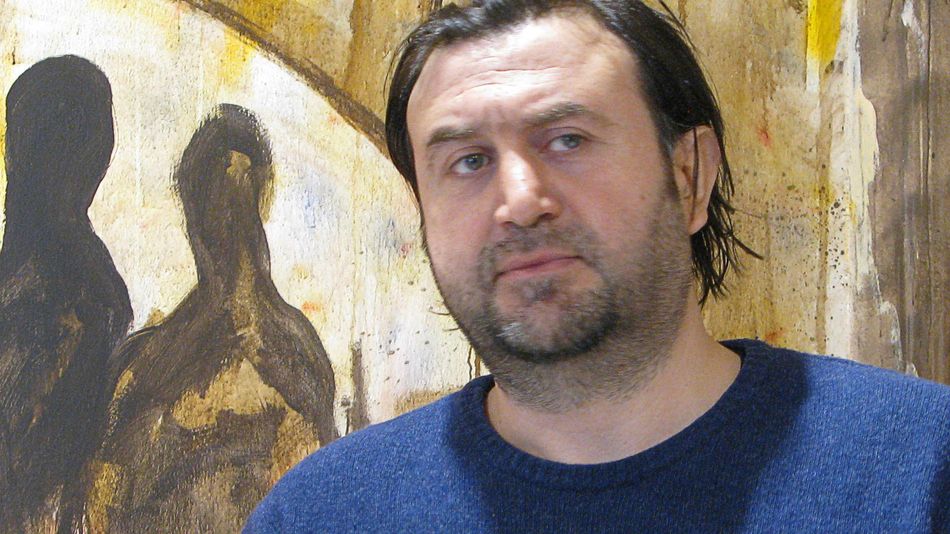
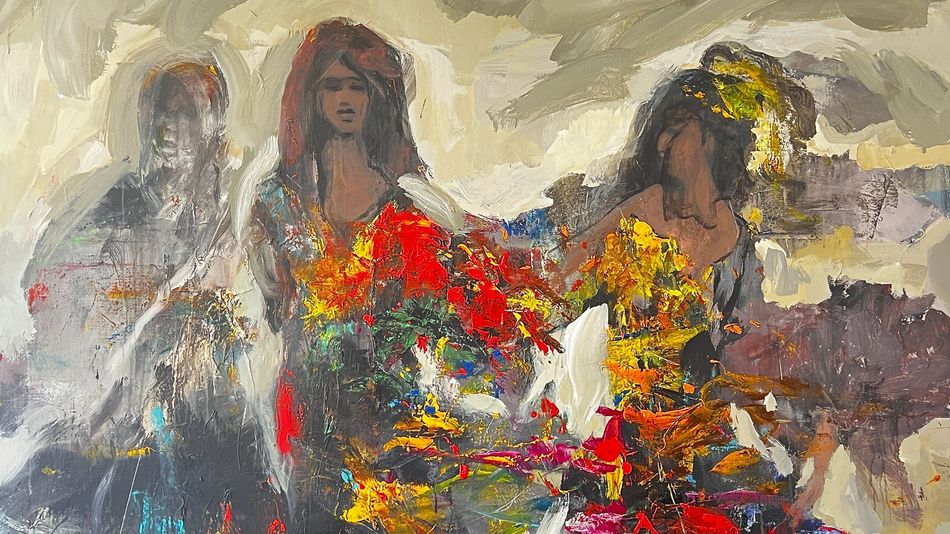
On the walls of a farmhouse southwest of Paris hang oil paintings of shadowy figures, their eyes closed or obscured by thick, black smudges. These pictures are Khaled Alkhani’s life’s work. Through each canvas, he has tried to make sense of what befell him and his family in Syria four decades ago.
Khaled was born in 1975 in Hama, the ancient city on the banks of the Orontes river in central Syria, to a wealthy, well-connected family–Khaled’s father, Hikmat, was an eye doctor and civil rights activist. But nothing could insulate Khaled from the political tensions that sporadically convulsed the city. The atmosphere “was boiling”, he recalls.
Five years before Khaled was born, Hafez al-Assad, father of the now deposed Syrian dictator Bashar, led the country’s third coup since 1963 and became Syria’s president. Hama turned into a node of resistance to the new authoritarian regime and a stronghold of the Muslim Brotherhood, the transnational Islamist organisation originally founded in Egypt. By the early 1980s, the Assad regime and the Brotherhood were locked in a cycle of attacks and vicious reprisals, and in February 1982, a small vanguard of the party staged a bloody uprising.
In response, regime troops bombarded the city and Khaled’s home was hit in the shelling. His father, Hikmat, decided that the family needed to leave, while he would stay in Hama to tend to the wounded.
Tens of thousands would be killed in the fighting. After three weeks, regime troops sent a telegram to the president from the Hama branch of the ruling Ba’ath party, declaring that the regime had suppressed the uprising and “stopped [the rebels] breathing forever”. It was the most extreme example yet of how far the Assads would go to crush dissent.
After several months hiding out in a nearby village, Khaled, his mother and siblings returned to the ruins of their hometown. Khaled’s father had not survived. Hikmat had been taken by regime troops and tortured in the city’s porcelain factory. When his body was returned to the family, it was disfigured. “They took out his eyes,” says Khaled. He believes his father “was still alive when they did it”.
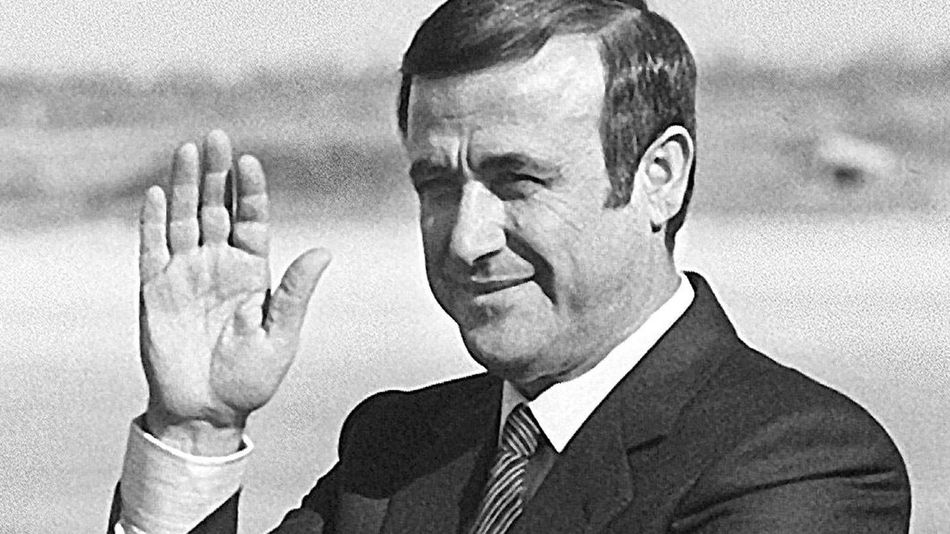
The men responsible for the slaughter in Hama were members of a Syrian military unit called Saraya al-Difa, Arabic for “the Defence Brigades”. This was the regime’s praetorian guard, loyal to Hafez al-Assad’s younger brother, Rifaat. Khaled and his fellow city-dwellers came to know Rifaat by another name: “the butcher of Hama”.
Rifaat’s defeat of regime opponents in the city solidified the Assads’ grip on power, but soon the ruling family was divided. In 1984, after Rifaat tried to overthrow his older brother, he was forced into exile. With around 200 loyalists in tow, Rifaat took refuge in the heart of old Europe: Geneva, Paris and London.
Hama’s reconstruction would take years, and much of what was damaged or destroyed in the violence couldn’t be replaced. While the people struggled to rebuild their city, Rifaat al-Assad set about building a property empire in Europe. The Assads had grown up in a farming family in the mountains of northwestern Syria, but power had accustomed Rifaat, and his wives, to a life of excess. Exile would be no different.
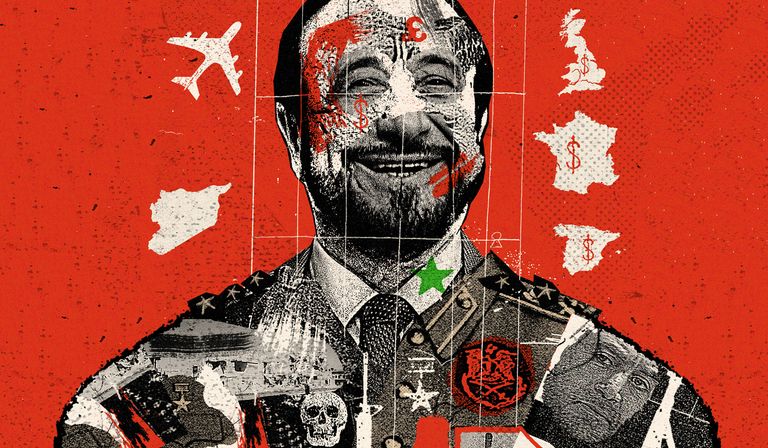
In the 1980s, Rifaat acquired properties in some of the most expensive corners of Europe. In Paris, he purchased a seven-storey hôtel particulier near the Arc de Triomphe. In Bessancourt, a small town a dozen miles northwest of the French capital, he acquired Le Haras de Saint-Jacques, a château and stable set in hectares of land. And in London, Rifaat bought the city’s second-largest private residence after Buckingham Palace: a 25-bedroom mansion in Highgate overlooking Hampstead Heath.
At the time, Europe’s old-money-no-money aristocrats were increasingly welcoming newly minted foreign oligarchs. The lawyers and bankers of a financialising west had begun to gorge on the wealth coming from abroad. And, despite a few hard-to-ignore lavish purchases, exactly what Rifaat owned was concealed by anonymous shell companies located in places such as the tiny Caribbean island of Curaçao, the British Virgin Islands and Panama.
For three decades, Rifaat’s family enjoyed a gilded exile in Europe
Stripped of the Saraya al-Difa troops, Rifaat enlisted a new corps to defend him: financiers managed his inexplicably acquired wealth, accountants shielded it from tax authorities, lawyers defended him from prying eyes and political patrons granted him access to the corridors of European power. In 1986, just four years after the Hama massacre, the Mitterrand government awarded Rifaat the Légion d’honneur—France’s highest military and civil accolade—for “services rendered to the French state”. (The precise nature of those services was never disclosed.)
For three decades, Rifaat’s family—he married four women and sired 16 children—enjoyed a gilded exile in Europe. (Rifaat himself, after returning to Syria for his mother’s funeral in 1992, spent much of the 1990s under house arrest there, before returning to Europe in 1998.)
But Rifaat could not escape the political cataclysm that had unfolded in Syria from 2011. As anti-regime protests spread and the government slaughtered protesters, French journalists began to take a closer look at the Assad living so lavishly in their midst. Pictures of Rifaat’s properties were splashed on the pages of Libération, contemporaneous reports of the atrocities in Hama resurfaced and Rifaat’s Légion d’honneur came under scrutiny. Two teams of investigative lawyers—one in Paris, one in Geneva—turned their attention to the then 76-year-old. Who was Rifaat al-Assad, really? Where, exactly, had his money come from?
One person who knew precisely what kind of a man Rifaat was had, like millions of other Syrians, been forced into exile by the civil war. Khaled Alkhani, by then an artist, had endured decades of harassment at the hands of Syria’s security services. On 6th June 2011, Khaled fled Syria permanently, first travelling to Hamburg, then Paris. Almost 30 years after the massacre, Khaled and Rifaat were once again in the same city. “We became neighbours,” Khaled says.
Late one evening in November 2013, Philip Grant, executive director of TRIAL International, a legal charity fighting impunity for international crimes, received a phone call from a Syrian lawyer. “Do you know who is currently sipping Martini at the Hotel Métropole on the lakeside?” the caller asked. The “butcher of Hama” had been spotted on the shores of Lake Geneva.
Swiss law allows the prosecution of war crimes and crimes against humanity committed abroad only if the perpetrator is on Swiss soil at the time proceedings are opened. “You can’t take the chance of having him leave Switzerland,” Grant remembers thinking. If TRIAL wanted to do anything, it had to act fast.
He asked one of his team, Bénédict De Moerloose, an investigator who had been with TRIAL for just over two years, to take a look. Coincidentally, De Moerloose had been to Hama on holiday with his parents as a young teenager, around a decade after the slaughter. “I remember seeing the walls still with bullet holes,” he says. The organisation pulled together open source material on the Hama massacre. Within days they were at the prosecutor’s office.
They were cautious, however. In late 2013, there was still hope for an end to the Syrian civil war. “It wasn’t clear for us what he was doing exactly in Geneva,” Grant says, “and we didn’t want to jeopardise any of the talks.” The prosecutor agreed to open a criminal investigation. But to avoid scuppering any peace talks or tipping Rifaat off, they would keep its existence secret. The prosecutor committed to formally questioning Rifaat next time he was on Swiss soil.
Under Swiss law, an organisation like TRIAL can’t bring lawsuits itself, but it can build case files to feed to state investigators. For the following decade, across France, Sweden, England, Turkey, Israel, Lebanon and the United States, De Moerloose would collect the evidentiary fragments required to build a case.
He needed two things: victims, who would be required to testify in a formal prosecution; and “insiders”—former regime officials or rebel combatants who had direct knowledge of the massacre. They needed to establish that there was sufficient hard evidence to mount a case that war crimes or crimes against humanity had been committed, that the Saraya al-Difa led the slaughter and that Rifaat was ultimately responsible.
After a stream of false starts, De Moerloose managed to find a man who had fought with the rebels in Hama and who could testify to Rifaat’s involvement: “[The man] had walkie-talkies which allowed them to listen to comms between the armies. He said he had heard the voice of Rifaat giving orders.” As for victims, there was no shortage of people who had lived through the horrors of Hama. With more Syrians taking refuge in Europe, there were a slew of potential witnesses, but they remained terrified of Syria’s brutal intelligence services, even in exile.
The same Syrian source who had alerted TRIAL to Rifaat’s appearance at the Geneva hotel said he might know someone. In the summer of 2014, De Moerloose travelled to a tiny studio apartment in Paris to meet the man and hear his story. That man was Khaled Alkhani.
In 2015, TRIAL heard Rifaat was returning to Geneva. The time was now
“He was the perfect person. Although he was fragile, he was also very strong,” De Moerloose recalls. “I could never refuse,” Khaled tells me, “and not only for my father. I was getting justice for 40,000 people.” He agreed to join the case as the first plaintiff. For security reasons, he received a codename. “They called me Hercules,” he says, grinning.
To charge Rifaat, prosecutors would need to formally interview him. In 2015, TRIAL heard Rifaat was returning to Geneva. The time was now. Grant and De Moerloose alerted the prosecutor’s office but the prosecutor demurred. “It was like having a war criminal like Ratko Mladić within reach and deciding there were more important things to do,” Grant says. (The Office of the Attorney General of Switzerland [OAG] said the “questioning was not appropriate at that time and given the stage of the proceedings.”)
The following Monday, Grant and De Moerloose demanded the court intervene and compel the prosecutor to interview Rifaat. The prosecutor was forced to pack his bags and head to Geneva. There, along with a lawyer from TRIAL, they found Rifaat in his hotel room. Whether due to shock or stupidity, Rifaat heard the prosecutors out before his own lawyer arrived and promptly ended the interview. He didn’t admit anything incriminating, but the fact he had been interviewed meant the door was now open to charging him.
The possibility of a charge didn’t mean one was coming, however. At a time when news was spreading of the regime’s chemical attacks on Ghouta in 2013, and the barrel bombing of Aleppo between 2013 and 2016, the prosecutor’s office appeared to have ground to a halt. Delays seemed to be incessant. Prosecutors failed to interview key witnesses. They showed little or no interest in new evidence uncovered by De Moerloose. One of the early prosecutors assigned to the case was removed, later complaining of a lack of political will and resources to prosecute rights abuses.
In 2017, TRIAL denounced in a press conference the Swiss failures to take the case seriously. De Moerloose and Grant believed that the Swiss, for whatever reason, did not actually want Rifaat to go to trial. The following year, the UN special rapporteur on torture, Nils Melzer, and Diego García-Sayán, special rapporteur on the independence of judges and lawyers, issued a letter denouncing the “unjustified delay” and a “lack of political will to investigate international crimes”. Perhaps most concerningly, they pointed to “directives” said to have been issued “with the aim of preventing an effective investigation and forcing the case to be closed, in disregard of the right of victims to a remedy”.
The OAG said it “vigorously advocated for the opening of court proceedings” and “categorically rejected the allegation that the investigations in the proceedings against Rifaat al-Assad were deliberately delayed as a result of political pressure. The OAG is an independent authority […] and is bound solely by the law and the relevant legislation”.
In Paris, meanwhile, investigators were following the money. In the early 2010s, William Bourdon, a human rights and corporate crime lawyer, was leading Sherpa, a legal NGO he founded to combat financial crimes linked to rights abuses. He was already familiar with the story of Rifaat—Bourdon had represented someone Rifaat sued for defamation.
Bourdon filed a complaint with the French public prosecutor, demanding an investigation into the source of Rifaat’s wealth. In late 2013, around the same time that TRIAL filed its complaint in Switzerland, the French prosecutor’s office opened a case, assigning Renaud Van Ruymbeke, an investigating magistrate who specialised in politically sensitive corruption cases.
Van Ruymbeke filed formal legal requests to jurisdictions where shell companies were registered in order to compel them to reveal the owners. He soon uncovered properties well beyond Rifaat’s known estate.
In France alone, Rifaat’s family had owned around 40 apartments overlooking the Seine, an office block in Lyon, land on the Franco-Swiss border and a plot of land in the French capital. In London, too, there was more: after selling Witanhurst, the Highgate mansion, in 2007, Rifaat spent £10m on a Mayfair home, while one of his sons had acquired a seven-bedroom house in Surrey.
All these properties were technically owned by companies and none of them bore Rifaat’s name. Ownership of those companies was divided between some of his wives and children, who were used as proxies through which Rifaat’s property was held, and it changed frequently. (However, Rifaat was held by Spanish prosecutors to retain “absolute control and dominium over the acquisitions”.) But it was when investigators began looking into his links to a British overseas territory, Gibraltar, that the case really took off.
In Gibraltar, investigators found sophisticated and labyrinthine structures
In Gibraltar, investigators found particularly sophisticated and labyrinthine structures. In one, a law firm run by two brothers, Marrache & Co, managed 29 Gibraltar-registered companies for Rifaat; these in turn owned 99 per cent of a further 29 companies—all of which came to acquire different properties on the Costa del Sol. (The Marrache brothers were later jailed for a £28m fraud in a separate case in 2014. They did not respond to requests for comment.) In addition to Marrache & Co was Isolas, a law firm whose senior partner served as Gibraltar’s finance minister for a decade. (Isolas did not respond to emails requesting comment.) The companies were ultimately controlled by a trust, registered in the Bahamas, the trustees of which included some of London’s most eminent lawyers—not least Mark Bridges, the private solicitor to Queen Elizabeth II.
Through a lawyer, Bridges denied any knowledge of Rifaat’s activities, citing “contradictory” evidence and information available at the time of his engagement in the early 2000s. His lawyer couldn’t disclose further details due to client confidentiality, and added that Bridges had not set up the trust for Rifaat and that he had retired as a trustee in February 2007, long before any judgments had been delivered against Rifaat al-Assad. It was firmly denied that he had been an “enabler” of any of Rifaat’s clandestine financial activities. There is no suggestion of any regulatory or other wrongdoing by Bridges, who was knighted for his services to the Queen in 2019.
When the Spanish police opened their own investigation in Spain, they finally revealed the scale of Rifaat’s holdings: the family covertly owned 507 properties across the Costa del Sol, with a total resale value of €695m—more than seven times that of his French assets.
In July 2016, the French authorities made their move: Rifaat’s €90m French property portfolio was frozen by the courts, preventing any sale of the assets. The next year the Spanish followed suit, as did the British. (The UK moved too late to prevent the sale of a £3.7m home in Surrey and, unlike the Spanish, did not open their own criminal investigation into Rifaat’s wealth.)
The freezing was only an interim step, however. Van Ruymbeke wanted to see Rifaat in court.
When the trial finally started in December 2019, Rifaat was nowhere to be seen. The trial was not held in one of the capital’s ancient seats of justice, but in a sterile glass building in the Paris suburb of Clichy. On Rifaat’s side of the chamber, lawyers and family members packed the benches. On the prosecutor’s side, it was mostly just Chanez Mensous, a lawyer working on the case at Sherpa, and Vincent Brengarth, Sherpa’s counsel. The atmosphere “was glacial”, Brengarth recalls.
At trial, state prosecutors produced wiretap evidence showing Rifaat was ultimately in control of the property empire; they demonstrated systematic attempts to conceal his ownership of the properties; they debunked Rifaat’s claims that Saudi royals alone had funded his acquisitions; and they showed where the money had really come from: $200m looted from Syrian state budgets, and a $100m Libyan loan, received the year Hafez sent his brother into exile.
On 17th June 2020, the French court found Rifaat al-Assad guilty of laundering embezzled public funds, tax fraud and employment offences. He was sentenced to four years in prison. His properties in France and the UK were to be confiscated. The money, Sherpa hoped, would be repatriated to Syria.
But as soon as the decision was announced, Rifaat’s lawyers declared his intention to appeal, and in France, jail time comes only after the appeals process has been exhausted. In 2021, Rifaat’s team took the prosecution’s case to the Court of Appeal. Once again, they failed. The case was due to head to France’s supreme criminal court, but Mensous was growing increasingly worried, as was Philip Grant in Geneva. They had each heard rumours that Rifaat was attempting to re-enter the family fold and move back to Syria, where he could evade prison. In a show of loyalty to Bashar al-Assad, Rifaat was pictured voting for his nephew in presidential elections held that year. It was a “clear sign”, says Mensous.
Her attempts to raise the alarm with French ministries failed. On 7th October 2021, Rifaat fled to Syria via Belarus. France’s supreme criminal court confirmed his conviction in 2022, but by then, it was too late.
In Geneva, Philip Grant could not believe the news of Rifaat’s escape. To have the Swiss OAG repeatedly procrastinating was one thing, but to have the French succeed, achieve a conviction, and then allow Rifaat to get away was incomprehensible.
Slowly, in the early 2020s, a trickle of cases against Assad regime officials were coming to trial across Europe under the patchily applied law of universal jurisdiction, which enables states to prosecute crimes against humanity, wherever they occur. In the first ever trial on Syrian state torture, launched in 2020, senior Syrian officials were convicted in Germany of crimes against humanity. Grant watched as the regime’s founding crimes in Hama went unanswered, while its more recent crimes took precedence.
Still, TRIAL—and Khaled Alkhani—refused to abandon the Swiss case. They fought Rifaat’s lawyers’ attempts to plead he was too old and infirm to stand trial. They pushed for a formal decision to send the case to court. On 11th March 2024, they succeeded. They did not actually expect to see Rifaat in court, but they wanted to signal that impunity for war crimes was not an option.
Later that year, on 8th December, the Assad regime fell. While Bashar al-Assad and his family fled to Moscow, Rifaat’s whereabouts were unknown. French outlets reported he had fled, via Lebanon, to Dubai. Khaled’s lawyer demanded to know where Rifaat was. They argued that if he was well enough to flee, he was well enough to stand trial. Rifaat’s lawyers refused, claiming, rather absurdly, that Khaled could take revenge. Then, on 20th January 2026, came the news they had most feared: Rifaat al-Assad, then 88, was dead.
In almost every interview I conducted for this story, one issue recurred. Grant, Mensous and above all Alkhani, all felt that the failure to imprison Rifaat al-Assad made little sense without one crucial ingredient: the complicity of European intelligence agencies in keeping him from justice.
Investigative reporters Christian Chesnot and Georges Malbrunot had uncovered more substantial proof, which they published in a 2014 book: dealings between Rifaat and various directors of the DGSE—France’s MI6—beginning in 1983 and continuing into the mid-2000s. Rifaat, they reported, was a backchannel for French intelligence, providing information on Syrian terrorists in Europe and building inroads to Damascus. But two sources told me that the relationship between Rifaat and French intelligence continued much later than that.
Jean-Christophe Poulet, a former mayor for Bessancourt, the site of Rifaat’s château and stable, received multiple visits from the intelligence services between 2001 and the early 2010s, for publicising the fact that dozens of Rifaat’s entourage remained in his region, effectively abandoned by their benefactor. And when Alkhani applied for French citizenship in 2019, he says he was summoned to the DGSE offices and questioned as to whether he was going to try to file a war crimes complaint against Rifaat in France.
A senior DGSE official also confirmed the relationship between Rifaat and French intelligence, but said there was nothing untoward about it. Given that “95 per cent of third world leaders (and a few in developed countries) make their fortunes through corruption, theft, trafficking and money laundering”, the DGSE dealing with Rifaat was simply, in their eyes, intelligence work. If they could prevent bloodshed by maintaining ties with the Butcher of Hama, then they would. (The official said that, due to his pending appeal, Rifaat was perfectly free to leave France in 2021. The DGSE did not respond to a request for comment.)
But all this obscures something else: it was not just the clandestine intelligence world that helped to protect Rifaat, but lawyers, bankers, fiduciaries and fixers. Even if unwittingly, they helped to erect the empire of anonymous shell companies through which Rifaat laundered his millions. They gave an imprimatur of legitimacy to his wealth. And some of them helped Rifaat to sue journalists who tried to unearth it. If the actions of the French, Swiss, British and Spanish states deserve scrutiny, so too does the work of professional enablers.
Rifaat’s death does not mean the end of the case. In France, tens of millions of euros of property have been pledged from the sale of his assets to rebuild the ruins of Syria. (None has yet been repatriated.) In the UK, the Mayfair home remains in a state of judicial limbo—frozen but not seized, uninhabited but not yet sold. And in Spain, the €700m money laundering case which indicted not only Rifaat, but some of his wives and children, remains ongoing, though with no sign of progress any time soon.
Almost a billion euros of assets remain on the line—money that Syria, broken by nearly 14 years of civil war, desperately needs.
This feature was produced in partnership with The Bureau of Investigative Journalism