The police burst in, broke up the gathering and arrested everyone involved. They carted them off to the cells, confiscated their phones and, in at least one case, raided their home and took away all the family laptops and hard drives.
The crime? Er, well, there may not have been one. Welcome to Britain in 2026 and the increasingly harsh way we handle not even protest, but the very thought of protest.
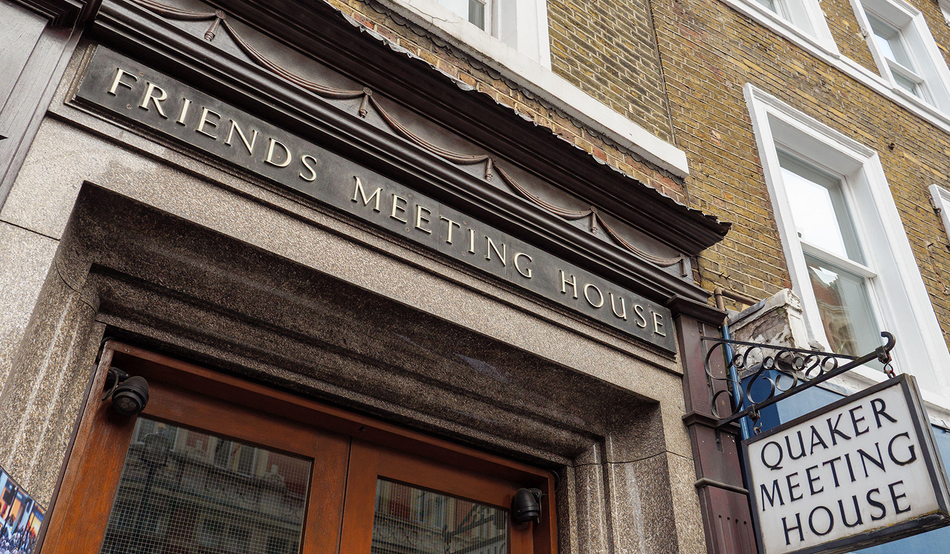
The setting, on 5th March, was the Quaker meeting house in Westminster. A group of around 15—let’s call them “concerned citizens”—had apparently assembled for a lesson in non-violent action. They sat in a circle and introduced themselves. And then the police stormed in.
It was a repeat of a similar police raid on the same Quaker meeting house a year previously, when 20 officers forced their way into a room where six young women were having tea and custard creams, and apparently discussing climate change and the humanitarian crisis in Gaza. A 25-year-old student journalist who was covering the meeting was held incommunicado for 16 hours while her flat was searched.
The police, in justifying their behaviour, claimed that, on both occasions, they had grounds to suspect that crimes were being planned. You might think of it as “pre-emptive justice”—a bit Minority Report. A year has passed since the first raid, but no charges have yet been brought.
Youth Demand—whose still-innocent members were gathered a year ago—has blocked traffic in Piccadilly Circus while demanding an arms embargo on Israel and a halt to more drilling for oil and gas. It says that’s not what members were talking about when the police arrived. But the police might have a different view.
This month’s raid was carried out on members of a group called Take Back Power. Formed after headline-grabbing protest groups such as Just Stop Oil hung up their hi-vis jackets, they are, on the whole, rather less militant. They have smeared apple crumble and custard on a display case housing some of the crown jewels. Can you imagine a more British act of resistance? John Wilkes meets Kenneth Williams.
In December, a small group tipped a few bags of manure at the foot of a Christmas tree in the Ritz Hotel lobby, in what they said was a disturbance designed to draw attention to inequality. How very mild-mannered of them.
More provocatively, they have orchestrated actions in which supporters enter supermarkets and liberate food to give to local food banks. They call it redistribution. Many would call it shoplifting.
The police say they broke up this month’s Quaker house meeting because they had “grounds to suspect” the group might have been planning more supermarket activism.
Someone attending this month’s meeting—who subsequently had his home raided and equipment seized—has denied that he was there to plan supermarket raids. He claims it was simply a teach-in on non-violent protest. As with last year’s arrests, no charges have been brought so far.
It’s all a far cry from the suffragettes who recruited a small army of arsonists and bombers to make their point. Historians have chronicled at least 500 occasions on which women torched or exploded buildings, having concluded that mere window-smashing was no longer making the headlines. Their targets included 32 churches and 31 railway stations. Today we erect plaques and statues to celebrate their tenacity and ultimate success.
What of today’s causes? You don’t have to be a fanatic to curse the gross inequalities that late-stage capitalism seems to accentuate. Or to believe that the young are getting a raw deal compared with their parents or grandparents. Or to worry yourself sick about the impending climate crisis.
Nor to believe that the House of Lords is an embarrassing anachronism that should be replaced by something more democratic. Or that our conventional politics isn’t doing a very good job of reflecting our myriad concerns. People may disagree on whether it’s right to call Israel’s actions in Gaza a genocide, but it’s not unreasonable to consider that it was, or to want to do something about it.
These are, more or less, the concerns of Youth Demand or Take Back Power, and maybe we might agree that it’s a broadly good thing that some people are exercised enough about such causes to want to meet and discuss forms of peaceful protest.
But what kind of protest? Smearing apple crumble in the vicinity of the Imperial State Crown seems unlikely to achieve much. The TBP website advertises future gatherings, including collage-making and a “sunset walk and picnic social”. None seems likely to move the dial in quite the way that arson and bombing did.
“Liberating” food from supermarkets may make some natural sympathisers feel a little uneasy. But for 350 years or more the Quakers have run foul of both convention and law. In the 17th century alone, as many as 15,000 Quakers were jailed, and 450 died in British prisons for holding beliefs which now seem entirely unremarkable.
Today, the UK is rated “obstructed” for civic freedoms by the Civicus Monitor, placing it among a small group of European democracies where protest and civil liberties are seen as under pressure. UN Special Rapporteurs have also raised concerns about aspects of the UK’s approach, particularly in relation to protest laws and counter-terrorism powers.
A new “cumulative disruption” clause in the Crime and Policing Bill would allow police to restrict protests based on the combined impact of repeated demonstrations—powers critics say are broad, vague and risk sweeping up movements from Palestine solidarity to climate and peace campaigns.
Keir Starmer is often mocked for his professional background in human rights. If only.
He will be familiar with the words of Lord Hoffman, often cited by civil liberties lawyers, acknowledging the long and honourable history in Britain of people breaking the law “to affirm their belief in the injustice of a law or government… It is the mark of a civilised community that it can accommodate protests and demonstrations of this kind.”
Hoffman argued for an unspoken bargain: protestors should act with a sense of proportion and not cause excessive damage or inconvenience. The police and magistrates should behave with restraint and take into account the conscientious motives of the activists.
That case was barely 20 years ago, and Hoffman’s words would have been celebrated by a rising QC involved in the case. He was called Keir Starmer. As Lennon and McCartney once put it: Get back to where you once belonged.