The news that Steven Spielberg’s latest sci-fi picture, Disclosure Day, has had a better-than-expected global opening weekend, making a shade under $100 million internationally, has led the excitable to describe it as a grand comeback for the 79-year-old director. Is it, though? Much of the response to the movie, particularly from the critics, seems dictated by fondness for Spielberg personally and nostalgia for his greater extraterrestrial pictures, such as Close Encounters of the Third Kind (1977) and ET (1982). Some of us still remember the dismal ending of Indiana Jones and the Crystal Skull (2008), in which Indy is confronted with aliens… and shudder.
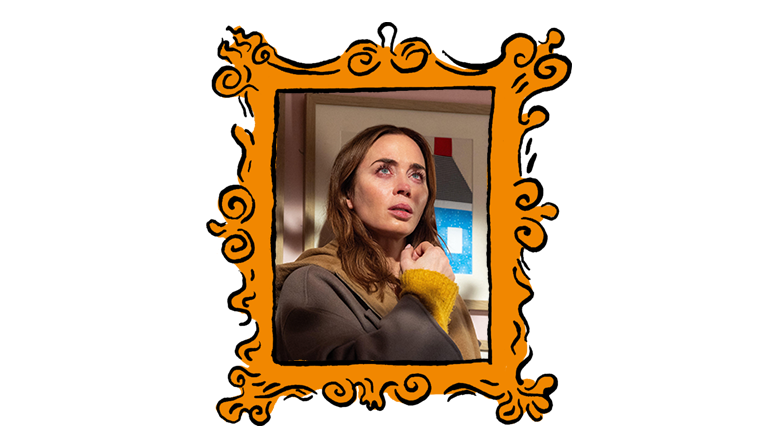
Disclosure Day is not a bad film. The cast, including Emily Blunt, Josh O’Connor and an against-type Colin Firth, are excellent; the occasional action scenes thrilling; and it is clear, and welcome, that Spielberg, who came up with the original story for the film as well as directing it, is still a thoughtful filmmaker capable of throwing in some unexpected curveballs and twists. Witness, for instance, the way that Eve Hewson’s character, a former novice who has left the convent, not only struggles with doubt that the existence of aliens somehow precludes the presence of god, but also, when temporarily possessed by extraterrestrial science, goes full mad nun, in a particularly welcome homage to Kathleen Byron’s unforgettable performance in Powell and Pressburger’s classic Black Narcissus (1947).
Yet decent performances and intriguing ideas are not, by themselves, quite enough—and, by the time the predictable and underwhelming ending rolls around, it is clear that Disclosure Day is not the return to form that so many, including me, had been hoping for. It is instead a continuation of the mid-tier Spielberg form that he has been coasting along in for the past two decades. Which is not to say that all of his films during this period have been bad. The Fabelmans (2022), West Side Story (2021) and The Post (2017) all have their fans, and I enjoyed the offbeat quirkiness of Bridge of Spies (2015), but not since the one-two punch of War of the Worlds and Munich (both 2005) has Spielberg made a truly essential and unmissable film. Once, if I’d said to a friend that I was off to see “the new Spielberg”, they would have known precisely what I meant. Now, however, I would probably be met with incomprehension.
When I was growing up, it was different. Spielberg established himself as the king of the modern blockbuster in 1975 with Jaws—and continued to hold this mantle until well into the 2000s. There were the epochal megahits—the Indiana Jones films, Jurassic Park (1993), E.T and, somewhat unexpectedly, Saving Private Ryan (1998)—but there were also the thoughtful and unexpected successes, too, like Empire of the Sun (1987) and the once-reviled, now-acclaimed A.I: Artificial Intelligence (2001). And, of course, his black-and-white Holocaust drama Schindler’s List (1993) established him as a serious auteur, too, winning over the critics who had often cavilled at his extraordinary success. While Spielberg was mocked for sentimentality and missteps such as Hook (1991) and 1941 (1979), he was also the premier American director of mainstream, audience-pleasing cinema. Countless other filmmakers exist in his image and the adjective “Spielbergian” is immediately evocative. I cannot imagine that anyone reading this will not have seen at least one film by him, so pervasive has his cultural impact been.
And yet cinema has changed far more in the last decade, in particular, than it did in the first four decades of Spielberg’s pre-eminence. There are still big-name directors, but—with one exception—they are either making smaller films seen by smaller audiences, or are stuck repeating their best-known tropes. It is unlikely that James Cameron’s next film would be such a huge hit, for instance, if it were not part of the Avatar universe. Many of Spielberg’s contemporaries, such as Martin Scorsese, now make their films for streaming services, where they are allowed creative control and large budgets in exchange for their work becoming part of an algorithm-driven collection of “content”. That Spielberg’s films are still coming out in cinemas, and being seen, is a triumph. That they no longer have the same cachet they once did is a tragedy.
That one exception? The irony is that Spielberg’s successor as the king of blockbuster cinema, Christopher Nolan, has his own all-but-guaranteed megahit coming out next month, in the form of The Odyssey. Nolan is everything Spielberg is not as a director—chilly, cerebral, British—yet his pictures continue to connect with a wide audience, who extol his virtues on social media with the passion of cult members (while his detractors equally fervently badmouth him, too). It was Spielberg who handed Nolan his Oscar for Best Director in 2024, when the younger man won for Oppenheimer, and the moment represented both a symbolic and literal passing of the torch. The blockbuster auteur has not entirely vanished, then, but he has a new face, and it is not the kindly visage of the man who invented the genre as we know it.