How do you do a centenary exhibition for Marilyn Monroe? This is not as straightforward question as it seems, for Monroe was just not another movie star. And she was also not just a movie star.
The first thing to do would be to show her films on the big screen. Few people reading this review will have ever seen a Monroe movie at a picture house, but it is on the big screen that she is best seen, not on a television or any handheld device. Only in that environment can you grasp what she achieved as a movie star—and the effect she had on her audiences.
Monroe had an extraordinary, perhaps unique, relationship with the camera. Sybil Thorndyke, who starred with her in The Prince and the Showgirl (1957) said to fellow cast members: “We need her desperately. She is the only one of us who knows how to act in front of a camera.” Jack Cardiff, the cinematographer on that same film, recalled: “There’s no doubt she had a genius. She wasn’t a great actress, she was a genius. She had a talent that in most cases was not seen until it was on screen. She had this extraordinary magic that came over on camera.” To not see Monroe on the silver screen is really not to know her at all.
But which of her films should you show? You could play it safe and choose the four great comedies: Gentlemen Prefer Blondes (1953), How to Marry a Millionaire (1953), The Seven Year Itch (1955) and Some Like It Hot (1959). It is this quartet that fixed the cultural icon of Monroe with which most people are familiar. She created an overwhelming construct, the comedic blonde bombshell, just as surely as Charlie Chaplin, Buster Keaton or Peter Sellers created any of theirs.
These four comedies are essential for any movie fan, especially in a cinema. All are perfectly shot and brilliantly directed and edited. But what Monroe brings to these films is impeccable comic timing and sheer on-screen dominance. She was already famous in the mid-1950s, but these films supercharged her popularity with the film-going public.
Yet those four are not actually that representative of Monroe. And one thing that the current, outstanding Marilyn Monroe: Self-Made Star season at the British Film Institute does well is to show a wider range of her films.
The BFI shows her in her first starring role in Ladies of the Chorus, a B-movie from 1948 in which she plays a showgirl daughter of a showgirl mother, the latter played by an actor only a few years older than Monroe. One scene is perhaps the most disconcerting in any Monroe film, if not in most films generally: the row of dancing girls crouched with toy dolls being manipulated to dance too.
The BFI also make a point of showing Monroe in straight dramatic roles, before any of the big comedies were released. There is her stunning, if small, role opposite Bette Davis in All About Eve (1950) and her early thriller Don’t Bother to Knock (1952)—in this reviewer’s opinion, her best film—where she plays a psychopath babysitter. And there is her extraordinary breakthrough in Niagara (1953), where she steals the audience’s attention from the titular falls themselves, here being shown in full Technicolor, complete with rainbows.
That Monroe made it big not through comedy films but in more serious roles is significant. When her comedy persona became such a hit, there was an expectation that she should stick to it. Billy Wilder, her director in The Seven Year Itch, said she should just now exploit the character she had constructed. Andrew Wilson, her latest biographer, who gave an informative talk at the BFI on the date of her actual centenary, 1st June, compared her constructed character with Chaplin’s Tramp.
But she chose not to cash in on this persona. It was one of many times she decided against what seemed to be in her direct economic and commercial interests. Many of those who comment on her life often seek to explain the decisions of what she chose to do, but it is perhaps important also to consider what she chose not to do. Though she could play the gold-digger, she did not monetise the gold-digger stereotype.
Elsewhere in Prospect, I have set out how, at this stage in her career, she took on and defeated Twentieth Century Fox. This confrontation was not only over money but also, tellingly, creative freedom and artistic control. She wanted to approve the directors and cinematographers whom she worked with. That this was a genuine sticking-point indicates the importance she placed both on her relationship with the camera and on how she was presented on screen.
One open question is why, when Monroe secured this commercial and creative freedom after 1956, she did not then use it to the full. She was only to make a handful of films before her early (and likely accidental) death in 1962. Of these only the further Wilder vehicle Some Like It Hot has left a firm impression on the popular memory. It would be easy for a film season to miss out her last films.
Seeing The Misfits in a cinema is an utter revelation
But the BFI also makes a point of also emphasising her later films, such as The Prince and the Showgirl, which was co-produced by her Marilyn Monroe Productions, and her last completed film, The Misfits (1961), which has also had a general cinematic re-release.
Thorndyke’s observation, quoted above, is true: Monroe’s performance in The Prince and the Showgirl works well on the big screen, as she more than holds her own with her thespian costar, Laurence Olivier.
And seeing The Misfits in a cinema is an utter revelation. It is a film of lasts: it was not only the last film of Monroe but also of Clark Gable; it was a film about the last cowboys and what they have been reduced to; and it also one of the last great Hollywood black-and-white films.
Some of the scenes, as the audience is warned, are distressing: there is cruelty to the horses inflicted by those cowboys. But the ultimate message is humane, and the conflict between the characters of Gable and Monroe over this cruelty is resolved with dramatic satisfaction. It is a film which should be far better known.
From the B-movies of the later 1940s, through bit-parts in masterpieces such as All About Eve and her early 1950s non-comedy starring turns, to the mid-1950s great comedies and her final sporadic films after 1956 to 1962, this is a film season that really could not have been done better. It is not only a tale of Monroe, but also of Hollywood from the later 1940s to early 1960s.
A completist may want more of early films, such as her small but attention-grabbing part in that other 1950 classic, The Asphalt Jungle, yet this is but a quibble. Overall, the BFI season is a triumph. The curator, Kimberley Sheehan, is to be heartily congratulated.
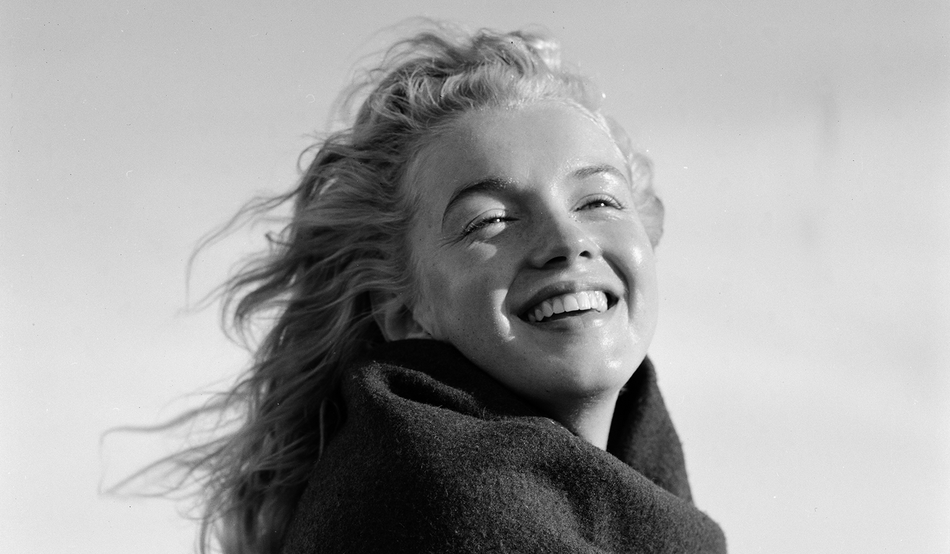
Another triumph is the companion exhibition at the National Portrait Gallery, as it was not only in front of the film camera that Monroe was a master of her art. This show is thorough and wonderfully curated, with the portraits being grouped as much as possible by photographer. Some of the hanging is astonishing: the presentation of the Blanket series by André de Dienes, for example, is breathtaking. And the careful contextualisation means that even old familiar pics can be looked at afresh.
One striking point about photographs of Monroe, even when many of them are placed together in one exhibition, is that no two photographs of her look the same. In an age of fixed smiles and stilted poses, the endless variation in this exhibition is a contrast to much of our Instagram culture. It is much an exhibition of portrait photography itself, as of its subject.
The photographer Phillipe Halsman once said that Monroe has an incredible talent for communicating with a camera lens. And many of the photographs in the exhibition speak to an expert partnership between subject and photographer, working together. Monroe was not passive but active in these artistic collaborations.
As an exhibition of photographic portraits, the NPG exhibition can only be regarded as peerless. It is difficult to imagine who else could be the subject of so many high-quality photographs by such a stellar collection of photographers. The exhibition is therefore a must-see for anyone interested in photography and art, as well as in the star depicted.
Both exhibitions remind us that Monroe came to stardom from outside the movie and celebrity system. She was a model with ambition who used opportunity and contacts to get her before the cameras, where her talent could do the rest. She paid for her own acting lessons with money she hardly had, and she listened to Ella Fitzgerald and others to help her learn to sing. She was an autodidact who made it. She worked with great directors and cinematographers and photographers, but the outputs were as much to her credit as to theirs.
And so it is fair to call her a genius of her craft. At that stage in the history of movies and also photography, it was perhaps the right time for someone to suddenly emerge with a special relationship with the lens and an intuitive understanding of what could be achieved. And Monroe did this largely by herself, with the help she could get. She was indeed, as the BFI rightly call their season, a self-made star.
Marilyn Monroe: Self Made Star opened at BFI Southbank on 1st June and runs until 31st July. The Misfits is rereleased in UK and Irish cinemas on 5th June. The National Portrait Gallery’s exhibition Marilyn Monroe: A Portrait runs from 4th June to 6th September