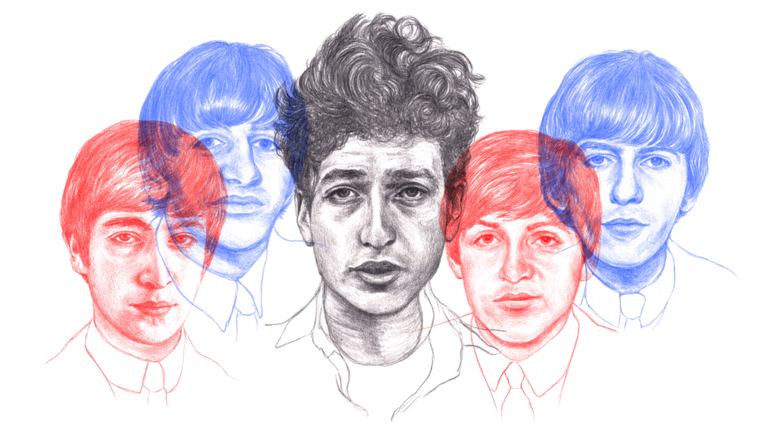
Here we go again. Back to “Yesterday”. Back to “The Times They Are A-Changin’”. Except: today looks very much like yesterday and those times ain’t a-changed one bit. The pop charts are still dominated by semi-literate two-chord jingles. And no publisher’s list is complete without a book on the artists who, 60 years ago, did most to temporarily challenge that situation: Bob Dylan and the Beatles.
In recent years, we’ve had critical studies of Dylan from Paul Morley and Ron Rosenbaum, and a 1,400-page double-decker life from Clinton Heylin (already the author of eight other books on the same subject). The Beatles, meanwhile, have been treated to masterly biographies by the journalist Craig Brown and the author Ian Leslie—as well as sundry less inspired takes on the band’s individual members.
Enter Jim Windolf, whose USP in Where the Music Had to Go is that he’s writing about both Bob Dylan and the Beatles. Georges Braque once said that, during the Cubist era, he and Picasso were “roped together like mountaineers”. The conceit of Windolf’s book is that Dylan and the Beatles have had a similar mutual dependence throughout their careers.
Certainly, both acts respected one another. Though Mike McCartney remembers his older brother Paul dismissing Dylan’s debut as “folk crap”, John Lennon was within a couple of years telling Melody Maker magazine that the Beatles had all gone “potty on Dylan”. As for Dylan, while he had made his name writing angrily political protest songs, his primary love was always the raucous rannygazoo of rock and roll. When he first heard the Beatles, he claimed not to have dared admit to his Greenwich Village pals that he liked the group’s sound. But once he was confident enough to dismiss those right-on fantasies about his being the voice of a generation, he confessed his love to the world: “Their chords were outrageous,” he said, but “their harmonies made it all valid.” The Beatles were, he said, “pointing the direction of where music had to go”. Where it had to go was away from self-congratulatory attitudinising and back to the nonsensical stomp of “A-wop-bop-a-loo-mop, a-lop-bam-boom”.
The Beatles adored Little Richard too, of course. During their ’prentice years in Hamburg and Liverpool, “Tutti Frutti” was one of their most oft-performed numbers. Still, what they took from Dylan’s work was exactly the opposite to what he’d taken from theirs. They liked the way he had opened up popular song to subject matter beyond the clinches and cliches of courtly love. Thanks to the Beatles, Dylan was emboldened to start calling himself “a song and dance man”. Thanks to Dylan, the Beatles began to think of themselves as serious artists.
The first Beatle to turn thought into action was Lennon—who took to dismissing his writing partner McCartney as a purveyor of “granny music”. Having disparaged the mention of “diamond rings” in “Can’t Buy Me Love” (significantly, the last song on which he and McCartney worked closely together), he would later say he was disgusted with himself for allowing that self-same jewellery into the lyrics of “I Feel Fine”. After the release of the group’s fourth album, Beatles for Sale, Lennon fought shy of compositional involvement in any song about the beauty of love.
From here on in, Windolf argues, intertextual relations ’twixt Dylan and the Fabs became increasingly complex. For the Beatles’ sixth long-player, Rubber Soul, to which McCartney contributed the indubitably gorgeous, irredeemably soppy “Michelle”, Lennon came up with “Norwegian Wood”, a quasi-surrealist number about a failed extramarital fling. Windolf calls it a “Dylan-style ballad”. In truth, it’s too sweet and whimsical to be anything like Dylan’s work. But Dylan himself was sufficiently intrigued by the song that he quickly penned a mildly parodic tribute in the form of Blonde on Blonde’s “4th Time Around”.
More than intrigued, actually, argues Windolf, who reminds us that, while recording his song, Dylan let it be known that Lennon had stolen its tune from him. Er, hang on a minute. Dylan did indeed make this claim, but it is obtuse nonsense—and Windolf really ought to have made clear that Dylan was out to goad Lennon. To be sure, Lennon had acknowledged that three of his recent songs (“I’m a Loser”, “A Hard Day’s Night” and “You’ve Got to Hide Your Love Away”) had been written under Dylan’s influence. But that influence was one of mood and mindset, not melody. After all, not even Dylan’s most worshipful fan could convincingly call him one of the great tunesmiths. And while in the melodic stakes Lennon was an also-ran next to McCartney, next to Dylan he was Schubert and Gershwin and Bacharach rolled into one.
Dylan’s career looks rather staid ext to the astonishing musical journey of the Beatles
That is why, for all Dylan’s aesthetic about-turns—from opportunistic protest singer to deranged dadaist, from country rocker to fiery born-again prophet—his ever-lengthening career looks rather staid and settled next to the astonishing musical journey that was the Beatles’ oh-so-short lifespan. In just five years, they went from being a middling beat combo to masters of a magical musical modernism, from writing such clever yet cosy and conventional pop ditties as “Love Me Do” and “Please Please Me” to conceiving aural palettes as wildly daring as “Strawberry Fields Forever” and “Penny Lane”.
A features editor at the New York Times, Windolf has little to say about the musicological aspects of that journey. His formal analyses go little deeper than the claim that minor keys are “melancholy” while major ones are “hopeful”. This would be trite even if it were true. But it isn’t true, as a quick play of Madonna’s “Into the Groove” will show. Here is a song so bouncy it can get even the most reluctant dad-dancer up on his feet. It is written in what Windolf would call the melancholy key of C minor.
Happily, the Beatles have already been the subject of a very fine critical study. The late Ian MacDonald’s magisterial Revolution in the Head: The Beatles’ Records and the Sixties is one of the best rock books yet written. Meanwhile, here comes Steven Rings’s What Did You Hear?—the first book to discuss Dylan’s work not in terms of its lyrical import but of its aural impact. A professor of music at the University of Chicago, Rings has fascinating things to say about Dylan’s use of rhythm and metre, and he is ear-openingly good on Dylan’s various vocal strategies. If his book is less interesting on the musicological front, then that may simply be because Dylan’s melodies and harmonies are so much more primitive and predictable than those of the Beatles.
The same goes double for their respective recording techniques. As Windolf shows, the Beatles were increasingly fascinated by the gizmos and gadgets their producer George Martin (less the so-called “fifth Beatle” than the band’s major third) was forever toying with. Soon enough, says Windolf, the Fabs’ working habits began to break down “the barriers that had separated songwriting, arrangement, and production”. The result was a band that saw “the studio as a composition tool” with the result that “the recording was the song”.
What a pity, then, that Windolf doesn’t spend some time probing how, for Dylan, the opposite has always been true. Never a primper and polisher, Dylan spends as little time in the studio as possible. Even his most finely wrought albums—Oh Mercy, say, or Time Out of Mind—are rough and ready things next to Sgt Pepper’s Lonely Hearts Club Band or The White Album. Dylan has always detested what he sees as the deadening repetitions of rehearsal and rerecording.
What counts for him is live performance. Windolf has a good chapter on how the Beatles and Dylan quit touring in the mid-1960s (in both cases to escape the horrors of fan mania). But he fails to acknowledge that, once Dylan got back on stage, he never got off it again. In a couple of years, Dylan’s so-called Never Ending Tour will mark its 40th anniversary. Few of the countless shows in this global marathon have been alike. The setlist changes most nights. Dylan takes on individual songs and alters them on a whim. He mucks about with lyrics. He fools around with time signatures. He can be halfway through one of his most famous songs before even the most seasoned fans have worked out what they’re listening to. By contrast, McCartney’s far less frequent live shows all run like clockwork—and have followed the same basic format for a quarter of a century.
The biggest omission in Where the Music Had to Go is a section on where the music came from. It came from the Great American Songbook, as Dylan and McCartney—both worshippers at the altars of Porter and Gershwin, Carmichael and Kern—have acknowledged. The first song Dylan ever performed in public was Harold Arlen and Johnny Mercer’s “Ac-Cent-Tchu-Ate the Positive”. Lennon and McCartney’s trade name was modelled on that of Macca’s songwriting heroes, Rodgers and Hammerstein. Back in 2012, McCartney released Kisses on the Bottom, a collection of covers of songs by the likes of Irving Berlin, Johnny Burke and Frank Loesser. Three years later came Dylan’s Shadows in the Night, the first of what turned out to be five albums on which he sings a multitude of showtunes that became standards through the voice of his beloved Frank Sinatra.
So it shouldn’t be a surprise that, for all the parallels tough-guy rock critics like to draw between the putatively Promethean Dylan and Lennon, it is the classicist McCartney whom Dylan says he is really “in awe of”. Why? “He can do it all and he’s never let up… He’s got the gift for melody, he’s got the rhythm, he can play any instrument. He can scream and shout as good as anybody and he can sing the ballad as good as anybody.”
I would go further and say it’s likely that even had rock and roll never come along, we would still have heard of Paul McCartney. His gifts are so enormous, he would have become famous in one or other musical arena. In an interview that ends Where the Music Had to Go, Windolf asks McCartney whether he goes on writing and performing because he’s “searching for truth” or because he’s “just like a bird who sings because it sings”. McCartney skirts the question, but Dylan answered it for both men 50 years ago in “You’re a Big Girl Now”, from his masterpiece, Blood on the Tracks: “Bird on the horizon / Sitting on a fence / He’s singing a song for me / At his own expense / And I’m just like that bird / Singin’ just for you / I hope that you can hear / Hear me singin’ through these tears.”
I’m not sure Jim Windolf’s book helps us hear either Dylan or the Beatles any clearer. Nor does it ever acknowledge that, for McCartney at least, the Beach Boys offered rather more terrifying competition than Dylan ever did. But, in making plain the debts the Beatles and Dylan owe each other, in showing how they both made music that was serious without being sententious, he makes you want to listen to them all over again anyway.