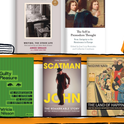
My latest novel, The Strangers, has just been published. I had no idea how it would land with readers and reviewers. This is something that is always almost impossible to predict, particularly with a book like this, which is very personal and very odd. It’s a combination of science fiction and memoir. I’ve been amazed by the response, which has almost had the effect of explaining to me what I was doing when I wrote the book. Hearing from readers and reading the wonderful reviews has given me renewed confidence in working in this strange way. I said to a writing friend: “I think this is a lesson that I must always write my weirdest idea.” She agreed.
Several people I know who’ve read the book have said it has given them strange dreams. I think this is a sign of tremendous success. I have put my own dreams into that book, and I feel that my subconscious is now in touch with the subconscious of readers.
I realise that I take on projects in order to force myself to do the things that I want to do but lack impetus for. For instance, in 2012 I co-created a smartphone fitness game: Zombies, Run! You play by going for a run or a walk in the real world and we put stories from the zombie apocalypse in your headphones to make the whole business of getting some exercise a bit less bloomin’ boring. The game is still going strong. I think I made it at least partly to ensure I always had to get back to exercise. Last year, I bought the entire game and set up a company to run it—quite an exciting and terrifying thing to do. I keep waiting for some grownup to turn up to tell me how I ought to be running this company, but instead it turns out that the decisions are mine.
It would be ridiculous, however, to run a company by fiat—it is managed in conversation with the staff members and with our fans. I am always thinking about what extra nice thing I could offer to fans of the game to help them start exercising or keep up their exercise routine. I went to a reformer Pilates class at a studio around the corner from my house and wondered how to incorporate movements like that into a battle with zombies.
Now, in a similar vein, I have invented a couch-to-5K programme for reading. It’s because I notice myself reading less, and reading with less pleasure and more duty. I find myself horrified by that. I remember the effortless hours of reading I did when I was a young person, and I want that back. The response has been incredible, so I’m thinking about how to turn it into a sustainable reading club (not a book club, because we won’t tell you what book to read).
A lot of people who worked in technology in the 1990s feel despondent now. I understand it. We started with such high hopes. We wanted to usher in a new era of knowledge and human collaboration. Instead, we got Elon Musk destroying USAID.
I do still feel hopeful, though. I find AI fascinating, and I roll my eyes at gullible journalists being taken in by very alarmist ideas about it being an existential threat to humanity. Can’t people see that these are just sci-fi stories? I always point people towards the phrase, “AI is a normal technology.” If you look this up on the internet, you will find a lot of non-alarmist thinking about what this tech might do.
My new Open University coursebooks arrived at the house—always a wonderful moment in the year. I am absolutely addicted to studying. Now that I am over 50, I find myself looking back on some of the confusions of my youth and thinking that I just needed more time for the person I am to come into focus.
Some people have brains that like to go very deep into one thing. For them, maybe it is obvious early on what they need to be spending their energy on and what kind of mind they want to develop. But I am a very diverse thinker. I have two undergraduate degrees now—in philosophy, politics and economics, and in classics—and two MAs, in creative writing and in classics. I’ve also worked in tech for 20 years and I’m now beginning my second course with the Open University in undergraduate maths. At the same time, I’ve presented programmes for the BBC on the history of thinking and on the history of science. In the early part of my career, I spent more than six years working at a corporate law firm.
At 51 I feel that I really can, for the first time, reap the rewards of this diversity.
Things from one area can inform my thinking somewhere else; I can draw analogies across historical periods. Even the work at the law firm turns out to be very relevant when I can read and write my own contracts. My life has had some tremendous difficulties and sadnesses, but I feel that over the past 30 years I have built the brain I always wanted to have. That is very satisfying. I don’t think I knew when I was 25 that nothing would be wasted and there would be no wrong turns.