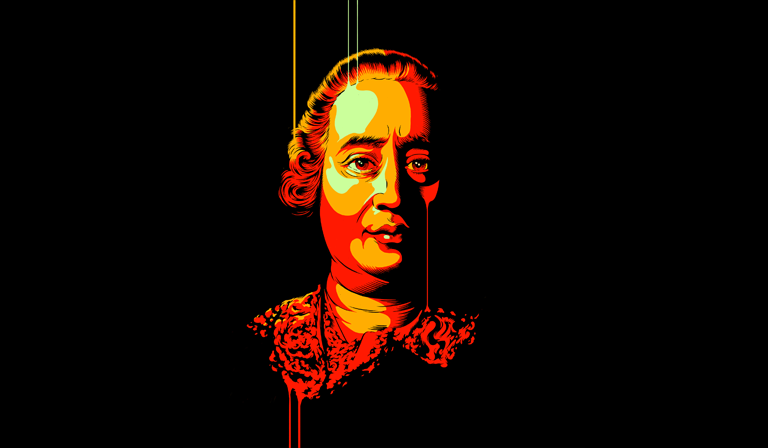
In 1776, fatally ill at the age of 65, David Hume imagined pleading with the boatman of Greek myth who ferries souls over the River Styx to the underworld: “Have a little patience, good Charon, I have been endeavouring to open the eyes of the public. If I live a few years longer, I may have the satisfaction of seeing the downfall of some of the prevailing systems of superstition”—only to get rebuffed: “You loitering rogue, that will not happen these many hundred years.”
The letter in which his fellow Scot the philosopher Adam Smith recounted Hume’s joke prefaces this new two-volume collection of Hume’s essays, the index to which has 28 entries for the word “superstition”. Civil liberty and freedom of thought are curtailed by “superstitious reverence to priests and princes”, he writes. But it is the former reverence—that paid to priests—that he mostly indicts. When he opens “Of Superstition and Enthusiasm” by describing these failings as “the corruptions of true religion”, he is being circumspect and disingenuous: elsewhere he treats religion itself (especially Catholicism) as a superstition. The “good sense” deployed in everyday affairs, he says, is abandoned when it comes to religious matters, which are “supposed to be placed altogether above the cognizance of human reason”.
Yet, while he was a key figure in the Enlightenment—exalting reason in the effort to undermine hierarchy, tradition, faith and orthodoxy—Hume also straddles the Counter-Enlightenment, the backlash that began to demote reason. In questioning the notion that reason enables us to attain some transcendent, impartial vision of reality, and in blurring the much-vaunted line between humans and the rest of nature, he anticipated Darwin, who would put us on all fours with “the beasts”. He surely influenced the “masters of suspicion”, as Paul Ricoeur called them—Nietzsche, Marx and Freud—in initiating the distrust of everything, above all our own minds. His main works on epistemology (the theory of knowledge)—A Treatise of Human Nature and An Enquiry Concerning Human Understanding—are interpreted in various ways. He is, of course, full of contradictions and inconsistencies, but these are more fruitful and inspiring than most of the pettifogging rigours of analytic philosophy. He is not just a historical stepping stone, I’d argue, but an enduring model of how to philosophise.
Hume’s method initially seems similar to that of Descartes, a century earlier—starting out with what is immediately being experienced and thought, and doubting everything else. Descartes, who assumes that “I” am doing the thinking, discovers and establishes (in the course of argument) that I am my mind, and labels the units of thought “ideas”. Hume makes it a further question of whether the fact of thinking entails a thinker, and considers the term “idea” misleadingly comprehensive. He distinguishes the raw, immediate stuff of experience (“impressions”) from the fainter copies of it (“ideas”) which are stored by the memory as concepts for classification (of colours, for instance) and which “return upon the soul” to produce new impressions for future guidance (such as wariness towards what has previously felt painful). Leaving aside verbal definitions and logical relations (which do not depend on experience), any idea about a supposed “matter of fact” should in principle be traceable back to the impressions from which it arose; if it can’t be so traced, it is invalid—and should be junked.
“Impressions” has not survived as a philosophical concept, though perhaps “sense data” and “qualia” are rough equivalents. Both terms are much disputed: philosophers cannot agree whether the entity they refer to is an object, an event or quite what. For Hume, impressions seem to include not only the taste of a madeleine, a glimpse of blue or the hiatus of an incipient sneeze, but also memories, passing thoughts and the process of calculating a mathematical sum—although how long a Humean impression is presumed to last is a moot point.
Hume’s impressions and Descartes’ ideas are probably borrowed from the Stoics—Zeno of Citium said that our mind, like pliable wax, is imprinted with phantasiai (notions and sensory images) and then has to judge how worthwhile or accurate these are. But given a sceptical starting point, who is to say if these transient mental states (if they exist at all) are anything more than subjective and self-enclosed, or that they refer to anything beyond themselves? Descartes “finds”, among the other ideas in my (in other words, “his”) mind, an idea of God—which, because it is the idea of a perfect being, must (apparently) necessarily correspond to something more real than itself. With God’s existence thus “proved”, I can be confident that, as long as I examine my ideas in the natural light of reason, I should be able to deduce when, and to what extent, they match up to reality. Hume, although he offers no such bulwark against solipsism, is in a way more question-begging than Descartes—he uses the pronoun “we” from the outset, as if addressing other experiencers who have experiences similar to his own (though, when opportune, he sometimes uses “I”).
We cannot observe the continuous existence of our intermittent impressions when they are unobserved, and therefore have no justification in claiming, as Descartes does, that they are caused by the variable attributes of persistent substances in an external world. Indeed, given that impressions are all “on the same footing”, I am not even entitled to pick out those that supposedly make up “my own body” from the general morass, nor to consider myself a spiritual substance—I have no impression, therefore no valid idea, of an enduring self. At best, Hume writes, perhaps “I am nothing but a bundle or collection of different perceptions” (Hume’s “I” differentiates his own type of experience from that of others who may, he concedes, experience differently). And although we observe, and remember observing, that certain impressions regularly occur in a certain sequence, nothing new is added to the initial observation of such a sequence by subsequent observations of it—no impression of the necessity by which the second impression follows the first, therefore no basis for believing that these “constant conjunctions” are linked by any “necessary connexion”. Or that they will continue to happen in the future. “Your appeal to past experience decides nothing in the present case,” says Hume.
‘Where am I or what?’ cries Hume
So it seems that we have to abandon the essential tools of science—causation, induction (inferring the future from the past) and prediction are illusions. Everything is random, and there is nothing but mental states (although Hume sometimes blurs these with the qualities of things). “You,” “I” or “we” are merely the stage on which impressions variously “pass, re-pass, glide away, and mingle”, although Hume warns us not to be misled by that metaphor—we have no justification for thinking that this “theatre” is a single thing at any one moment, that it persists over time, or that it is located anywhere. “Where am I or what?” cries Hume near the end of Book 1 of the Treatise.
He calls himself a mitigated sort of sceptic (his doubt tempered by common sense) and argues that Descartes could not “advance a step beyond” his supposedly self-evident thinking—to do so would require invoking “those very faculties, of which we are supposed to be already diffident”. Which is surely a bit rich; isn’t Hume more than diffident himself? But—this is where he is so brilliant—although I am not rationally entitled to believe in the world, my body, my self, causation or induction, luckily, he says, nature forces me to believe what reason would leave in suspense. “I may, nay I must yield to the current of nature, in submitting to my senses and understanding; and in this blind submission I shew most perfectly my sceptical disposition and principles.” For Hume, anticipating Darwin and Freud, human reason is not transcendent but circumscribed within the limits of a particular species.
Descartes’s aim was to achieve a God’s eye, sub specie aeternitatis view of reality. His was called “the mechanical philosophy”, but that only applies to his physics—the mind is exempted from his clockwork cosmos. Our ideas occur willy-nilly, he says, but we have free will and thus can decide whether or not to assent to them. And in the struggle for knowledge, we know our minds better than anything else.
Hume, though, declares that “the essence of the mind [is] equally unknown to us with that of external bodies”. He wants to do for the mind what Newton did for the physical world: to discover, by looking inward, the laws that govern it. Three “principles of union or cohesion,” he opines, make one idea lead to another: resemblance (for instance, having impressions of a portrait leads us to think of the person portrayed, or perhaps of his father); contiguity (mention of one apartment in a building makes us wonder about the others); cause and effect (when we have the impression or idea of a wound, we tend to think both of what caused it and of its painful effects). In the mental world, he says, there is “a kind of attraction, which… will be found to have as extraordinary effects as in the natural”. But although his model of the mind is mechanical, leaving little room for conscious command, Hume respects the intuition that we have some control over how our ideas move and combine. Their association should be considered not “an inseparable connexion” that is “infallibly cause[d]” but “a gentle force, which commonly prevails”; the imagination, he says, is “guided by some universal principles, which render it, in some measure, uniform with itself in all times and places”.
Rather than a periscope elevated above and surveying its impressions, the mind is composed of them—is part of the mechanism, and governed by necessary connections, even though there may not be any outside it. Hume seeks to chart the processes that make us believe what we do, whether or not it is actually true. Belief, he says, is not a verdict handed down by a reason that stands aloof from sensation; indeed, “all probable reasoning is nothing but a species of sensation”. It “depends not on the will, nor can be commanded at pleasure”; it is just a particular way of regarding impressions, and an involuntary one. “I can give no reason why I shou’d assent to” an opinion except that, out of the possible alternatives, one “strikes more strongly upon me”.
Often, too, our belief “proceeds merely from an illusion of the imagination”, which gives us a spurious sense of the connectedness that is lacking. Our imagination is like a boat which, after the rowers have stopped rowing, “carries on its course without any new impulse”. Thanks to the mental equivalent of the law of inertia, it pushes us over the gaps between impressions and supplies the (idea of) continuity itself.
Similarly, although we have no impression of any “necessary connexion” between a cause and its effect, due to repeated experiences of the same types of “constant conjunction” (a billiard ball always moving when hit, for instance), we unconsciously develop a “full and perfect” habit of transferring the past to the future, so that we instinctively feel an internal sense as to what has to happen next. In his moral philosophy, Hume says that although no “is” statement (about matters of fact) entails an “ought” statement (about moral obligation), a mental mechanism nonetheless bridges the gap between how things are and how we ought to behave. “Sympathy”, which we might now call “empathy” (that word was only coined in the 20th century), is Hume’s term for the way we sense one another’s emotions, so that, like stringed instruments, we vibrate in concord with one another’s unease, joy, grief, amusement or whatever, and are prompted to requisite action.
Some of our impressions may “operate on our mind in such an insensible manner as never to be taken notice of” and “may even in some way be unknown to us”. We deduce unconsciously as well as consciously, and our deductions may cut across one another. Many of the “ideas” thus formed cannot count as valid, of course, because they are mere reflexes, and not formed in the proper way, as copies of impressions. When we infer “like effects from like causes, and vice versa”, we do so automatically—as the result of inadvertent deductions. How could we survive if we weren’t convinced of the predictable necessity of cause and effect? The inference is too crucial to our lives to be “trusted to the fallacious deductions of our reason”.
Hume uses “reason” in different senses, without ever quite admitting it. Here it has its standard, time-honoured meaning: a deliberate and transcendent arbiter of the appearances to our faulty senses. It is, he says, too cumbrous, slow and hesitant to rely on in practical matters—it doesn’t appear during infancy, is “extremely liable to error and mistake”—and may, of course, direct us to doubt the reality of the world, cause and effect, induction and our selves. By contrast, another thing he sometimes calls reason (or “experimental reasoning”) operates almost from birth and is automatic, fluent and dependable, enabling the development, through habit and trial and error, of behaviours helpful in responding to our environments. It is, he says, “nothing but a species of instinct or mechanical power, that acts in us unknown to ourselves”, a natural faculty that we have “in common with beasts”. Hume urges that reason (the highfalutin kind) should, for the sake of our biological and social survival, be slave to the senses and emotions, submitting to “the current of nature” so as to make us believe what rational argument cannot justify. Ultimately, then, reason is as inimical to “good sense” as religion is, and “good sense” itself is merely unwarranted credulity, a form of superstition.
He is assuming—and differentiating—the mental and the physical
Hume is aware of the paradox here: “Such an opinion, if rested on natural instinct, is contrary to reason, and if referred to reason, is contrary to natural instinct.” But surely he cheats. Just as there seems to be an external world, he says, so too we have an unjustified sense of necessary connection. Seeming and feeling, however, are surely types of impression. And he relies on a distinction between what seems to be there according to our “internal [deductive, mental] impressions” and what would seem to be there if we relied only on our “external [sensory] impressions”. By default, he is assuming, and differentiating, the mental and the physical; and he implies a further distinction beyond the respective seemings—what really is the case. Of course, a belief in mind/body dualism—the view that mind and matter are fundamentally different kinds of things—may be one of our helpful “blind and powerful” natural instincts.
Hume also suffers from an inconsistency common to Descartes, Locke and other mind/body dualists of the Enlightenment who use theories of ideas. “Idea” is a term that we still use roughly as they did, and with the same ambiguity: when a friend suggests having a picnic in the park and I say that I had just had exactly the same idea, in one sense of “idea”—its publicly expressible subject matter, what it is about—my idea was indeed the same as hers. In another—its temporary existence as a mental event or “object”—it could not possibly have been the same; it was peculiar to me at a particular point in time. Hume, like other idea theorists, trades on this ambiguity. Both his impressions and ideas do double duty; they are at once mental events and what those events are about. His mechanisms of resemblance, contiguity, cause and effect, feelings of necessary connection… they only work (or seem to) because the subject matter of each impression—what it is of or about—is what supposedly incites and precipitates its association with another.
It is as if there were an inner eye in the mind, and it could simultaneously see the inside and the outside of the items that compose these causal chains. But is it your reflection in the mirror, not the mirror itself as an object you hold, that prompts you to wipe the smudge off your face? Hume’s ideas and impressions are expected to somehow be the reflection and the mirror simultaneously. “Is the idea of large itself large?” was an objection that Plato levelled at his own theory of “Ideas” (now called “Forms”) from which the Enlightenment ideas were derived.
Philosophising is dolphin-like—it strives to rise above the element to which it belongs and, at the same time, inhabit it. Philosophers try to observe the very thing that is doing the observing—the mind. The observing and the observed encompass one another in a Möbius strip.
Hume has been, and still sometimes is, taken to be mired in self-contradictions, and to end up in nihilistic scepticism. But, in a famous 1905 article, Norman Kemp Smith argued that he was actually a naturalist, and the so-called New Humeans, such as Galen Strawson, variously argue that he may in fact believe many of the things he claims to doubt. Perhaps Hume believes (although he cannot justifiably say he knows) that the world, objects, causation, induction, the self are there, all right, but are behind the barrier of our inability to perceive them. Or perhaps, as with Kant—who said that Hume woke him from his “dogmatic slumber”—he believes that our experience is indeed caused by something outside it, but that the nature of this is unknowable and ineffable.
Hume is tortuous, infuriating, intriguing, stirring, hilarious and lastingly pertinent. He is, however, not just an underminer of superstitions current in his own era, but an initiator of new ones—the scientisation of philosophy, default suspicion of our world and our minds, and what would become the wheels-within-wheels, sophistical tergiversations of literary theory. Quite a legacy, in fact.