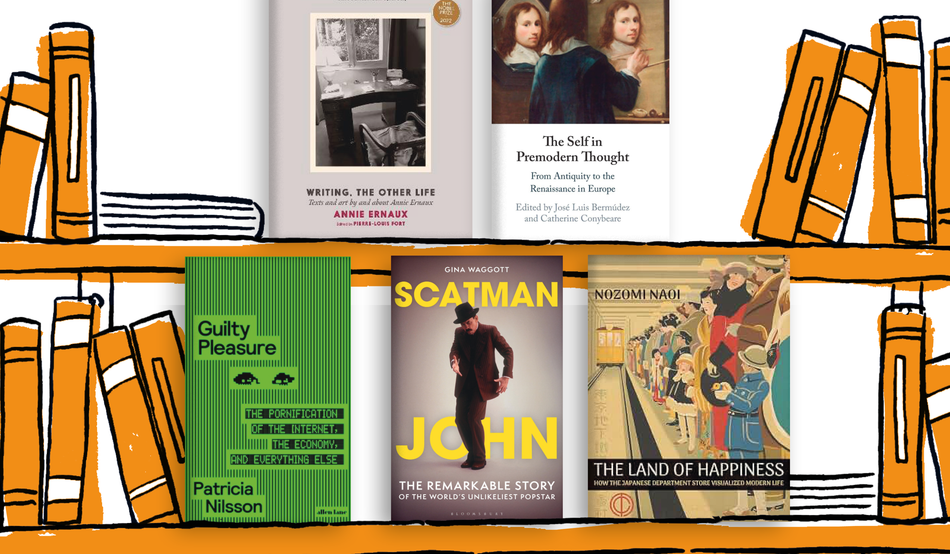
Guilty Pleasure: The Pornification of the Internet, the Economy, and Everything Else
by Patricia Nilsson (Allen Lane, £25)
A few years ago, Patricia Nilsson attended her first porn industry party in Prague. She remembers expecting “something out of Boogie Nights – silk robes and sleaze, bathed in a softly lit haze of lust and decadence”. Instead, she found herself in a much flatter, more sterile environment, surrounded by traffic traders, payment processors and advertising tech consultants in chequered shirts. Nilsson, a Financial Times reporter, wanted an answer to her question: who was making money from “free” porn?
Guilty Pleasure answers this before becoming a broader story about “the masturbatory business model of the internet”, which porn companies helped forge. From live streaming to algorithmic engineering, porn sites were often the pioneers when it came to developing and scaling up the technologies that serve as a foundation for our digital ecosystem. Nilsson argues convincingly that much of the online world now runs on the onanistic logic of porn, which has “turned leisure into an endless loop of compulsive self-gratification: craving, stimulation and temporary relief”.
Her investigation takes us from the studios of the San Fernando Valley, which became a centre of porn production during the 1970s, to the opaque conglomerates in Montreal and Prague that went on to dominate the industry from the 2000s. Nilsson’s brilliantly researched and well-written debut is more than an engaging account of how pornography became one of the “most abundant free commodities”, however. It also raises a series of challenging questions: to what extent do algorithms influence our fantasies—and how much do they “merely reflect sides of ourselves we’d rather not recognise”? And who has the right to police what happens on the internet?
As Nilsson realised while writing her book, the story of porn in the 21st century is ultimately “the story of why the internet makes us feel so weird”. And it’s this seemingly simple observation that remains the most troubling.
Christopher Webb
The Land of Happiness: How the Japanese Department Store Visualized Modern Life
by Nozomi Naoi (MIT Press, $45)
In 1856, Utagawa Hiroshige made a woodblock print depicting Mount Fuji looming over Echigoya, the large gofukuten (kimono shop) that was the predecessor to Japan’s first department store, Mitsukoshi. The equivalence is obvious: the store is, or should be, as emblematic of the country as its greatest mountain.
Hiroshige was perhaps a little early, but his prediction was ultimately borne out: by the early decades of the 20th century, Japan’s department stores, some of which included theme parks and cable cars, had become an embodiment of the country’s wholesale tilt towards a western-inflected modernity; a mecca for its burgeoning middle class; the place where childhood was made; and the dreamworld by which it could map all that it still aspired to be. With their rise coinciding with the proliferation of new printing techniques, department stores also became unlikely sites of experimentation in advertising, quite plausibly making them the originators of Japanese graphic design as we understand it today.
This is all fascinating terrain, but unfortunately this particular survey falls victim to many of the problems common to books about the history of design and visual culture. In what is perhaps the biggest indicator that this was written to be leafed through, the same ground is trodden again and again; example upon example is given with plentiful detail—and alongside beautifully reproduced images—but without leaving much immediate sense as to why any of this is significant within a sociological context.
In the end, how much you get out of this book will probably depend on your prior interest in this niche subject: one for the student, not the lay reader.
David McAllister
The Self in Premodern Thought: From Antiquity to the Renaissance in Europe
edited by José Luis Bermúdez & Catherine Conybeare (Cambridge UP, £95)
The western “self” probably originated with Plato’s “psyche”. In Homer, that term denoted the life force that inhabits a warrior and leaves him at death; over the following three centuries, it accrued attributes of perception, emotion and personality; in Plato it refers to a human’s rational and moral essence, and can correctly be translated as “soul”, “self” or “mind”. To what extent those hazy concepts converge, and how far each applies to an inner entity other than the body, have been key questions in philosophy and theology ever since.
The papers in this collection respond to, and aim to supplement, Charles Taylor’s 1989 Sources of the Self. They focus less on the familiar reflective self, discovered through introspection, than on the “outward-turning”, relational, active self; and not just in pre-Renaissance philosophy but in theology and literature. Augustine, puzzling over what exactly the soul could be before conception, refused to separate the spiritual and corporeal (argues Catherine Conybeare). For Aquinas (says Dominik Perler), the mind, rather than being immediately self-apprehending, comes to know itself through perceiving and manipulating external objects. Officially, at least (Alexis Torrance reminds us), Christians believe that the self, in order to survive death, ultimately needs its body as well as its soul.
Also discussed are those who insist on the self’s otherness to the body in aid of affirming liberty. “The inner fortress” of free will is secure against slavery and the Inquisition, declared protagonists in Renaissance Spanish dramas. Men and women have identical sorts of soul, insisted Mary Astell in 17th-century England, and therefore should have equal access to education.
These multidisciplinary papers, although not adding up to a thesis, are revelatory about the complex nature of the self.
Jane O’Grady
Scatman John: The Remarkable Story of the World’s Unlikeliest Popstar
by Gina Waggott (Bloomsbury, £21.99)
John Larkin, aka Scatman John, became famous in the mid-1990s with the novelty techno hit “Scatman (Ski-Ba-Bop-Ba-Dop-Bop)”, an unholy mix of Europop, motivational rapping and scat singing. The fiftysomething went on to sell millions of records across the world before his death in 1999. But, as Gina Waggott tells us, he was also a gifted jazz pianist for whom music was salve and salvation in a life marred by sexual abuse, addiction and a severe stutter. His struggle to mask, overcome and finally accept his stuttering is the main theme of her authorised biography.
Those coming for some lightly ironical 1990s nostalgia will enjoy the second half, chronicling his period of fame, with its overly reverent descriptions of his pop career (“In April, just as excitement for ‘Scatmambo’ was building in Europe…”) and liberal use of popular biography tropes. These include unlikely internal monologues rendered in italics (“Annie Lennox came on with ‘No More I Love Yous.’ There’s something special about her, John thought. Then the Cranberries’ ‘Zombie’… Great stuff.”) and merry stereotyping (“BMG Japan’s executives sat in perfect formation – smiling, polite and formal. They listened patiently as Manfred-san made his case...”).
In contrast, Larkin’s life before then has the arc of a Scorsese antihero: from troubled, rebellious kid to hard-living bar musician to tuned-out hippy, junkie and sometime coke dealer in 1980s Los Angeles to 12-step true believer. In this light, only the most churlish person would begrudge the happiness and comfort his fame brought him and fellow stutterers (including Waggott) or belittle his determination to direct his late good fortune to positive ends.
Peter Williams
Writing, the Other Life
by Annie Ernaux, edited by Pierre-Louis Fort (Seven Stories Press, £25)
On an unseasonably autumnal day in July 1968, a 27-year-old French writer sat with her journal and quipped: “Are ennuis better than ennui?”
That writer was none other than Annie Ernaux. And that quip is included in this collection of diary entries, photographs and reflections by and about the 2022 Nobel laureate. It is a metatextual bonanza, published here in English for the first time.
If Ernaux’s autofictional works Simple Passion (1991) and Happening (2000) were not intimate enough, here we find pieces that helped the translator Alison L Strayer to, as she puts it, “breathe” and “walk” Ernaux’s prose. With images of the writer’s “open hands, their timeless palms”, the dotted is and crossed ts of her calligraphy, her despair at writer’s block… Ernaux is not only read this time but seen, even understood.
Contributors ranging from cinematographers to academics—and even Simone de Beauvoir, through a series of letters—offer their own take on Ernaux while attempting to pinpoint her distinct style. Ernaux’s writing speaks for itself, of course, but encountering it in between the critical passages, we come to appreciate her original lines all the more.
And that “we” ought to be as broad as possible. A writer who speaks of her desire, her reproductive rights and her body need not belong to a female readership alone. Such is the hope when Ernaux’s works, taught to young men and women in Francophone colleges around the world, become collective knowledge. As she writes here, “maybe if men saw blood, they would stop wanting to spill it”.
The privilege of finding ourselves in Ernaux’s writing, as this collection inspires us to do, exists only because she had the courage to make literature from her life. And for that, “I read you and then read you again”.
Sophie Farmer