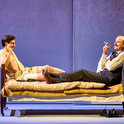
Ken Turner may not be a household name, but, for a brief moment last May, a Led By Donkeys video in which he appeared was all over social media. Turner, sporting an old helmet and army fatigues, identified himself as a 98-year-old former British serviceman, as he stood in front of a Sherman tank: “I’m old enough to have seen fascism the first time around, and now it’s coming back.” Decrying Elon Musk’s support for far-right politicians in Europe, he declared, “We’ve crushed fascism before and we’ll crush it again.” Cue footage of him inside the tank that, to the tune of the “Colonel Bogey March:” (aka “Hitler Has Only Got One Ball”), mowed over a Tesla car.
Turner has always been devoted to antic imagination. After being demobbed, he went to art school and, by the early 1960s, his paintings were drawing the attention of Frank Auerbach, Leon Kossoff and ICA co-founder Roland Penrose. But Turner found the gallery scene too flash, segregated from society. All around, developers were gobbling up real estate; high rises blocking the skies; growing car ownership making it harder for children to run wild. Inspired by cross-currents—street theatre, experimental cinema, student protests, the reality-bending architectural writings of Buckminster Fuller—he and his wife, Mary, set up an organisation called Action Space.
Such marvellous, anarchic madness they hatched up! Child-lifting inflatable cranes; games of cricket played with an invisible ball; adult playgrounds in shopping precincts; gardens built from cane sticks. Grey urban streets became carnivalesque. Prison-like estates felt—for a moment or two—elastic. Over the decades, sometimes under different names, Action Space carried on creating such carry-ons. Turner moved to St Ives in the 1990s but never stopped painting or giving vivid, perplexing performances in which he dragged cod through the seaside town or yelled “This!” at innocent potatoes.
Turner will celebrate his 100th birthday on 21st July. He’s the oldest living performance artist in the UK. His son Huw Wahl, who as a seven-year-old boy sat with him through Arts Council grants meetings, has made a film portrait—Expiry—which he describes as a “love letter to aging playfully”. Here’s Turner crawling through the Mên-an-Tol, late-Neolithic standing stones in Cornwall which poet DM Thomas once likened to “the wind’s vagina”. Here he is, one gusty day, on his hands and knees, gingerly moving across Porth Nanven beach’s round rocks, which are so smooth they’re known locally as “dinosaur eggs”.
“Do some movement” was one of Action Space’s credos. Wahl shows Turner in a modestly attended gallery ripping up bits of paper and rolling around the floor with a younger woman in a freeform piece about climate change. “People have to move to survive,” he intones: it doesn’t sound dystopian so much as a fact of life. A tribute to humanity’s adaptability, even. In these scenes, I’m reminded of something John Mortimer once wrote: “Dying is a matter of slapstick and pratfalls. The ageing process is not gradual or gentle. It rushes up, pushes you over and runs off laughing. No one should grow old who isn’t ready to appear ridiculous.”
The film’s emulsion is made of organic gelatin—crushed animal bones. It has blemishes, sudden streaks, erratic colours
The film’s title is a pun of sorts. It’s been made using expired 16mm film donated by friends or bought on eBay. Some of it dates back to 1967. Digital cinema often looks artificial, cryogenic; Expiry’s emulsion is made of organic gelatin—crushed animal bones. It has blemishes, sudden streaks, erratic colours. It has a pulse, feels alive. In the words of Keanu Reeves, “When the director says ‘Action’ and the film is rolling, it feels like something is at stake. It feels important and intense—uniquely.”
Wahl, who is 40, tells me that he grew up thinking his father might die at any minute. He might have crafted a biographical portrait of his old man, a filmic monument. But Expiry—elusive, suggestive, visually gorgeous—is less about Turner’s life than about life itself. Early on, he’s heard saying: “I’m 97, how old are you, then?” He laughs more than he groans or howls. In one scene, shot along a seashore, he gets a medical check-up from a raver-turned-Buddhist named Doctor Rainbow who, as well as giving him a thumbs up, asks, “Were you purposefully breathing in time with the waves?”
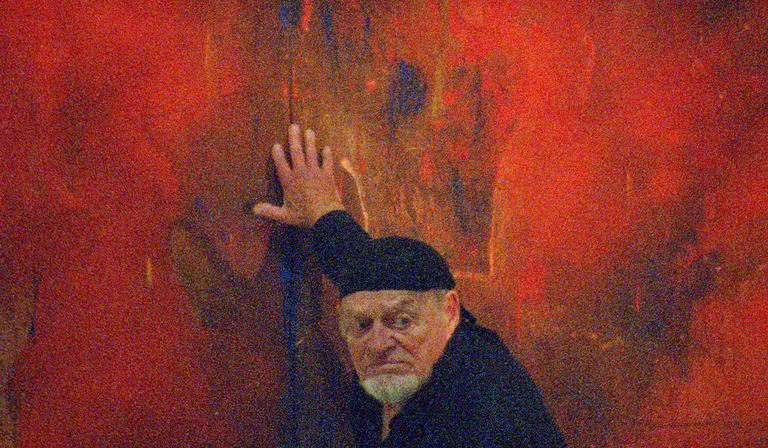
Elsewhere Turner is shown sketching in what turns out to be … a graveyard. He wonders if he’s becoming a spider. He muses, “When I paint my sense of being enters the material. So I’m part of the paint and the paint actually talks to me.” Always in the moment, always open to transformation: Turner is the youngest centenarian—the sagest life coach—one could ever hope to spend time with.